

Sublocade is a monthly buprenorphine injection for opioid use disorder, given under the skin of the abdomen by a trained provider, and it replaces daily dosing with a single appointment every four weeks. It is not a starting point: a person has to stabilize on an oral buprenorphine product for at least seven days first, and that week of preparation is what makes the first shot safe.
Key Takeaways
- StatPearls reports 8 to 24 mg of a sublingual buprenorphine product daily for at least seven days before a first Sublocade injection.
- Sublocade carries a boxed warning against intravenous administration. Injected into a vein, the depot forms a solid mass that causes occlusion, tissue damage and death.
- The product is restricted to a Risk Evaluation and Mitigation Strategy program, so it is never dispensed to a patient at a retail pharmacy.
- Buprenorphine has a ceiling on respiratory depression, which StatPearls describes as a safety advantage over methadone. That ceiling does not protect against combining it with alcohol or sedatives.
- Riverside Recovery of Tampa administers Sublocade on site and continues it through residential and day treatment, with five medical providers covering the program.
What Is the Sublocade Injection?
Sublocade is extended-release buprenorphine given as a monthly subcutaneous injection into abdominal tissue. A trained provider administers it. The liquid converts to a solid gel depot under the skin that releases buprenorphine steadily across four weeks.
The depot mechanism is what separates it from every oral form. Buprenorphine leaves the gel at a controlled rate, so blood levels stay flat rather than peaking and falling each day. Steady levels remove the daily cycle of relief and craving that daily dosing produces.
Is Sublocade a narcotic?
Yes. Buprenorphine is a Schedule III controlled substance under the Controlled Substances Act. The scheduling reflects genuine abuse potential, and it sits below Schedule II drugs such as methadone, oxycodone and fentanyl.
Is Sublocade an opioid?
Sublocade is an opioid. Buprenorphine is a partial opioid agonist, meaning it activates the mu-opioid receptor partially rather than fully. That partial activation treats opioid use disorder by suppressing withdrawal and craving without producing the effect of a full agonist.
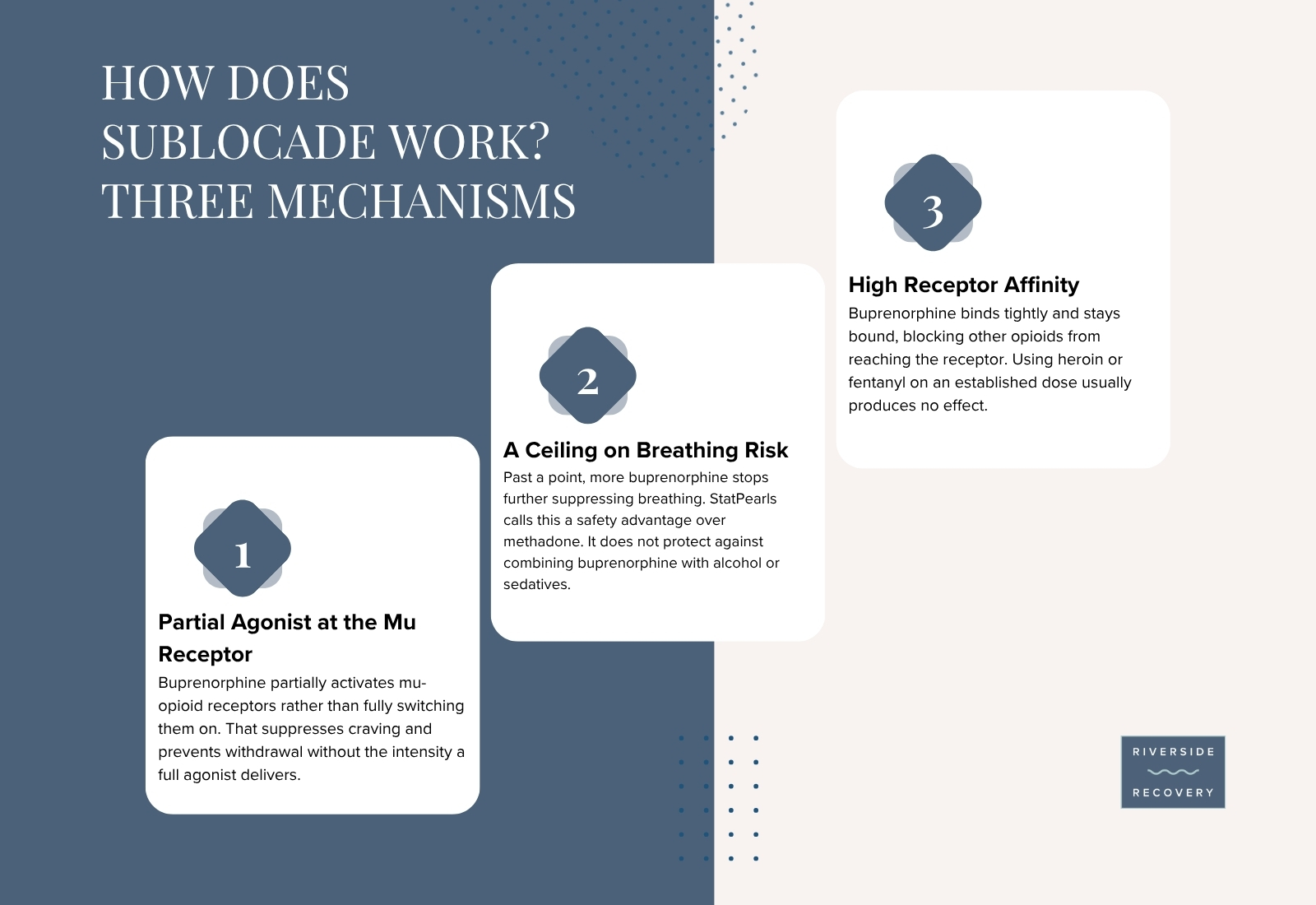
Three pharmacological properties explain why partial activation works.
How Does Sublocade Work?
Sublocade works through three mechanisms: partial agonist activity at the mu-opioid receptor suppresses craving and withdrawal, a ceiling effect on respiratory depression that StatPearls calls a safety superiority over methadone, and high-affinity binding that blocks other opioids from reaching the receptor.
What does partial agonist mean?
A full agonist such as fentanyl switches the mu-opioid receptor fully on. Buprenorphine switches it partially on. The receptor registers enough activation to stop withdrawal and quiet craving, without delivering the intensity that drives continued use.
Does Sublocade block other opioids?
Buprenorphine binds tightly to the mu-opioid receptor and stays bound, which physically prevents other opioids from reaching it. At established treatment levels, using heroin or fentanyl usually produces no effect. That blockade is protective and it does not extend to alcohol or benzodiazepines, which act on different receptors entirely.
Does Sublocade give you a buzz?
Sublocade is not designed to produce euphoria and generally does not. Steady extended release avoids the peaks that produce a high, and the partial agonist ceiling limits the effect regardless of amount. Patients transitioning from full agonists usually describe feeling normal rather than medicated.
Reaching that steady state requires a specific sequence before the first injection.
What Happens Before the First Injection?
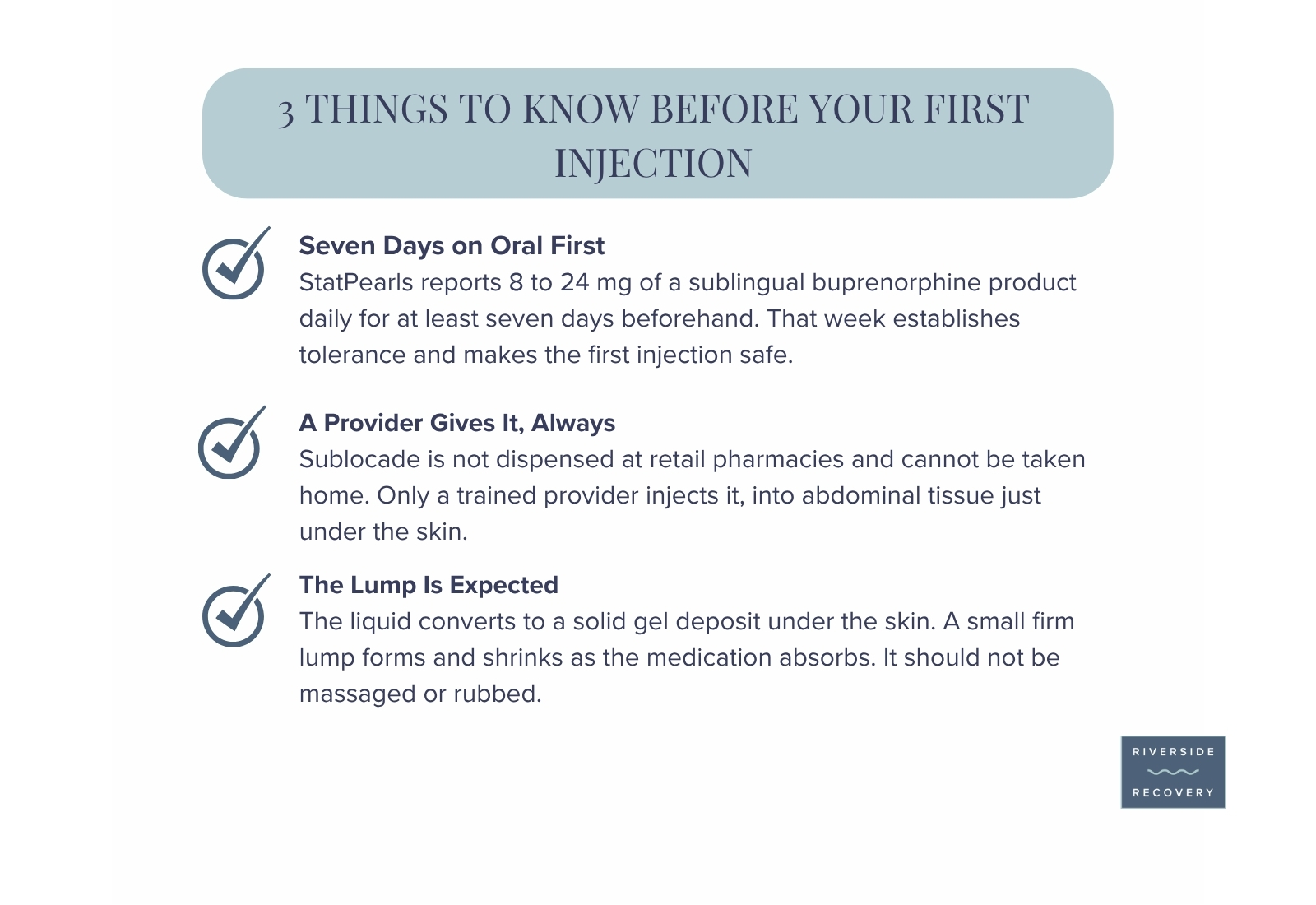
A patient must take an oral buprenorphine product first. StatPearls reports 8 to 24 mg of a sublingual product daily for at least seven days before transitioning to Sublocade. That week establishes tolerance and confirms the medication is tolerated.
Starting the injection without that stabilization risks precipitated withdrawal. Buprenorphine displaces full agonists from the receptor while activating it only partially, so a person with full agonists still present experiences sudden, severe withdrawal. The precipitated withdrawal mechanism is the reason the oral period is not optional.
Because a depot cannot be removed once injected, the oral week also functions as a reversible trial. A patient who reacts badly to sublingual buprenorphine stops the tablet. A patient who reacts badly to the depot waits it out.
What Does the Sublocade Schedule Look Like?
StatPearls describes a 300 mg extended-release injection given subcutaneously every month, with intervals of at least 26 days for the first 2 months. Maintenance then runs 100 mg or 300 mg monthly, depending on the transmucosal dose the patient transitioned from.
- Days 1 to 7 before the first injection: The patient takes 8 to 24 mg of a sublingual buprenorphine product daily for at least 7 days, which StatPearls describes as the induction and titration step.
- Injection day: A provider injects 300 mg subcutaneously into abdominal tissue. The appointment takes minutes.
- Days 1 to 3 after injection: A firm lump forms as the liquid converts to a gel depot. Injection site soreness and itching peak here.
- Month 2: A second 300 mg dose follows, with an interval of at least 26 days from the first.
- Month 3 onward: Maintenance runs 100 mg or 300 mg monthly. For patients transitioning from long-term transmucosal buprenorphine at 8 to 18 mg, StatPearls notes the second-month dose can be either.
The lump is expected and should not be massaged or rubbed, because disturbing the depot alters the release rate. It shrinks as the medication absorbs.
What is the Sublocade withdrawal timeline?
Buprenorphine continues releasing from the depot for months after a final injection, so blood levels decline gradually rather than stopping. That long tail means stopping Sublocade does not produce the abrupt withdrawal that discontinuing a daily medication does. Any planned stop is managed by the prescriber rather than by missing appointments.
What Are the Side Effects of Sublocade?
The most common Sublocade side effects are constipation, headache, nausea, vomiting, injection site pain and itching, fatigue and elevated liver enzymes. Injection site reactions are the effect specific to the depot form rather than to buprenorphine itself.
What requires immediate medical attention?
Severe injection site reactions involving intense pain, blistering, an open wound or tissue death require prompt assessment. Signs of liver injury, including yellowing skin or eyes, dark urine and right upper abdominal pain, require the same. Allergic reactions producing facial or throat swelling and difficulty breathing are emergencies.
Why must Sublocade never be injected intravenously?
Sublocade carries a boxed warning against intravenous administration. The formulation is designed to solidify on contact with body fluid. Injected into a vein, it forms a solid mass that occludes the vessel, and the result is serious tissue and vascular injury or death. This is why the product is restricted to a Risk Evaluation and Mitigation Strategy program and never dispensed for home use.
Is Sublocade addictive?
Buprenorphine produces physical dependence, which is a predictable pharmacological effect rather than addiction. Dependence means the body adapts and withdrawal follows abrupt cessation. Addiction, classified in the DSM-5-TR as opioid use disorder, involves compulsive use despite harm. Taking Sublocade as prescribed treats that disorder rather than sustaining it.
How it compares to the alternatives determines whether the monthly form is the right choice.
How Does Sublocade Compare to Suboxone and Brixadi?
Sublocade and Suboxone both contain buprenorphine. Suboxone is a daily sublingual film or tablet that also contains naloxone, while Sublocade is a monthly injection containing no naloxone. Brixadi is a separate extended-release buprenorphine injection available in weekly and monthly forms.
| Medication | Form | Frequency | Contains naloxone |
|---|---|---|---|
| Sublocade | Subcutaneous abdominal injection | Every 4 weeks | No |
| Brixadi | Subcutaneous injection | Weekly or monthly | No |
| Suboxone | Sublingual film or tablet | Daily | Yes |
| Vivitrol | Intramuscular gluteal injection | Every 4 weeks | Not applicable, antagonist |
Brixadi differs from Sublocade in two ways that matter clinically: it offers a weekly option, and it requires a shorter oral buprenorphine lead-in. Vivitrol belongs in a different category entirely, because naltrexone blocks the opioid receptor rather than partially activating it, and it requires the patient to be fully opioid-free first.
Readers deciding between the daily and monthly buprenorphine forms can compare Suboxone treatment directly. Whichever form is chosen, the medication is one component of a larger plan.
Where Can You Get Sublocade Treatment in Tampa?
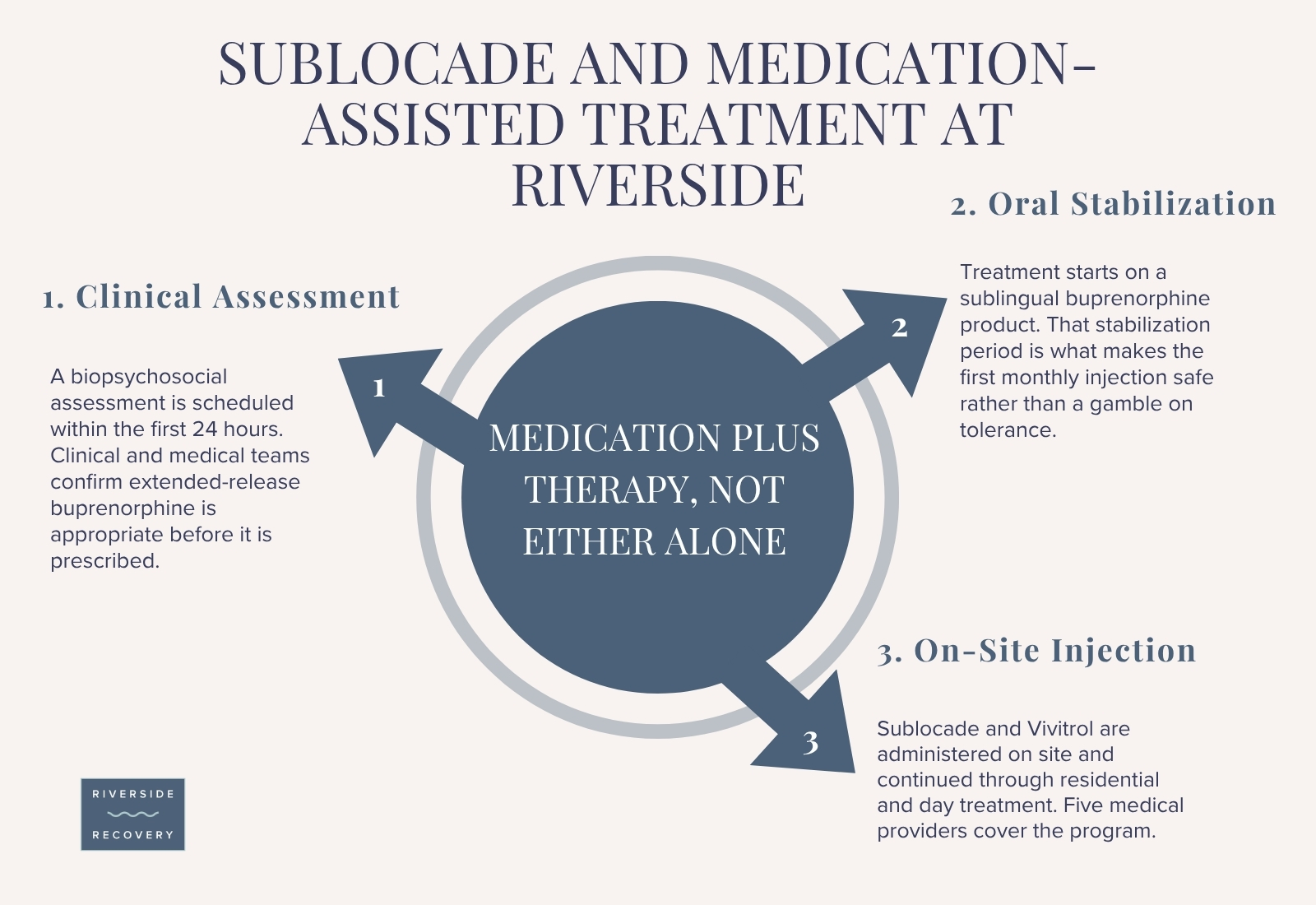
Riverside Recovery of Tampa administers Sublocade on site and continues it through residential and day treatment. Five medical providers cover the program under Medical Director Dr. Michael Sore, MD, who is certified in addiction medicine and evaluates for Florida’s IPN and PRN programs.
Because Sublocade is restricted to a Risk Evaluation and Mitigation Strategy program, it cannot be collected from a pharmacy. Treatment requires a facility certified to stock and administer it, which is what makes on-site availability the practical question rather than a convenience.
Treatment begins with a biopsychosocial assessment scheduled within the first 24 hours, followed by oral buprenorphine stabilization, then the first injection. Medication is paired with counseling rather than substituted for it. The clinical team maintains 1:8 staffing against a Florida requirement of 1:15, with registered nurses on every shift.
Insurance is verified during a phone pre-assessment before arrival, and same-day admission is possible for morning callers.
“I treat the oral week as the part that matters. A tablet can be stopped the same day if a patient reacts badly to it. A depot cannot. Because we administer Sublocade on site rather than referring out for it, the same team that runs the stabilization week gives the injection and watches what happens next. Five medical providers cover that, and registered nurses are on every shift.”
Dr. Michael Sore, MD, Medical Director, Riverside Recovery of Tampa
Frequently Asked Questions
Are Suboxone and Sublocade the same thing?
Both contain buprenorphine, but Suboxone is a daily sublingual film or tablet that also contains naloxone, while Sublocade is a monthly injection given by a provider. Sublocade contains no naloxone.
How addictive is Sublocade?
Buprenorphine produces physical dependence rather than addiction when taken as prescribed. Its partial agonist ceiling and steady release remove the peaks that drive compulsive use.
How long does Sublocade stay in your system?
Buprenorphine releases from the subcutaneous depot for months after a final injection. Blood levels decline gradually rather than ending abruptly, which shapes how the medication is stopped.
What happens if you miss a Sublocade dose?
Contact the prescriber promptly. Release continues from the existing depot, so a short delay is managed differently from missing a daily medication, though the schedule should be restored quickly.
Can you drink alcohol on Sublocade?
No. Alcohol is a central nervous system depressant, and combining it with buprenorphine produces life-threatening respiratory depression, coma and death. The buprenorphine ceiling effect does not protect against this.
Does Riverside Recovery of Tampa administer Sublocade on site?
Yes. Sublocade and Vivitrol are administered on site and continued through residential and day treatment. Eligibility requires patient agreement, clinical and medical appropriateness, and no history of medication misuse.
Is treatment covered by insurance?
Insurance is verified during the phone pre-assessment before arrival. The facility is accredited by CARF and The Joint Commission.