


Hangxiety is the anxiety that arrives as blood alcohol concentration falls toward zero, and hangxiety is a component of the alcohol hangover rather than a separate diagnosis in the DSM-5-TR.
The mechanism is rebound. Alcohol amplifies the brain’s inhibitory signaling while alcohol is present, and the compensating excitation is left unopposed once alcohol clears.
Repeated hangxiety carries clinical weight, because anxiety is also an early symptom of alcohol withdrawal, and anxiety disorders and alcohol use disorder occur together far more often than chance predicts.
Key Takeaways
- Hangxiety begins when blood alcohol concentration approaches zero, which is why hangxiety peaks the morning after rather than during drinking.
- Alcohol enhances GABA signaling acutely, and the brain’s compensating glutamate activity produces rebound anxiety as alcohol leaves the body.
- The odds ratios linking alcohol use disorder to any anxiety disorder range between 2.1 and 3.3, according to Smith and Randall’s 2012 review in Alcohol Research: Current Reviews.
- Anxiety appearing 8 to 48 hours after the last drink alongside tremor, sweating or confusion indicates alcohol withdrawal, not hangxiety, and alcohol withdrawal requires medical assessment.
- Drinking to relieve anxiety produces a positive feedback loop that worsens both the anxiety and the drinking, so treating one condition alone is not advisable.
What Is Hangxiety?
Hangxiety is the anxiety, dread and restlessness that form part of an alcohol hangover, appearing as blood alcohol concentration approaches zero. Hangxiety is a colloquial term rather than a clinical diagnosis, and hangxiety describes the psychological half of a hangover that most people experience physically.
Verster and colleagues published an updated hangover definition in the Journal of Clinical Medicine in 2020. The alcohol hangover, they wrote, is the combination of negative mental and physical symptoms which can be experienced after a single episode of alcohol consumption, starting when blood alcohol concentration approaches zero. Two details in that definition matter for hangxiety.
- Timing. Hangxiety is tied to falling blood alcohol, not to a fixed hour of the day, so hangxiety can begin late at night rather than the following morning.
- Quantity. Verster and colleagues removed the heavy-drinking requirement from the earlier definition, so a hangover, and therefore hangxiety, follows a single drinking episode at any blood alcohol level.
The DSM-5-TR does carry a related diagnosis, alcohol-induced anxiety disorder, but that diagnosis requires anxiety symptoms significant enough to warrant clinical attention and is not satisfied by an ordinary hangover.
Why Does Alcohol Cause Anxiety the Day After Drinking?
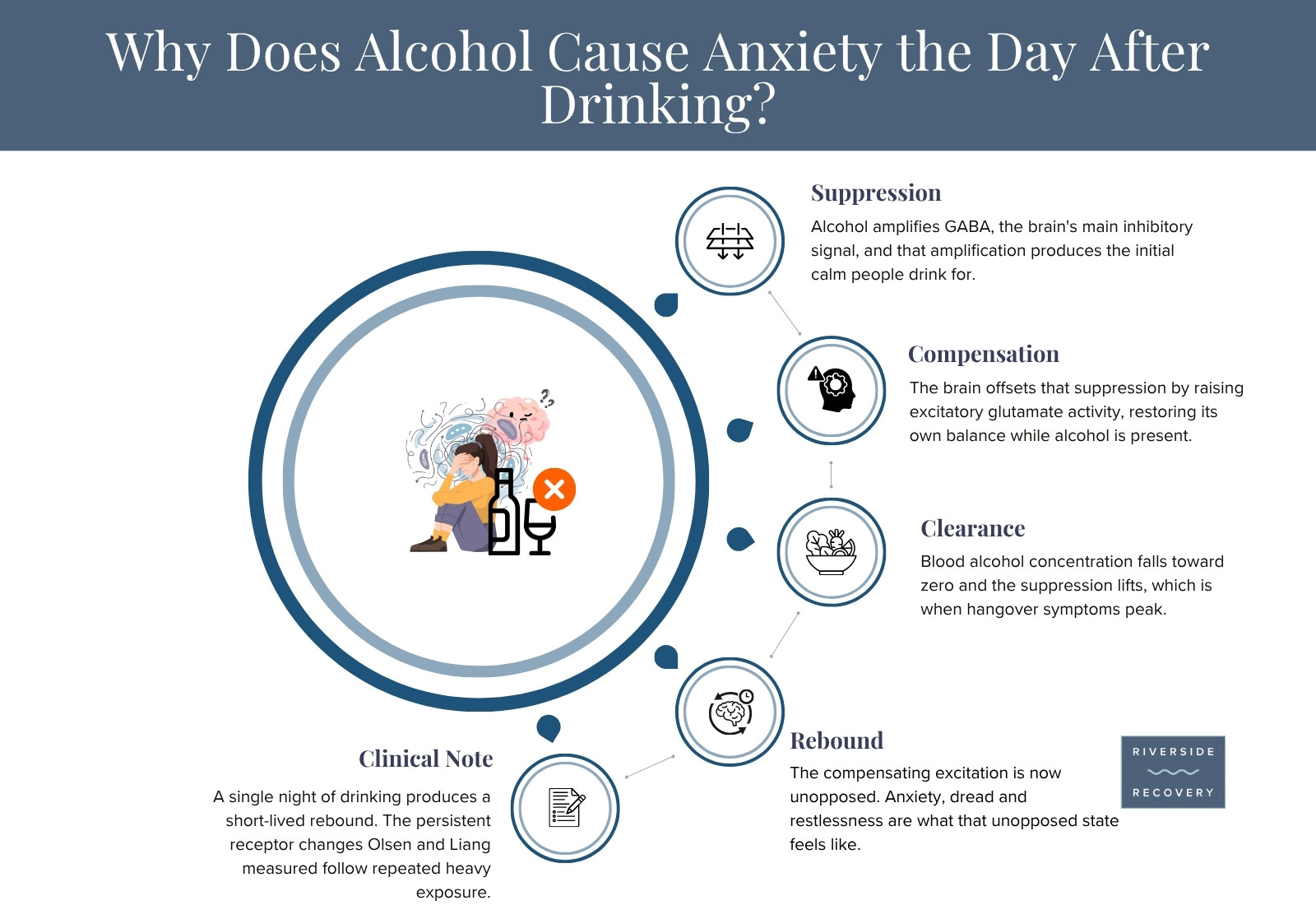
Alcohol causes next-day anxiety through neurotransmitter rebound: alcohol amplifies GABA to produce the initial calm, the brain counters with extra excitatory activity, and that counter-response is left unopposed once alcohol clears the body.
Olsen and Liang described the underlying balance in Molecular Brain in 2017. Alcohol affects brain function by interacting with multiple neurotransmitter systems, they wrote, especially disruption of the delicate balance between GABA and glutamate, the major excitatory neurotransmitter.
Olsen and Liang set out the direction of that adaptation directly. Short-term alcohol exposure tilts this balance toward CNS depression, while under long-term alcohol exposure, the brain attempts to compensate by bringing the balance back toward equilibrium.
The consequence appears when alcohol is removed. When alcohol consumption is abruptly discontinued or reduced, Olsen and Liang wrote, these compensatory changes are no longer opposed by the presence of alcohol. That unopposed state leads to the excitation of neurotransmitter systems and the development of the alcohol withdrawal syndrome.
The rebound runs through four stages:
- Suppression. Alcohol amplifies GABA, the brain’s main inhibitory signal, which produces the initial calm.
- Compensation. The brain raises excitatory glutamate activity to offset that suppression.
- Clearance. Blood alcohol falls toward zero and the suppression lifts.
- Rebound. The compensating excitation is left unopposed, and anxiety is what that feels like.
One distinction prevents a common misreading of that mechanism. A single night of drinking produces a short-lived rebound, while the persistent receptor changes Olsen and Liang measured follow repeated heavy exposure. Hangxiety after one occasion and alcohol withdrawal after sustained drinking sit on the same axis at very different magnitudes.
How Long Does Hangxiety Last?
Hangxiety peaks as blood alcohol returns to about zero and can last 24 hours or longer, according to the National Institute on Alcohol Abuse and Alcoholism. Anxiety that keeps intensifying past that point points to alcohol withdrawal instead.
The duration follows the hangover itself, because hangxiety is one of its symptoms. The National Institute on Alcohol Abuse and Alcoholism states that hangover symptoms peak when the blood alcohol concentration in the body returns to about zero, and that the symptoms can last 24 hours or longer.
The same agency records that a hangover is not merely uncomfortable. Hangovers can be both painful and dangerous, and during a hangover a person’s attention, decision-making and muscle coordination can all be impaired.
Why day three rules out a hangover
StatPearls records that alcohol withdrawal signs and symptoms may present within hours of alcohol cessation and peak around 72 hours. A hangover does not peak at 72 hours, so an anxiety course that is still intensifying on day three is not a hangover.
Anyone tracking recovery time from a single episode will find related timelines in the guide to how long it takes to sober up from alcohol.
How Do You Calm Hangxiety?
Hangxiety is managed by restoring sleep, blood sugar and fluids, waiting out the rebound, and avoiding further alcohol, because no treatment shortens a hangover reliably. Drinking again to relieve hangxiety restarts the cycle that produced hangxiety in the first place.
There are five measures that address the physiology behind hangxiety rather than masking hangxiety:
- Rehydrate steadily, because alcohol suppresses vasopressin and increases fluid loss.
- Eat a balanced meal, because alcohol disrupts glucose regulation and low blood sugar mimics anxiety.
- Sleep, because alcohol fragments the second half of the night and sleep loss independently raises anxiety.
- Move gently, because light activity reduces physiological arousal without adding stress.
- Skip caffeine, because caffeine raises heart rate and amplifies the same arousal that produces hangxiety.
One measure is specifically counterproductive. Drinking again relieves hangxiety temporarily by restoring GABA suppression, and that relief is the mechanism by which morning drinking develops.
When Is Hangxiety Actually Alcohol Withdrawal?
Anxiety is alcohol withdrawal rather than hangxiety when anxiety appears 8 to 48 hours after the last drink, worsens instead of fading, or arrives with tremor, sweating, nausea, rapid heartbeat or confusion. Alcohol withdrawal is a medical condition and alcohol withdrawal can be fatal without treatment.
StatPearls describes the early presentation plainly: following alcohol cessation, alcohol withdrawal syndrome typically presents as minor symptoms such as mild anxiety, headache, gastrointestinal discomfort, and insomnia. Anxiety and headache therefore appear in both a hangover and withdrawal, which is precisely why the timeline decides between them.
The alcohol withdrawal timeline
StatPearls sets out four windows that separate withdrawal from a hangover:
- Onset: symptoms may present within hours of alcohol cessation.
- Seizure window: alcohol-related seizures typically occur between 8 and 48 hours after cessation.
- Peak: symptoms peak around 72 hours.
- Delirium window: patients are at risk of alcohol withdrawal delirium anywhere from 3 to 8 days after cessation.
The prognosis for delirium has changed substantially. StatPearls states that the mortality rate of alcohol withdrawal delirium has historically been as high as 20%, but with advances in critical care, prompt diagnosis, and treatment, the rate is now around 1%.
How clinicians grade withdrawal severity
Clinicians grade severity with a named instrument rather than by impression. StatPearls sets three thresholds for the Clinical Institute Withdrawal Assessment for Alcohol, Revised:
- Mild withdrawal is a CIWA-Ar score of 8 or less.
- Moderate withdrawal is a score between 8 and 15.
- Severe withdrawal is a score above 15.
When to get emergency help
Call 911 during or after drinking if any of these six signs appears.
- A seizure
- Confusion or disorientation
- A very high heart rate
- Chest pain
- Repeated vomiting
- Loss of consciousness
For emotional crisis or suicidal thoughts, the 988 Suicide and Crisis Lifeline is reachable by calling 988, texting 988, or using the chat service at 988lifeline.org. The 988 Lifeline provides Spanish-language service and American Sign Language support for Deaf and hard of hearing callers.
The full symptom course is set out in the reference on alcohol withdrawal syndrome, and the headache component specifically in alcohol withdrawal headache.
Does Drinking to Ease Anxiety Make Anxiety Worse?
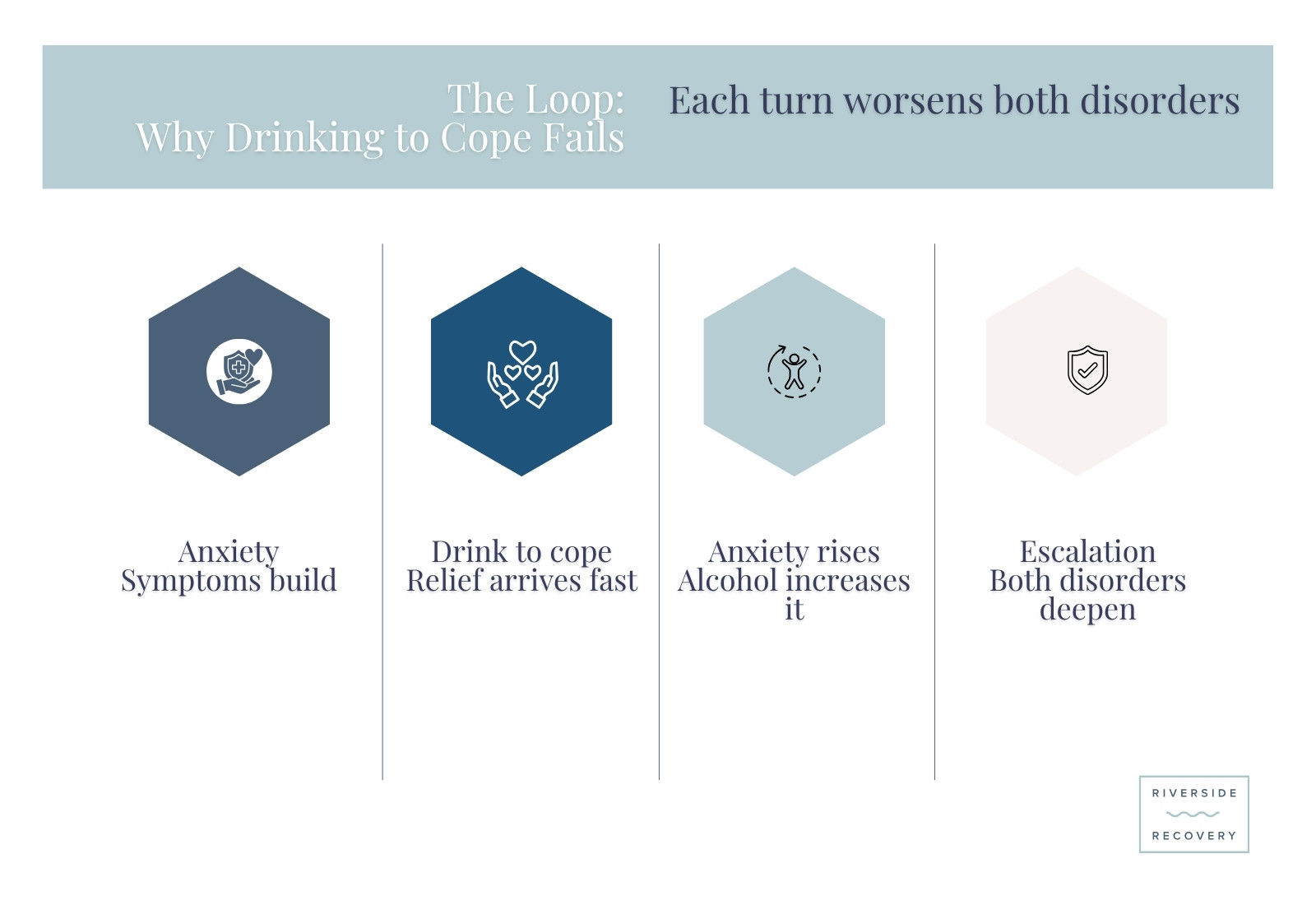
Drinking to ease anxiety makes anxiety worse over time, because alcohol relieves anxiety acutely and increases it afterwards, which creates a feedback loop in which each condition drives the other. Smith and Randall documented that loop in their 2012 review for Alcohol Research: Current Reviews.
Smith and Randall named the pattern the self-medication model. The model proposes that people with anxiety disorders attempt to alleviate negative consequences of these conditions by drinking alcohol to cope with their symptoms. That coping eventually leads to the later onset of alcohol use disorders.
The escalation is the documented part. Smith and Randall wrote that studies have demonstrated that alcohol use can increase anxiety, which can result in a positive feedback loop leading to exacerbation of both disorders.
The two conditions also arrive in a typical order. Reviewing Kushner and colleagues from 2008, Smith and Randall calculated that three of four individuals with comorbid disorders developed the anxiety disorders first.
How common drinking to cope actually is
Smith and Randall put a figure on it, and the figure depends entirely on where it is measured:
- 50 to 97 percent in clinical samples of people with both an anxiety disorder and an alcohol use disorder, with the highest rates among people with phobias.
- 21.9 percent in the community, among individuals with anxiety disorders who endorsed self-medicating with either alcohol or drugs.
- Three of four people with both conditions developed the anxiety disorder first, on Smith and Randall’s reading of Kushner and colleagues.
The Centers for Disease Control and Prevention defines binge drinking as four or more drinks for women, or five or more drinks for men during an occasion. The same agency attributes about 178,000 deaths in the United States each year to excessive alcohol use.
What Do People Get Wrong About Hangxiety?
Three widespread beliefs about hangxiety contradict the published evidence: that hangxiety follows only heavy drinking, that hangxiety proves an anxiety disorder, and that a morning drink is a legitimate remedy.
Each one is answered by the published evidence:
- Misconception: hangxiety only happens after heavy drinking. Evidence: Verster and colleagues removed the heavy-drinking requirement from the hangover definition in 2020, attaching a hangover to a single episode of alcohol consumption at any blood alcohol level.
- Misconception: hangxiety means a person has an anxiety disorder. Evidence: hangxiety is a rebound effect of alcohol clearance and occurs in people with no psychiatric diagnosis. Anxiety that persists between drinking episodes is the finding that warrants assessment, not hangxiety itself.
- Misconception: a morning drink is a reasonable way to settle hangxiety. Evidence: a morning drink relieves hangxiety by restoring the GABA suppression the brain is rebounding from. Smith and Randall identified that relief as the reinforcement driving progression toward an alcohol use disorder.
How Is Co-Occurring Anxiety and Alcohol Use Disorder Treated?
Co-occurring anxiety and alcohol use disorder are treated together rather than in sequence, because treating one condition alone leaves the other driving relapse. Smith and Randall concluded that recommendations to treat both anxiety and alcohol use disorders appear warranted on both theoretical and empirical grounds.
Treating only the condition judged primary was the older convention, and Smith and Randall recorded that it generally has been accepted in the comorbidity literature that this approach is not advisable. Smith and Randall set out three alternatives instead:
- Sequential. One condition is treated, then the other.
- Parallel. Both are treated at the same time by separate providers.
- Integrated. Both are treated at the same time within one plan and one team.
Smith and Randall advised clinicians to weigh the relative advantages and disadvantages of each when planning treatment.
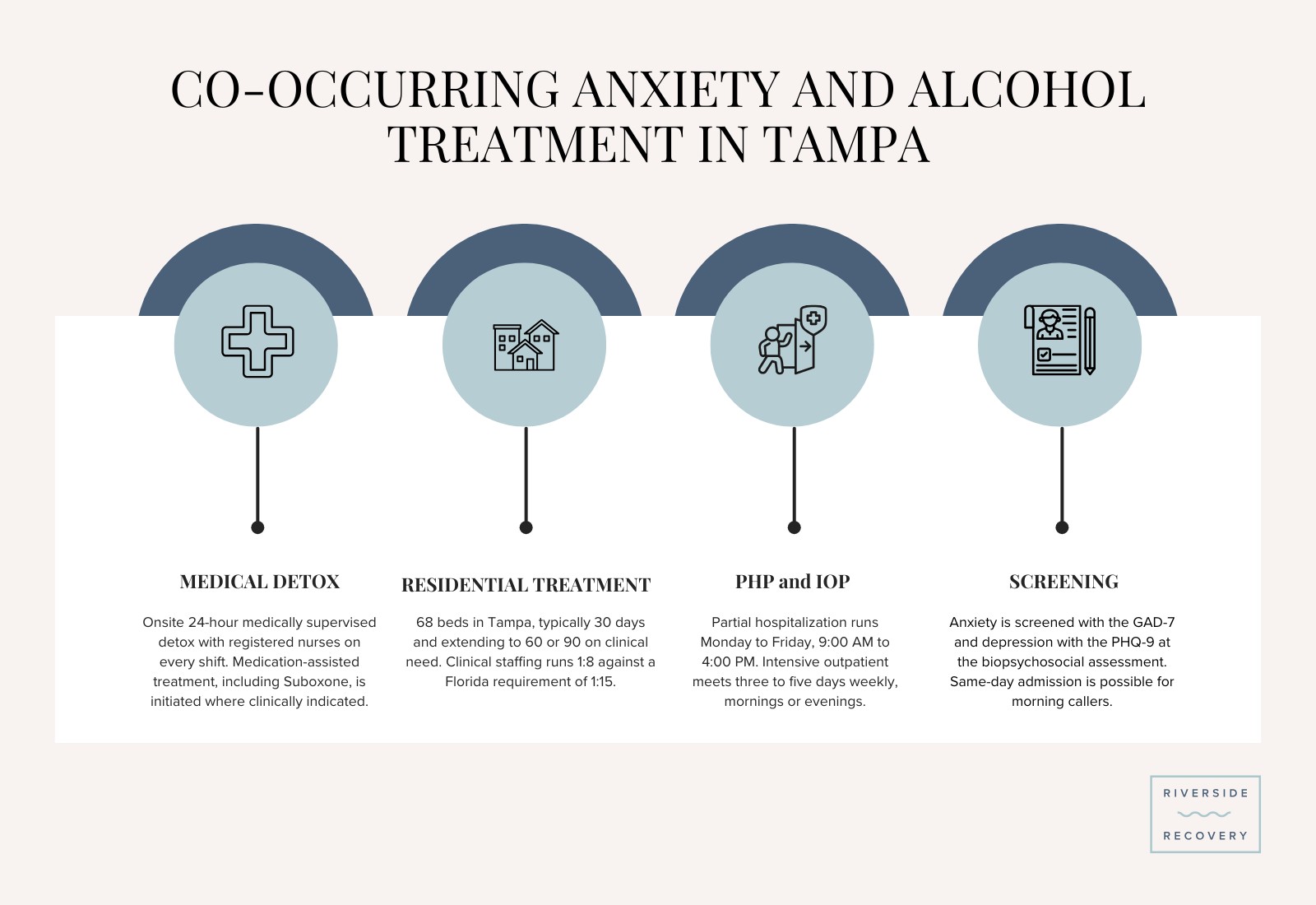
Riverside Recovery of Tampa treats the following co-occurring mental health conditions, in every case alongside a substance use disorder:
- Anxiety
- Depression
- Obsessive-compulsive disorder
- Panic disorders
- Post-traumatic stress disorder
- Bipolar disorder
- Trauma
Riverside Recovery of Tampa does not admit primary mental health conditions without co-occurring substance use, and Riverside Recovery of Tampa serves adults aged 18 and over only.
Anxiety is screened with the GAD-7 and depression with the PHQ-9 during the biopsychosocial assessment, so a co-occurring presentation is measured at intake rather than inferred later.
Treatment at Riverside Recovery of Tampa
Where drinking has become daily or heavy, withdrawal is managed before anxiety treatment can be effective, which is the function of medical detox. Riverside Recovery of Tampa holds ASAM Level 3.5 certification for clinically managed high-intensity residential care, and steps down through four further levels:
- Residential treatment
- Day and night treatment
- Intensive outpatient programming
- Outpatient programming
Readers whose anxiety persists between drinking episodes should look at anxiety and substance use disorder treatment, which describes how the two diagnoses are addressed in one plan.
Alcohol’s wider effects on the body are covered in the reference on the side effects of alcohol.
Frequently Asked Questions
Why does alcohol help my anxiety in the moment?
Alcohol enhances GABA, the brain’s primary inhibitory neurotransmitter, which reduces physiological arousal and produces short-term calm. That effect reverses as alcohol clears, because the brain’s compensating excitatory activity is then unopposed.
Will quitting alcohol reduce anxiety?
Stopping alcohol removes the rebound cycle that generates hangxiety. Anxiety that continues after sustained abstinence indicates an independent anxiety disorder, which Smith and Randall found precedes alcohol dependence in three of four comorbid cases.
How do you feel better after a night of drinking?
Rehydrate, eat a balanced meal, sleep, and avoid caffeine and further alcohol. No intervention reliably shortens a hangover, so the physical symptoms and hangxiety resolve as blood alcohol clearance completes.
Is hangxiety a sign of alcohol use disorder?
Hangxiety alone is not a sign of alcohol use disorder. Anxiety that appears 8 to 48 hours after the last drink, worsens rather than fades, or arrives with tremor and sweating indicates withdrawal and warrants clinical assessment.
Can you get hangxiety without a hangover?
Hangxiety is one symptom of the hangover state rather than a separate event, so hangxiety occurs within a hangover. Some people experience the psychological symptoms strongly while the physical symptoms stay mild.
Does hydrating or eating prevent hangxiety?
Hydration and food reduce the dehydration and low blood sugar that amplify hangxiety, and neither prevents the neurotransmitter rebound itself. Only the quantity of alcohol consumed changes the size of that rebound.
References
- Verster, J.C., Scholey, A., van de Loo, A.J.A.E., Benson, S., & Stock, A.-K. (2020). Updating the Definition of the Alcohol Hangover. Journal of Clinical Medicine, 9(3), 823. pmc.ncbi.nlm.nih.gov/articles/PMC7141232
- Smith, J.P., & Randall, C.L. (2012). Anxiety and Alcohol Use Disorders: Comorbidity and Treatment Considerations. Alcohol Research: Current Reviews, 34(4), 414-431. pmc.ncbi.nlm.nih.gov/articles/PMC3860396
- Olsen, R.W., & Liang, J. (2017). Role of GABA-A receptors in alcohol use disorders suggested by chronic intermittent ethanol (CIE) rodent model. Molecular Brain. pmc.ncbi.nlm.nih.gov/articles/PMC5605989
- Alcohol Withdrawal Syndrome. StatPearls, National Center for Biotechnology Information Bookshelf NBK441882. ncbi.nlm.nih.gov/books/NBK441882
- Hangovers. National Institute on Alcohol Abuse and Alcoholism. niaaa.nih.gov/publications/brochures-and-fact-sheets/hangovers
- Facts About Excessive Drinking. Centers for Disease Control and Prevention. cdc.gov/drink-less-be-your-best/facts-about-excessive-drinking
- 988 Suicide & Crisis Lifeline. Substance Abuse and Mental Health Services Administration. 988lifeline.org