



Vivitrol is a monthly naltrexone injection used to treat alcohol use disorder and opioid use disorder, and it blocks opioid receptors rather than activating them, which separates it from every other injectable in addiction treatment. Because it blocks rather than substitutes, two things have to happen before the first dose: the person must be free of opioids, and the drinking must stop.
Key Takeaways
- StatPearls describes Vivitrol as 380 mg of naltrexone given by deep intramuscular gluteal injection every four weeks.
- A patient must be opioid-free, including tramadol, for at least 7 to 10 days before the first dose. Starting sooner triggers precipitated withdrawal.
- Headache, anxiety, low energy, joint and muscle pain, nervousness, abdominal cramps, insomnia and nausea were each reported in more than 10% of patients in opioid use disorder studies.
- Opioid tolerance falls during naltrexone treatment, and returning to a previous dose after stopping can be fatal. This is the most serious risk associated with the medication.
- Baseline and periodic liver function tests are necessary, and most providers avoid prescribing when liver enzymes run 3 to 5 times above normal.
What Is Vivitrol?
Vivitrol is extended-release injectable naltrexone, given as 380 mg by deep intramuscular injection every four weeks. Naltrexone is a mu-opioid receptor antagonist, meaning it occupies and blocks the receptor rather than activating it.
Naltrexone also exists as a daily tablet. The injection exists because a daily tablet is the step people most often stop taking, and a monthly appointment removes that decision from every morning.
Is Vivitrol an opioid?
Vivitrol is not an opioid. Naltrexone blocks the mu-opioid receptor and acts as a weaker antagonist at kappa and delta receptors. It produces no opioid effect, creates no dependence, and causes no withdrawal when stopped. That also means it provides no relief to someone still physically dependent on opioids, which is why the opioid-free interval is mandatory.
How does Vivitrol work on drinking?
Alcohol triggers endorphin release, and those endorphins bind opioid receptors to produce part of alcohol’s reward. Naltrexone blocks that binding, so drinking delivers less of what the brain expects. StatPearls describes a second mechanism specific to alcohol: naltrexone modifies the hypothalamic-pituitary-adrenal axis to suppress ethanol consumption.
Naltrexone does not prevent intoxication. A person who drinks on it still becomes impaired, and the medication is not a safety net for driving or judgment. The detail of what happens when someone drinks anyway is covered in the guide to drinking while on naltrexone.
What Has to Happen Before the First Injection?
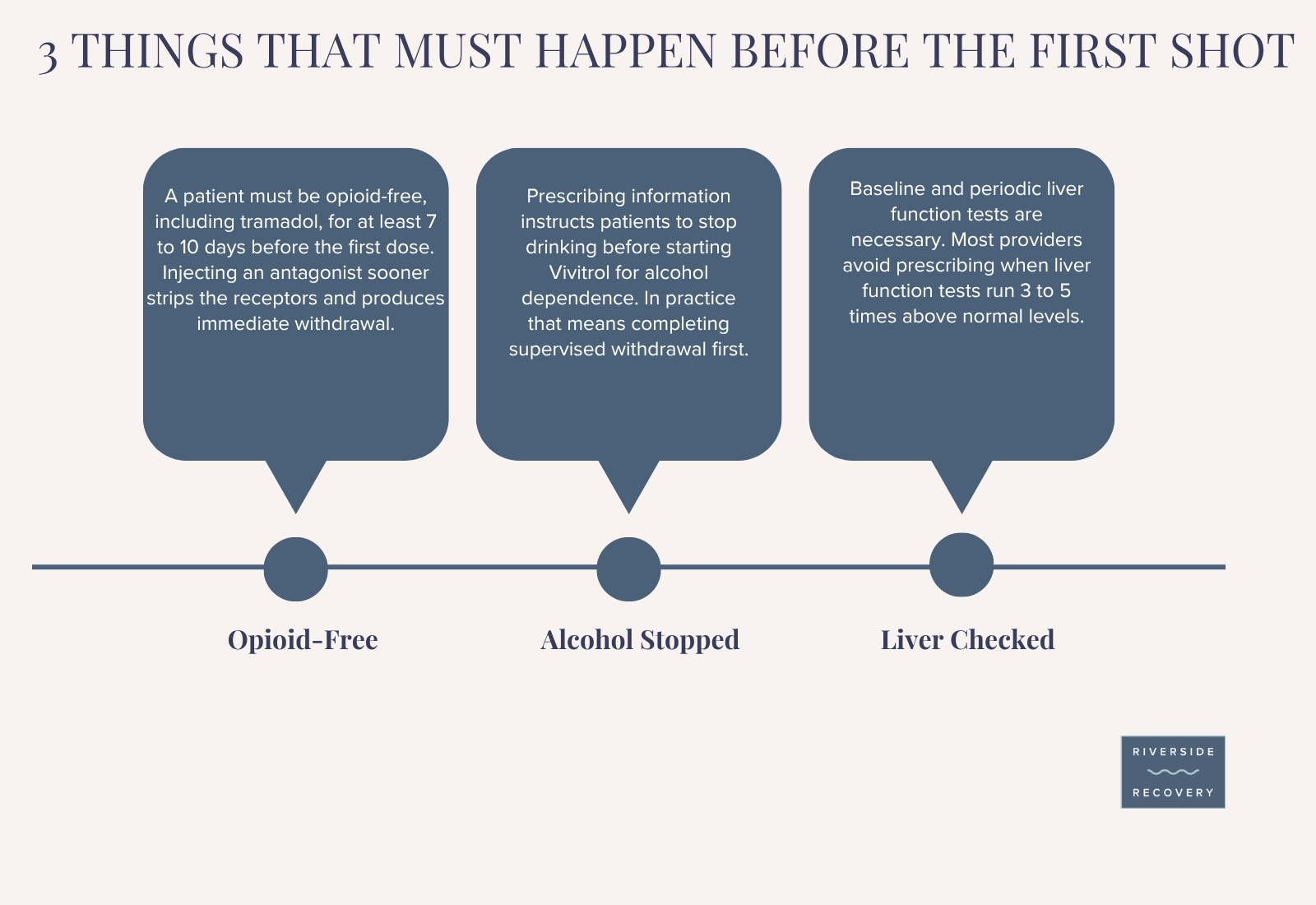
Three requirements precede a first Vivitrol injection: the patient must be opioid-free for at least 7 to 10 days including tramadol, drinking must have stopped, and baseline liver function tests must be checked.
Why is the opioid-free interval mandatory?
Injecting an antagonist into someone with opioids still present strips the receptors and produces immediate, severe withdrawal. Providers confirm the interval with a naloxone challenge or a urine screen rather than taking a patient’s word for it, because the depot cannot be removed once given.
Why must drinking stop first?
Manufacturer prescribing information instructs patients to stop drinking before starting Vivitrol for alcohol dependence. In practice that means completing alcohol withdrawal under supervision, because withdrawal from heavy daily drinking carries seizure and delirium risk that the injection does nothing to address.
Why is liver function checked?
Naltrexone hepatotoxicity is dose-dependent, so baseline and periodic liver function tests are necessary. Most providers avoid prescribing when liver function tests run 3 to 5 times above normal levels. Elevated enzymes are common in people with alcohol use disorder, so this test frequently determines timing rather than eligibility.
What Does the First Month on Vivitrol Look Like?
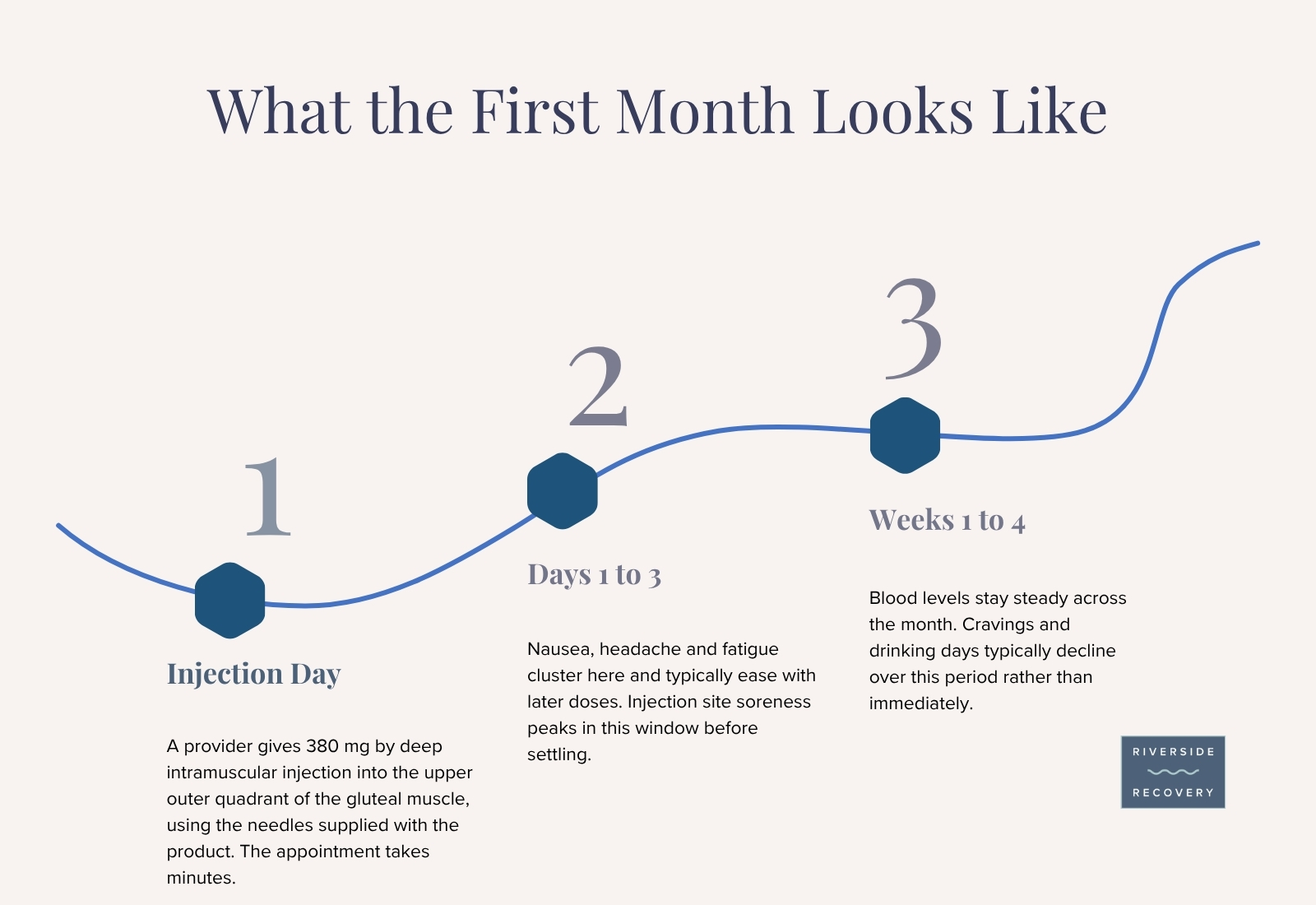
The first month follows a predictable sequence: injection day takes minutes, days 1 to 3 carry the most side effects, and weeks 1 to 4 hold steady blood levels while cravings decline gradually rather than immediately.
- Days 1 to 10 before the first shot: The opioid-free interval runs its course or alcohol detoxification completes. Baseline liver function tests are drawn.
- Injection day: A provider gives 380 mg by deep intramuscular injection into the upper outer quadrant of the gluteal muscle, using the needles supplied with the product.
- Days 1 to 3: Nausea, headache and fatigue cluster here and typically ease with later doses. Injection site soreness peaks in this window.
- Weeks 1 to 4: Blood levels stay steady across the month. Cravings and drinking days decline over this period rather than immediately.
- Every 4 weeks after: The injection repeats, alternating sides. Liver function is rechecked periodically throughout treatment.
Knowing which of those effects are expected and which are not is what makes the first month manageable.
What Are the Side Effects of Vivitrol?
Headache, anxiety, low energy, joint and muscle pain, nervousness, abdominal cramps, insomnia and nausea were each reported in more than 10% of patients in opioid use disorder studies. Injection site reactions are the effect specific to the depot form.
Which side effects are common?
Headache and nausea cluster in the first days after an injection and diminish with subsequent doses. Fatigue during the day alongside disrupted sleep at night is a frequently reported combination. Joint and muscle aching is common and is not the same as opioid withdrawal. Anxiety and nervousness matter specifically because patients mistake them for a return of the underlying condition.
Which side effects require medical attention?
Severe injection site reactions involving intense pain, hardening, blistering, an open wound or tissue death require prompt assessment. Signs of liver injury, including yellowing skin or eyes, dark urine, persistent fatigue and right upper abdominal pain, require the same. Allergic reactions producing facial or throat swelling and difficulty breathing are emergencies. Cough, wheezing and shortness of breath have been reported and warrant assessment.
Any new or worsening depressed mood during treatment needs immediate clinical attention. Call or text 988 to reach the Suicide and Crisis Lifeline, or chat at 988lifeline.org. The service is free, confidential and available 24 hours a day, with Spanish-language and ASL access.
What is the risk after stopping Vivitrol?
Opioid tolerance falls during naltrexone treatment. Returning to a previously tolerated dose after stopping can be fatal, and prescribing information carries this warning explicitly. Opioid painkillers also will not work normally during treatment, which matters for surgery and emergencies, so medical alert identification is advisable. Protection declines toward the end of each four-week interval, which is why a missed appointment leaves a gap.
How Does Vivitrol Compare to Other Alcohol Medications?
Three medications hold FDA approval for alcohol use disorder: naltrexone, acamprosate and disulfiram. Naltrexone blocks opioid receptors to reduce reward, acamprosate stabilizes glutamate and GABA signaling after drinking stops, and disulfiram blocks alcohol metabolism to produce an unpleasant reaction.
| Medication | Action | Form | Prerequisite |
|---|---|---|---|
| Vivitrol | Opioid antagonist, blocks | Monthly injection | 7 to 10 days opioid-free |
| Oral naltrexone | Opioid antagonist, blocks | Daily tablet | Same opioid-free interval |
| Acamprosate | Glutamate and GABA modulation | Tablet, three times daily | Started after abstinence begins |
| Disulfiram | Blocks alcohol metabolism | Daily tablet | No alcohol for 12 hours |
The monthly injection suits patients for whom daily adherence is the failure point. Acamprosate suits patients with liver impairment, because it is cleared by the kidneys rather than the liver. Disulfiram works through deterrence rather than craving reduction and requires a patient committed to abstinence.
Medication choice is one part of a plan that also addresses what surrounds the drinking.
Where Can You Get Vivitrol Treatment in Tampa?
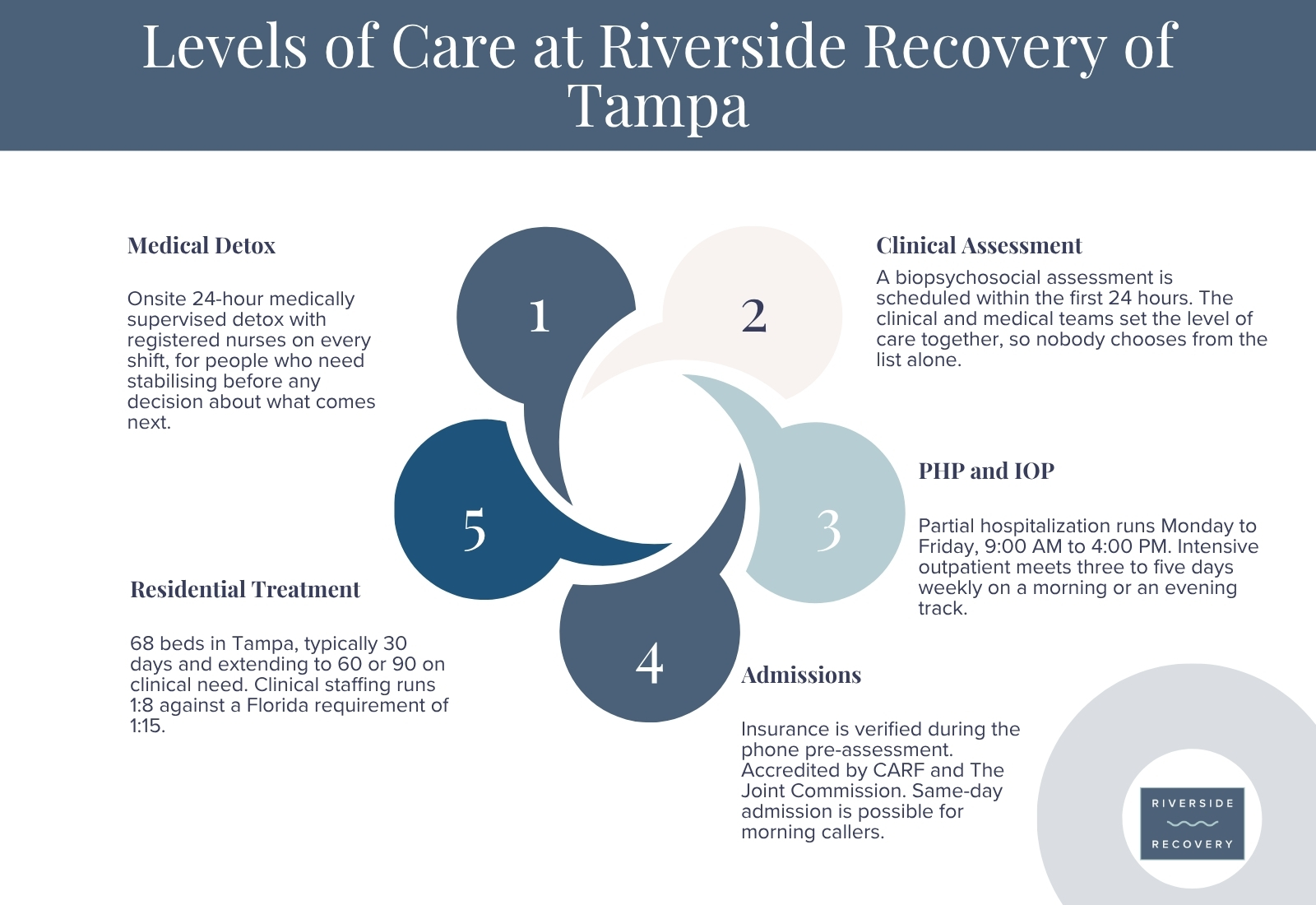
Riverside Recovery of Tampa administers Vivitrol on site as part of its medication-assisted treatment program, continued through residential and day treatment. Five medical providers cover the program under Medical Director Dr. Michael Sore, MD, certified in addiction medicine.
Naltrexone requires liver monitoring, so patients with existing liver disease need a facility equipped to manage it. The Tampa program accepts medically complex admissions including liver transplant referrals and patients requiring hepatitis treatment, with gastrointestinal specialization on the detox unit and no blood alcohol cutoff.
Vivitrol is prescribed alongside counseling rather than instead of it, because the medication addresses craving while therapy addresses what surrounds it. The clinical team runs a sixteen-member clinical staff at 1:8 staffing against a Florida requirement of 1:15, with registered nurses on every shift. Eligibility requires patient agreement, clinical and medical appropriateness, and no history of medication misuse.
Insurance is verified during a phone pre-assessment before arrival, and same-day admission is possible for morning callers.
Frequently Asked Questions
What does Vivitrol do if you drink alcohol?
It blocks part of the reward alcohol produces by preventing endorphins from binding opioid receptors. It does not prevent intoxication, so a person still becomes impaired.
How long does Vivitrol last for alcohol?
Each injection covers about four weeks. StatPearls describes the depot as a 380 mg monthly form given every four weeks, and blocking effect declines toward the end of that interval.
Where is the Vivitrol shot given?
By deep intramuscular injection into the upper outer quadrant of the gluteal muscle, using the needles supplied with the product. It alternates sides between doses.
What happens if you miss a Vivitrol appointment?
Protection declines as the interval lengthens. Contact the prescriber promptly, because restarting may require confirming the opioid-free interval again depending on how much time has passed.
Can you take painkillers on Vivitrol?
Opioid painkillers will not work normally. Non-opioid options are used instead, and carrying medical alert identification is advisable for emergencies and planned surgery.
Does Riverside Recovery of Tampa administer Vivitrol on site?
Yes. Vivitrol and Sublocade are administered on site and continued through residential and day treatment, with five medical providers covering the program.
Is treatment covered by insurance?
Insurance is verified during the phone pre-assessment before arrival. The facility is accredited by CARF and The Joint Commission.
References
- Naltrexone, StatPearls
- Jonas et al. (2014) Pharmacotherapy for adults with alcohol use disorders in outpatient settings, JAMA 311(18) 1889-1900
- Garbutt et al. (2005) Efficacy and tolerability of long-acting injectable naltrexone for alcohol dependence, JAMA 293(13) 1617-1625
- Medications for Opioid Use Disorder, SAMHSA TIP 63