


Feening means craving a substance so intensely that the urge feels physical rather than optional. The word is street slang, not a clinical term, and people use it to describe the moment a craving stops feeling like a preference and starts feeling like a demand.
A person who says they are feening is describing urgency that reasoning cannot easily override. The same word, also spelled fiending or feining, applies to alcohol, nicotine, opioids and stimulants, because cravings for each substance run through the same reward circuitry.
Clinicians treat that urgency as craving, one of the diagnostic criteria for substance use disorder. Cravings rise, peak and fall, and understanding that curve is what makes them manageable.
Key Takeaways
- Feening is slang for craving, not a diagnosis: the DSM-5-TR lists craving as one of the 11 diagnostic criteria for substance use disorder, and meeting any 2 of those 11 criteria within a 12-month period indicates a disorder.
- Cravings peak and pass: G. Alan Marlatt’s relapse prevention model treats an urge as a wave that crests and subsides when a person does not act on it. The 20-to-30-minute window widely repeated in relapse-prevention practice is a clinical rule of thumb rather than a measured fixed duration, and individual episodes vary considerably.
- Learned cues drive feening, not weak willpower: Robinson and Berridge’s incentive-sensitization theory, published in Brain Research Reviews in 1993, attributes craving to a dopamine system that becomes hypersensitive to drug-associated cues.
- Feening and withdrawal are different problems: cravings can strike years into abstinence, while withdrawal follows a bounded timeline after the last dose.
What Does Feening Mean?
Feening describes an overwhelming urge to use a substance, and the term carries more weight in recovery communities than in casual speech. Someone who says they are feening reports a craving that has become intrusive rather than passing.
The word appears across every substance category. People report feening for alcohol use disorder triggers, for nicotine, and for stimulants with equal intensity, because the underlying brain circuitry does not vary much by drug.
Feening for Drugs: How the Craving Shows Up
Feening for drugs means craving a drug so strongly that getting it crowds out everything else. The phrase usually signals psychological and physical dependence together: the person feels restless and preoccupied, and some notice sweating, nausea or a racing heart as the urge builds.
Feening vs Fiending vs Feining: Which Spelling Is Correct?
Fiending is the standard English spelling, and feening is the phonetic variant that now dominates everyday usage. Both words point to the same experience.
- Fiending: This spelling derives from “fiend,” a noun meaning a person consumed by an overpowering desire. The phrase “dope fiend” entered American usage in the early twentieth century as a slur against people with drug addiction.
- Feening: This phonetic respelling emerged later within communities affected by substance use and is now the more common written form online.
- Feining and feenin: Both are informal variants of the same term, and neither carries a separate meaning.
- Feen and fein: These shortened forms appear in music and social media, where they often describe wanting anything badly rather than a substance specifically.
Is Feening a Formal Diagnosis?
Feening is not a formal DSM-5-TR diagnosis. The term describes subjective craving, which the DSM-5-TR does recognize as a diagnostic criterion within substance use disorder rather than as a standalone condition.
Clinicians measure craving with validated instruments instead of slang. The Penn Alcohol Craving Scale (PACS) is a five-item self-report tool that scores craving frequency, intensity and duration over the previous week, with higher totals predicting greater relapse risk.
Why Does Feening Happen in the Brain?
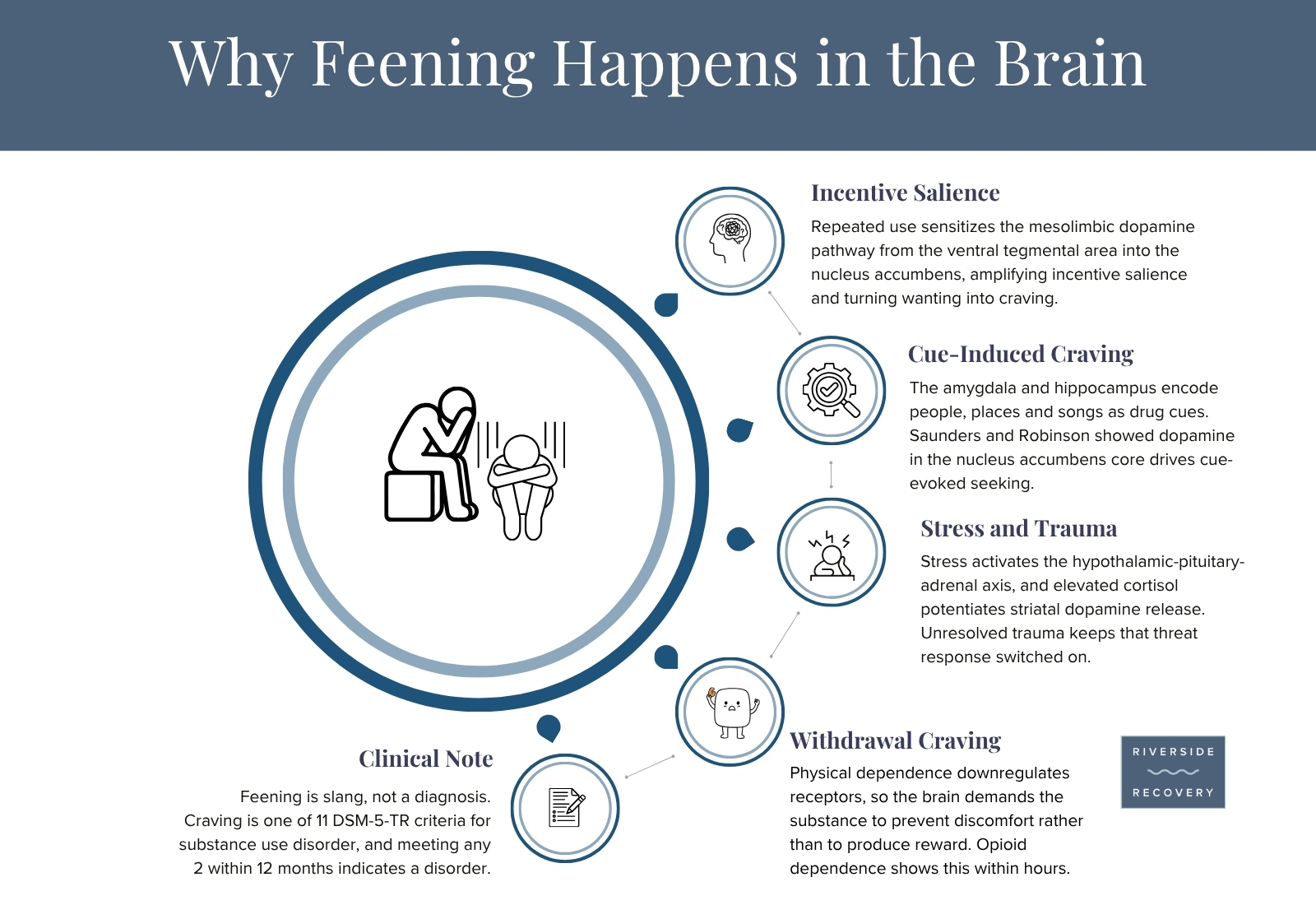
Feening originates in the brain’s reward circuitry, where repeated substance use rewires how strongly drug cues command attention. Four pathways drive it: incentive salience in the dopamine system, conditioned cues, stress and trauma, and withdrawal-driven craving.
Incentive Salience and the Dopamine Reward Pathway
Repeated substance use sensitizes the mesolimbic dopamine pathway, which projects from the ventral tegmental area into the nucleus accumbens. That sensitization amplifies incentive salience, the process that converts ordinary wanting into compulsive craving.
Terry Robinson and Kent Berridge developed this incentive-sensitization theory to explain why craving intensifies even as drug pleasure fades. Their model separates “wanting” from “liking,” which accounts for the common report of chasing a substance that no longer feels good.
Cue-Induced Craving and Conditioned Triggers
Environmental cues acquire motivational power through Pavlovian conditioning, so a specific street, song or person can trigger feening years after the last use. The amygdala and hippocampus encode these associations, and the nucleus accumbens core translates them into drug-seeking.
Saunders, Yager and Robinson demonstrated this mechanism directly in the Journal of Neuroscience in 2013, showing that a dopamine antagonist injected into the nucleus accumbens core reduced cue-evoked cocaine seeking. Their work confirms that cues drive craving through dopamine signaling rather than conscious choice.
Stress, Trauma and Emotional Triggers
Stress activates the hypothalamic-pituitary-adrenal axis, and elevated cortisol potentiates dopamine release in the striatum. That interaction explains why feening spikes during conflict, grief and exhaustion.
Unresolved trauma compounds the effect by keeping the threat response persistently activated. People who developed substance use as emotional regulation experience cravings as relief-seeking rather than pleasure-seeking.
Withdrawal-Driven Cravings
Physical dependence generates a second craving pathway, where the brain demands a substance to prevent discomfort rather than to produce reward. Opioid dependence illustrates this pattern most sharply, because receptor downregulation produces distress within hours of a missed dose.
How Long Does Feening Last?
Feening lasts minutes per episode, with no fixed measured duration. A single craving rises, peaks and falls, and the overall pattern of cravings changes over months of abstinence, as the 3 stages below show.
- A single craving: Marlatt’s relapse prevention model treats an urge as a wave that crests and subsides when a person does not act on it. The 20-to-30-minute window repeated in relapse-prevention practice is a clinical rule of thumb, not a measured duration, and episodes vary from person to person.
- Early abstinence: Cravings recur often in the first weeks and cluster around familiar cues and routines.
- Later recovery: Cue-triggered craving does not fade in a straight line. Parvaz, Moeller and Goldstein reported in JAMA Psychiatry in 2016 that EEG responses to cocaine cues in adults with cocaine use disorder followed an inverted-U curve across abstinence, a pattern called incubation of craving.
Recurrent cravings during this period signal emotional relapse rather than failure, and they respond to intervention.
What Are the Signs of Feening?
The signs of feening are psychological, physical and behavioral changes that intensify as a craving escalates. Intrusive thoughts and irritability come first, physical arousal follows in intense episodes, and repeated episodes reshape behavior over time.
Common Psychological Signs
- Intrusive and repetitive thoughts: The substance dominates attention, and mental rehearsal of using becomes difficult to interrupt.
- Irritability and agitation: Minor frustrations provoke disproportionate reactions while the urge remains active.
- Anxiety and restlessness: A sense of urgency builds that feels resolvable only through use.
- Rationalization: The mind generates permission-giving thoughts such as “just once” or “I have earned this.”
- Narrowed focus: Work, conversation and responsibilities recede as obtaining the substance takes priority.
Severe Physical Signs
- Autonomic arousal: Sweating, elevated heart rate and tremor accompany intense cravings, particularly with stimulant use.
- Salivation and appetite changes: Conditioned physiological responses activate in anticipation of use.
- Sleep disruption: Insomnia and vivid using dreams intensify daytime craving.
- Gastrointestinal distress: Nausea and stomach discomfort accompany cravings in benzodiazepine dependence and opioid dependence.
Long-Term Behavioral Consequences
- Escalating risk tolerance: Persistent feening drives decisions a person would otherwise reject, including unsafe sourcing and driving under the influence.
- Relationship deterioration: Secrecy and broken commitments accumulate as cravings dictate schedules.
- Financial and legal harm: Spending escalates and consequences compound as use continues.
- Tolerance and dose escalation: Chasing relief requires progressively larger amounts, which raises overdose risk sharply.
What Is the Difference Between Feening and Withdrawal?
Feening is a craving that cues, stress or emotions trigger at any point in recovery, while withdrawal is a time-limited physical syndrome that starts hours after the last dose. The two overlap in early abstinence, but each needs different treatment.
| Feature | Feening (craving) | Withdrawal syndrome |
|---|---|---|
| Trigger | Cues, stress, emotional states | Falling blood concentration of the substance |
| Onset | Seconds after cue exposure | Hours after the last dose |
| Duration | Minutes per episode; 20 to 30 minutes is a clinical rule of thumb, with wide individual variation | Days to weeks, following a fixed course |
| Timeline after quitting | Can occur years into abstinence | Resolves after the acute phase |
| Medical risk | Risk comes from acting on it | Can be life-threatening without supervision |
| Primary treatment | Behavioral skills, therapy, medication | Medically supervised detox |
Alcohol withdrawal can escalate to seizures and delirium tremens, which makes unsupervised cessation dangerous. Opioid withdrawal is rarely fatal but produces distress severe enough to drive relapse.
How Do You Stop Feening?
To stop feening, interrupt the urge rather than fight it head-on. The 5 techniques below do this: urge surfing, grounding and state change, delaying the decision, playing the tape forward and identifying the first trigger in the chain.
Urge Surfing
Urge surfing treats a craving as a wave to be ridden rather than a force to be blocked. Marlatt developed the technique on the premise that resisting an urge with force strengthens it, while observing it without acting allows the decay curve to complete.
Grounding and State Change
Physical state change disrupts the craving loop faster than reasoning does. Cold water on the face, brisk movement and paced breathing all shift autonomic arousal, and grounding techniques return attention to the present moment.
Delay and Decide
Postponing a decision gives the urge time to crest and fall, which is the premise of Marlatt’s urge surfing. The choice looks different once intensity drops.
Play the Tape Forward
Cravings present the first drink and omit everything after it. Mentally rehearsing the full sequence through to consequences restores the information the urge suppresses, and structured urge management makes the practice automatic.
Identify the First Domino
Most episodes begin before the obvious trigger, with skipped meals, lost sleep or unresolved conflict. Tracking these antecedents converts relapse prevention from reaction into anticipation.
How Are Cravings and Substance Use Disorder Treated?
Cravings and substance use disorder are treated with a layered approach of behavioral therapy and medication rather than any single intervention. First-line therapies and medications come first, with adjunct and investigational options added for specific substances.
- First-line behavioral therapies: Cognitive behavioral therapy targets the permission-giving thoughts that convert craving into use. Dialectical behavior therapy builds distress tolerance, and mindfulness-based relapse prevention trains non-reactive observation of urges.
- First-line medications: Naltrexone blunts alcohol and opioid reward, acamprosate stabilizes glutamate signaling in early abstinence, and disulfiram creates a deterrent reaction. Buprenorphine and methadone suppress opioid craving through partial and full agonist action, as SAMHSA’s Treatment Improvement Protocol 63 describes, delivered through medication-assisted treatment.
- Second-line and adjunct approaches: Contingency management reinforces verified abstinence with tangible rewards and holds the strongest evidence base for stimulant use disorder. Motivational interviewing and group therapy address ambivalence and isolation.
- Emerging and investigational treatments: N-acetylcysteine is under investigation for restoring glutamate homeostasis and reducing craving. Deep transcranial magnetic stimulation received FDA clearance in 2020 as a short-term aid for smoking cessation and remains investigational for other substances, while ketamine is in trials for alcohol use disorder.
How Does Riverside Recovery of Tampa Treat Cravings?
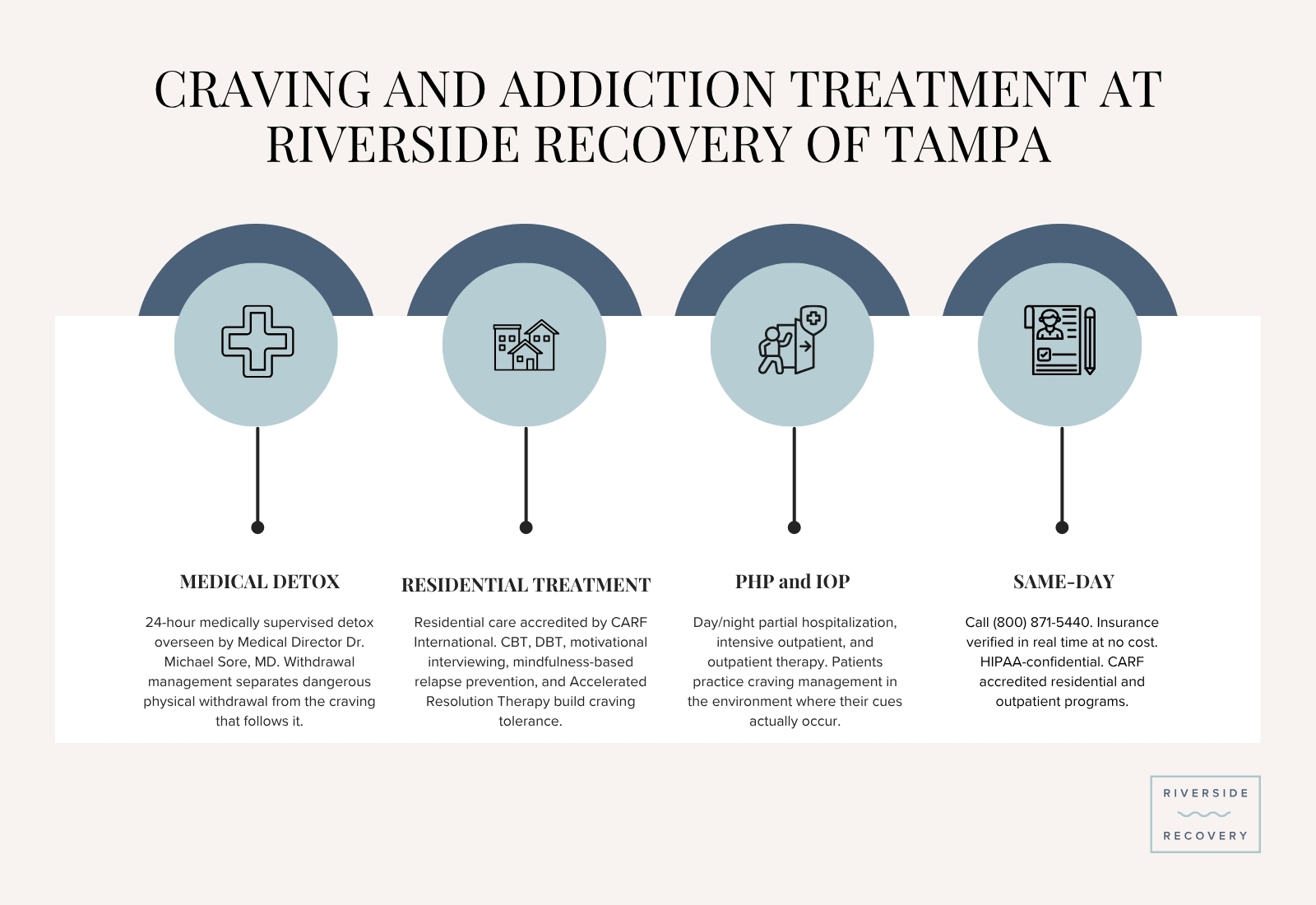
Riverside Recovery of Tampa treats craving across every level of care on a riverfront campus in Tampa, Florida, with a second location in New Port Richey.
Medical Detox
Medical detox provides onsite, medically supervised care with registered nurses on every shift during withdrawal, which separates dangerous physiological withdrawal from the craving that follows it.
Residential Treatment
Residential treatment removes access to established cues during the period when cravings recur most frequently. Clients live on the campus with structured programming and continuous clinical support.
Day and Night Treatment
Partial hospitalization delivers intensive daily programming while clients return home in the evening, which allows craving management to be practiced in the environment where cues occur.
Intensive Outpatient Program
The intensive outpatient program offers day and evening sessions so clients maintain work and family obligations while building craving tolerance.
Dual Diagnosis Treatment
Dual diagnosis treatment addresses co-occurring anxiety, depression and trauma alongside substance use, because untreated psychiatric symptoms reliably intensify craving.
Riverside Recovery’s clinical team applies cognitive behavioral therapy, dialectical behavior therapy, accelerated resolution therapy, motivational interviewing and contingency management across these programs.
Frequently Asked Questions
What does feening mean in slang?
Feening is slang for craving something intensely, most often a drug or alcohol. Outside substance use contexts, people use it loosely to describe wanting anything badly. Within recovery, the word signals an urge strong enough to override intention.
Is it fiending or feening?
Fiending is the standard English spelling, derived from the noun “fiend.” Feening is the phonetic variant and is now more common in writing online. Both refer to the same experience, and neither spelling changes the meaning.
What does it mean when someone is feening?
The person is experiencing a craving intense enough to dominate their attention and decision-making, and is describing urgency rather than preference. Treat the statement as a request for support, not as a confession.
What does feining mean?
Feining is another informal spelling of fiending and carries the same meaning of intense craving. It should not be confused with “feigning,” which means pretending. The similar spelling causes frequent confusion.
How long does a craving last?
A single craving rises, peaks and fades if a person does not act on it, and relapse-prevention practice uses 20 to 30 minutes as a rule of thumb. Cravings grow less frequent over months of abstinence, though isolated intense urges occur years later.
Can you feen for something that is not a drug?
Yes. People report feening for gambling, food, sex and screen use, because these behaviors engage the same dopamine reward pathway. The DSM-5-TR classifies gambling disorder as a behavioral addiction alongside the substance use disorders, though its nine criteria describe preoccupation, loss of control and restlessness on cutting down rather than craving specifically.
Does feening mean someone is addicted?
Not on its own. Craving is one of 11 DSM-5-TR criteria for substance use disorder, and a diagnosis requires at least 2 criteria within 12 months. Persistent cravings do warrant a clinical assessment.
Do cravings ever stop completely?
Cravings become far less frequent and less intense over months of abstinence, but occasional urges can continue long term. Ongoing skills practice and support reduce both their frequency and their power to drive use.
References
- American Psychiatric Association. (2022). Diagnostic and Statistical Manual of Mental Disorders (5th ed., text rev.). American Psychiatric Publishing.
- Robinson, T. E., & Berridge, K. C. (1993). The neural basis of drug craving: An incentive-sensitization theory of addiction. Brain Research Reviews, 18(3), 247-291.
- Saunders, B. T., Yager, L. M., & Robinson, T. E. (2013). Cue-evoked cocaine craving: Role of dopamine in the accumbens core. Journal of Neuroscience, 33(35), 13989-14000.
- Marlatt, G. A., & Donovan, D. M. (2005). Relapse Prevention: Maintenance Strategies in the Treatment of Addictive Behaviors (2nd ed.). Guilford Press.
- Flannery, B. A., Volpicelli, J. R., & Pettinati, H. M. (1999). Psychometric properties of the Penn Alcohol Craving Scale. Alcoholism: Clinical and Experimental Research, 23(8), 1289-1295.
- National Institute on Drug Abuse (NIDA). (2020). Drugs, Brains, and Behavior: The Science of Addiction. https://nida.nih.gov/research-topics/addiction-science/drugs-brain-behavior-science-of-addiction
- Substance Abuse and Mental Health Services Administration. (2021). Treatment Improvement Protocol 63: Medications for Opioid Use Disorder. https://store.samhsa.gov/product/TIP-63-Medications-for-Opioid-Use-Disorder-Full-Document/PEP21-02-01-002
- Berridge, K. C., & Robinson, T. E. (2016). Liking, wanting, and the incentive-sensitization theory of addiction. American Psychologist, 71(8), 670-679.
- Sinha, R. (2008). Chronic stress, drug use, and vulnerability to addiction. Annals of the New York Academy of Sciences, 1141(1), 105-130.
- Parvaz, M. A., Moeller, S. J., & Goldstein, R. Z. (2016). Incubation of cue-induced craving in adults addicted to cocaine measured by electroencephalography. JAMA Psychiatry, 73(11), 1127-1134.
- Bowen, S., Chawla, N., & Marlatt, G. A. (2021). Mindfulness-Based Relapse Prevention for Addictive Behaviors (2nd ed.). Guilford Press.