
Wet brain is the informal name for Wernicke-Korsakoff syndrome, a brain disorder caused by severe thiamine deficiency that long-term heavy drinking produces through four separate pathways. It arrives in two stages: Wernicke encephalopathy, an acute emergency that responds to fast thiamine treatment, and Korsakoff syndrome, the lasting memory damage that follows it. Recognizing the first stage is what changes the outcome, because the window for reversal is measured in hours.
Key Takeaways
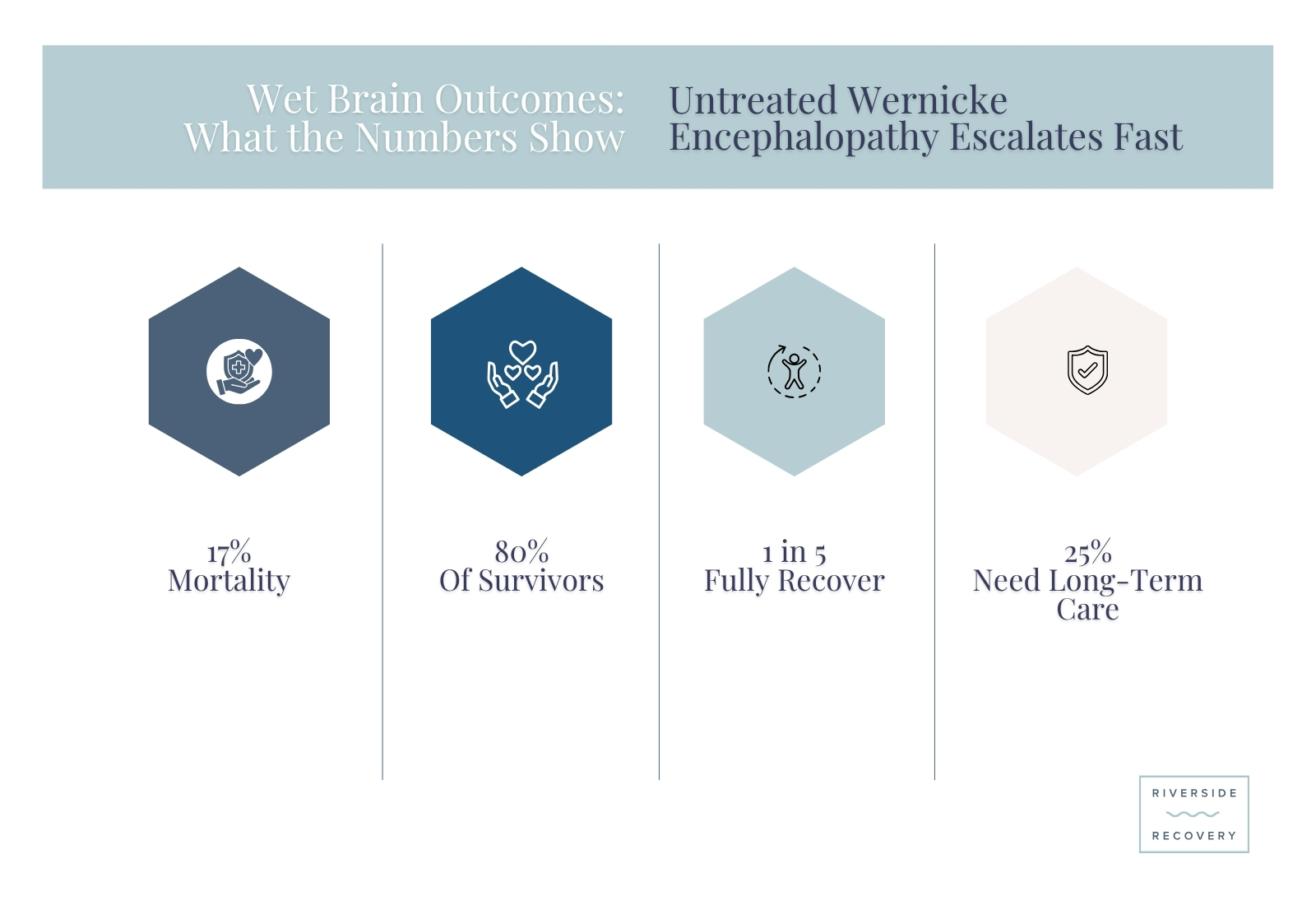
- Wernicke encephalopathy carries an estimated 17% mortality rate, StatPearls reports, and 80% of those who survive go on to develop Korsakoff syndrome.
- The classic triad is present in only a minority of patients, StatPearls reports, and only about 20% of cases are recognized before death.
- Thiamine deficiency injures the mammillary bodies and the medial thalamus, the circuit the brain uses to convert experience into stored memory.
- Intravenous thiamine precedes glucose in every emergency protocol, because glucose given first consumes the remaining thiamine and worsens the injury.
- Riverside Recovery of Tampa accepts medically complex alcohol admissions, including liver transplant referrals, with no blood alcohol cutoff.
What Is Wet Brain?
Wet brain is Wernicke-Korsakoff syndrome, a neurological disorder produced by thiamine deficiency, most often from long-term heavy drinking. It combines two conditions: Wernicke encephalopathy, an acute medical emergency, and Korsakoff syndrome, a lasting memory disorder that follows it.
Clinicians do not use the term wet brain. The nickname predates modern understanding of the condition and refers to the association with heavy drinking rather than to anything anatomical. Wernicke-Korsakoff syndrome is the diagnostic name, and thiamine deficiency is the mechanism.
Thiamine, also called vitamin B1, converts to thiamine pyrophosphate, the active form brain cells use to metabolize glucose. Brain tissue holds no meaningful thiamine reserve. StatPearls reports thiamine reserves are likely depleted within 2 weeks of limited intake, which is why the acute stage arrives over days after years of drinking.
That deficiency does not develop from one cause, and understanding the four pathways explains why the condition resists a single fix.
How Does Thiamine Deficiency Cause Wet Brain?
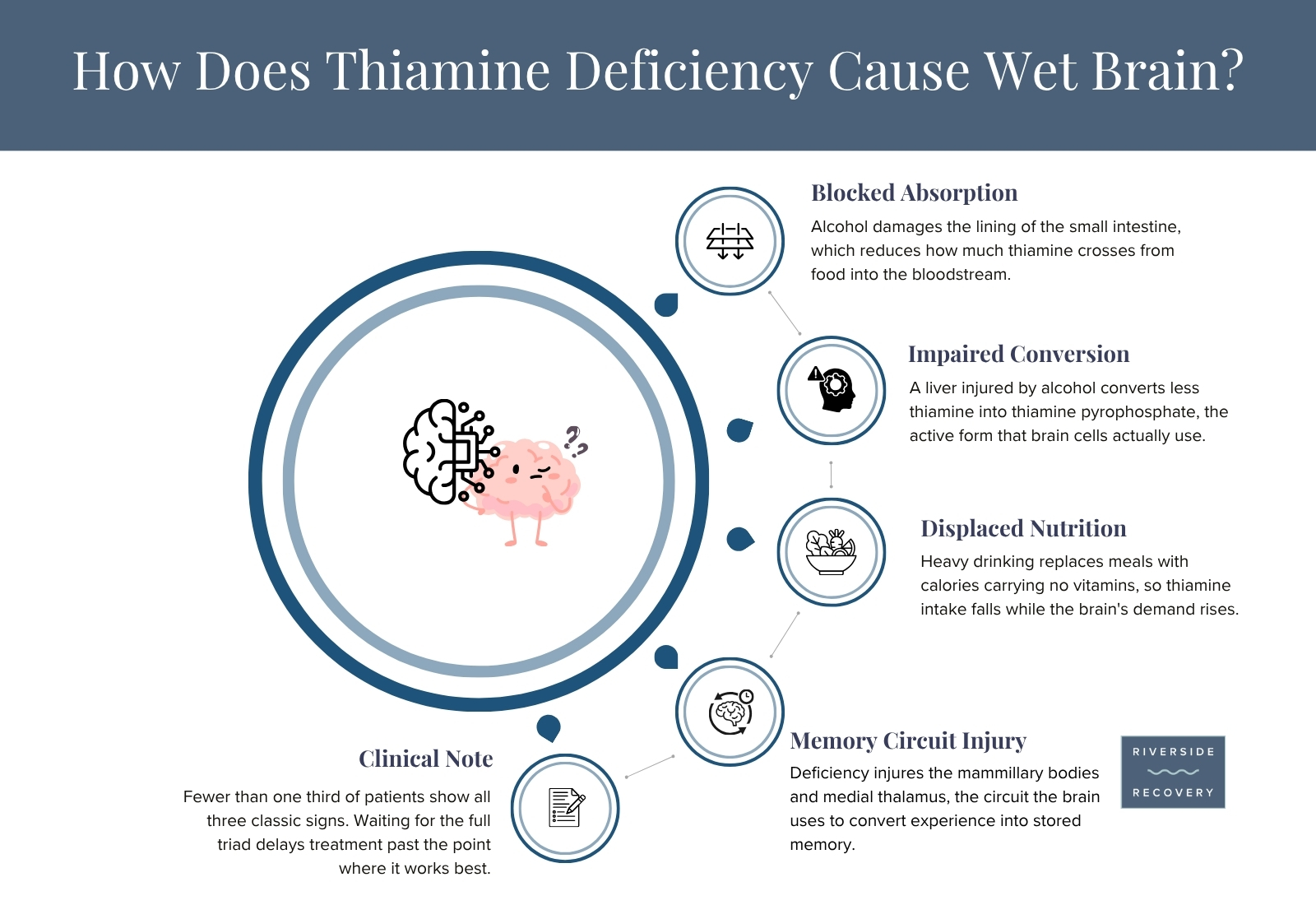
Alcohol produces thiamine deficiency through four separate pathways: it displaces food intake, blocks absorption in the small intestine, impairs conversion to the active form in an injured liver, and raises the brain’s thiamine demand while supply falls.
Displaced nutrition and blocked absorption
Heavy drinking replaces meals with calories carrying no vitamins, so thiamine intake falls. Alcohol then damages the lining of the small intestine, which reduces how much of the remaining thiamine crosses from food into the bloodstream. Intake and uptake fail together.
Impaired conversion and the injured memory circuit
A liver injured by alcohol converts less thiamine into thiamine pyrophosphate, so even absorbed thiamine reaches the brain in a form cells cannot use. The deficiency then injures the mammillary bodies and the medial thalamus. Those structures form the circuit that converts experience into stored memory, which is why memory rather than intelligence is what fails. Readers tracking the wider neurological picture can review the science on alcohol and brain cells.
Damage to that circuit produces a symptom set that changes sharply between the two stages.
What Are the Symptoms of Wet Brain?
Wet brain symptoms fall into two stages. Wernicke encephalopathy produces confusion, eye movement abnormalities and unsteady gait. Korsakoff syndrome produces severe memory loss with confabulation, where a person fills memory gaps with invented detail they believe is true.
What are the first signs of wet brain?
Appetite loss, mild unsteadiness and word-finding difficulty appear before the emergency stage. New confusion in a person who drinks heavily is the sign that requires immediate assessment. These early signs are easy to attribute to intoxication, which is the reason the diagnosis gets missed.
What are the emergency symptoms?
Wernicke encephalopathy classically presents with three findings: confusion, ophthalmoplegia (paralysis of the eye muscles, producing double vision or abnormal eye movement), and ataxia (loss of coordinated gait). StatPearls reports the classic triad is present in only a minority of patients, and only about 20% of cases are recognized before death. Any one of the three in a person who drinks heavily is grounds for emergency thiamine. The Caine criteria, established in 1997, are 85% sensitive when two or more of those features are present.
What does Korsakoff syndrome look like?
Korsakoff syndrome produces anterograde amnesia, the inability to form new memories, alongside retrograde memory loss. Confabulation is the distinguishing feature: the person produces detailed accounts of events that did not occur, without any intent to deceive. Long-term personality and reasoning remain comparatively intact, which distinguishes it from broader dementias.
How does wet brain change behavior?
Apathy is the behavioral change families report most often. The person stops initiating conversation, loses interest in activities they valued, and appears emotionally flat. Confabulation compounds it, because relatives hear confident accounts of events that never happened and read them as lying rather than as a symptom. Irritability and resistance to correction follow from the same memory failure.
What are the final stages of wet brain?
Advanced Korsakoff syndrome produces profound anterograde amnesia with dense disorientation to time and place, and the person requires supervision for daily activities. Continued drinking accelerates that trajectory, while sustained abstinence with thiamine repletion holds a proportion of patients stable for years.
How fast those symptoms appear depends on how depleted thiamine stores already are.
How Long Does It Take to Develop Wet Brain?
Thiamine reserves are likely depleted within 2 weeks of limited intake, StatPearls reports, and alcohol blocks absorption on top of that. Years of heavy drinking typically precede Wernicke-Korsakoff syndrome, but the acute Wernicke stage develops over days once stores run out.
That timeline explains a pattern clinicians see during detox. A person stops eating, continues drinking, and the deficiency crosses the threshold inside two weeks. It also explains why the condition appears outside alcohol entirely: hyperemesis gravidarum, bariatric surgery, prolonged vomiting and severe malnutrition each produce the same deficiency by a different route.
Whether the damage reverses depends almost entirely on which stage treatment reaches.
Is Wet Brain Reversible?
Wernicke encephalopathy reverses in many cases when intravenous thiamine is given fast. Korsakoff syndrome frequently does not. StatPearls reports that among those who survive Wernicke encephalopathy, 80% go on to develop Korsakoff syndrome.
Thiamine stops further injury once Korsakoff memory damage is established rather than undoing it. The variable that moves the outcome is how many hours pass between the first confusion and the first thiamine dose.
Abstinence changes the trajectory independently. Continued drinking sustains the deficiency and adds the wider long-term effects of alcohol on top of the existing injury.
What is the life expectancy with wet brain?
Life expectancy depends on how early thiamine reaches the patient and whether the drinking stops. Untreated Wernicke encephalopathy carries an estimated 17% mortality. Patients who receive fast treatment and sustain abstinence frequently live for decades with residual memory impairment rather than a shortened lifespan. A prognosis for any individual comes from their treating physician.
How Is Wet Brain Treated?
Wet brain treatment begins with high-dose intravenous thiamine, given before any glucose. Glucose administered first consumes the remaining thiamine to metabolize it, deepening the deficiency and worsening the neurological injury. Magnesium repletion follows, because thiamine cannot function without it.
Why thiamine precedes glucose
This sequence is the single most important detail in emergency management. A person found confused receives glucose routinely. In suspected Wernicke encephalopathy that order causes harm, and the protocol reverses it. Magnesium acts as a cofactor for the enzymes thiamine drives, so an untreated magnesium deficiency makes thiamine repletion fail.
What happens after the acute stage
Stabilization is followed by medically supervised withdrawal management, because continued drinking sustains the deficiency. Alcohol withdrawal carries its own risks of seizure and delirium, and it is managed separately from the thiamine repletion. Nutritional rehabilitation, cognitive assessment and treatment for alcohol use disorder follow once the acute danger passes.
Distinguishing this condition from broader alcohol-related cognitive decline determines which of those treatments applies.
How Is Wet Brain Different From Alcohol-Related Dementia?
Wet brain describes Wernicke-Korsakoff syndrome, which stems specifically from thiamine deficiency and injures the mammillary bodies and thalamus. Alcohol-related dementia is a broader diagnosis covering wider cognitive decline from long-term drinking, with different anatomy and a different treatment response.
The practical difference is reversibility. Wernicke-Korsakoff syndrome has a specific, fast, cheap treatment in thiamine, and the acute stage responds to it. Alcohol-related dementia has no equivalent single intervention. Memory dominates in Korsakoff syndrome while executive function and judgment dominate in alcohol-related dementia.
Both conditions require the same first step, which is stopping the drinking under medical supervision.
Where Can You Get Treatment for Wet Brain in Tampa?
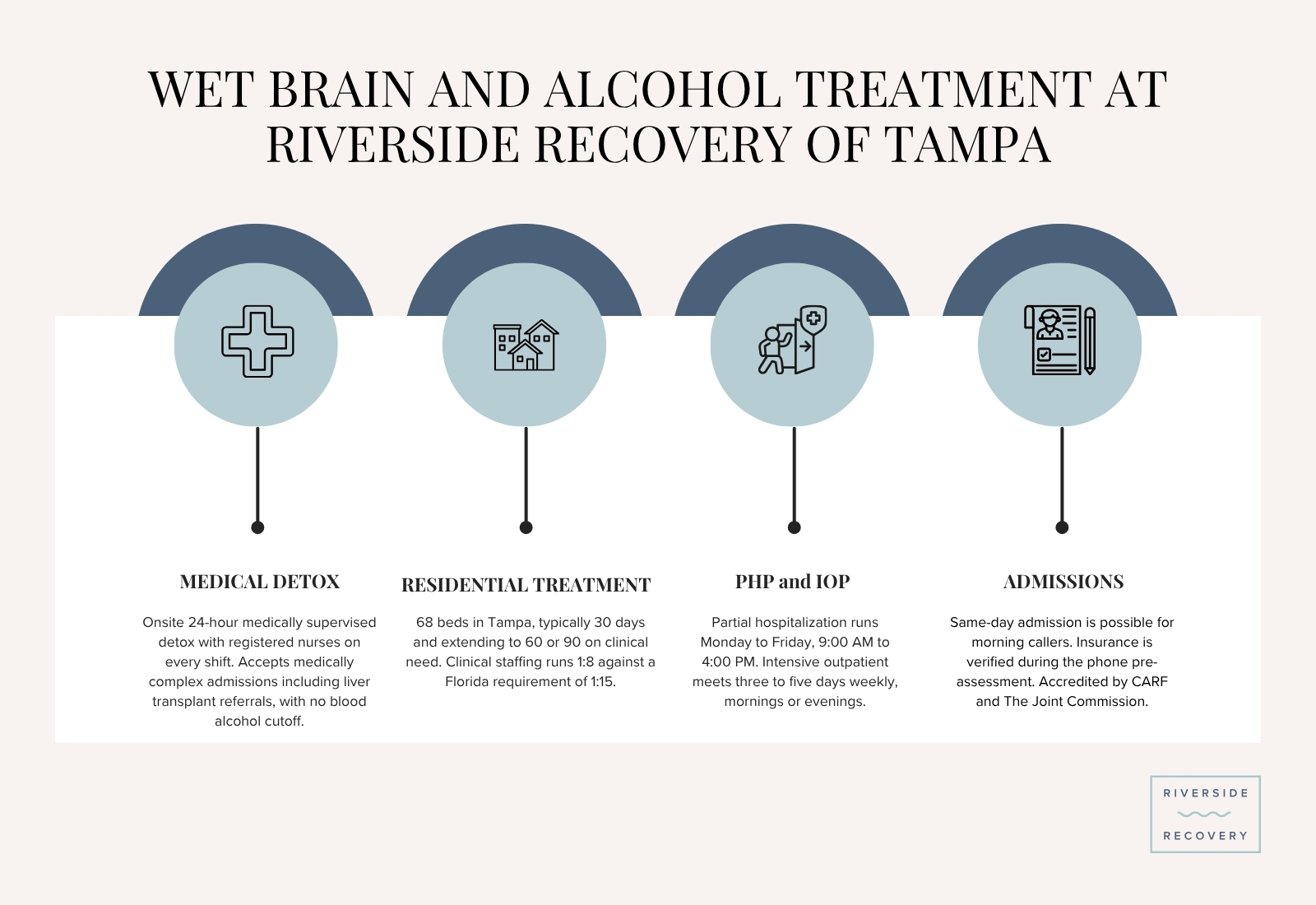
Riverside Recovery of Tampa provides 24-hour medically supervised detox with registered nurses on every shift, and accepts medically complex alcohol admissions including liver transplant referrals with no blood alcohol cutoff. Medical Director Dr. Michael Sore, MD is certified in addiction medicine.
Thiamine deficiency rarely arrives alone. Patients presenting with cognitive symptoms after long-term drinking frequently carry liver disease, malnutrition and electrolyte disturbance at the same time, which is why the detox unit carries gastrointestinal specialization and registered nurse coverage on every shift.
Residential treatment runs 68 beds in Tampa, typically 30 days and extending to 60 or 90 on clinical need, with clinical staffing at 1:8 against a Florida requirement of 1:15. The clinical team includes five medical providers and a sixteen-member clinical staff. The facility is accredited by CARF and The Joint Commission.
Anyone showing new confusion after heavy drinking needs emergency assessment today rather than an admission call. For everyone past that acute stage, a phone pre-assessment establishes the level of care and verifies insurance before arrival, and same-day admission is possible for morning callers.
“I do not wait for all three signs, because most patients never show all three. New confusion in someone who drinks heavily is enough for me to start thiamine that hour. What matters just as much is that we do not have to send that patient out to do it. There is no automatic hospital referral here for medical clearance, and the detox unit carries GI specialization, so the assessment and the treatment happen in the same place on the same day.”
Dr. Michael Sore, MD, Medical Director, Riverside Recovery of Tampa
Frequently Asked Questions
Why is it called wet brain?
The nickname is informal and predates modern understanding of the condition. It refers to the association with heavy drinking rather than to anything anatomical. Clinicians use Wernicke-Korsakoff syndrome instead.
Can wet brain happen without alcohol?
Yes. Any condition causing severe thiamine deficiency produces it, including hyperemesis gravidarum, bariatric surgery, prolonged vomiting and severe malnutrition. Alcohol is the most common cause rather than the only one.
Does thiamine reverse the damage?
Thiamine reverses acute Wernicke encephalopathy in many cases and prevents progression to Korsakoff syndrome. Once Korsakoff memory damage is established, thiamine stops further injury rather than undoing it.
Is wet brain a form of dementia?
Korsakoff syndrome is classified as a major neurocognitive disorder, which places it in the dementia family. Its cause, anatomy and treatment response separate it from Alzheimer disease and from alcohol-related dementia.
How long does treatment at Riverside Recovery of Tampa last?
Residential treatment typically runs 30 days and extends to 60 or 90 days on clinical need. The clinical and medical teams set the level of care together after a biopsychosocial assessment scheduled within the first 24 hours.
Is treatment covered by insurance?
Insurance is verified during the phone pre-assessment before arrival. The facility is accredited by CARF and The Joint Commission, and same-day admission is possible for morning callers.
Does Riverside Recovery of Tampa accept medically complex admissions?
Yes. The Tampa program accepts liver transplant referrals and patients requiring hepatitis treatment, with gastrointestinal specialization on the detox unit and no blood alcohol cutoff at admission.