


Quaaludes are the brand name for methaqualone, a synthetic sedative-hypnotic drug.
They were widely prescribed in the 1960s and 1970s before being classified as a DEA Schedule I controlled substance in 1984 and removed from legal pharmaceutical production entirely. They are no longer manufactured legally anywhere in the United States.
Methaqualone’s pharmacological profile produced intense sedation, euphoria, and disinhibition, making it popular as a recreational drug and frequently associated with sexual assault cases during its period of legal availability. Its high abuse potential, narrow therapeutic index, and documented harm led to a complete ban.
Understanding what Quaaludes were, how they worked, and why they disappeared matters because methaqualone analogs and counterfeit sedatives continue to circulate in illicit drug markets, and the neurobiological harms of GABA-A receptor sedative misuse remain clinically relevant today.
Key Takeaways
- Methaqualone (Quaaludes) was classified as a DEA Schedule I controlled substance in 1984, meaning it has no currently accepted medical use and a high potential for abuse.
- Methaqualone acts as a central nervous system depressant through GABA-A receptor potentiation, producing effects similar to barbiturates and benzodiazepines with a higher overdose risk and narrower therapeutic index.
- Quaaludes were a widely misused recreational drug from the 1960s to the 1980s; the United States placed methaqualone under Schedule II control in October 1973 and moved it to Schedule I in August 1984.
- In South Africa and parts of Africa, methaqualone is still manufactured illicitly under the name “mandrax” and combined with cannabis in a drug called “white pipe,” making it an ongoing public health concern internationally.
- Sedative-hypnotic use disorder, which includes patterns of abuse consistent with historical Quaalude misuse, responds to evidence-based treatment including medically supervised detoxification, medication-assisted treatment, and dual diagnosis programming.
What Are Quaaludes?
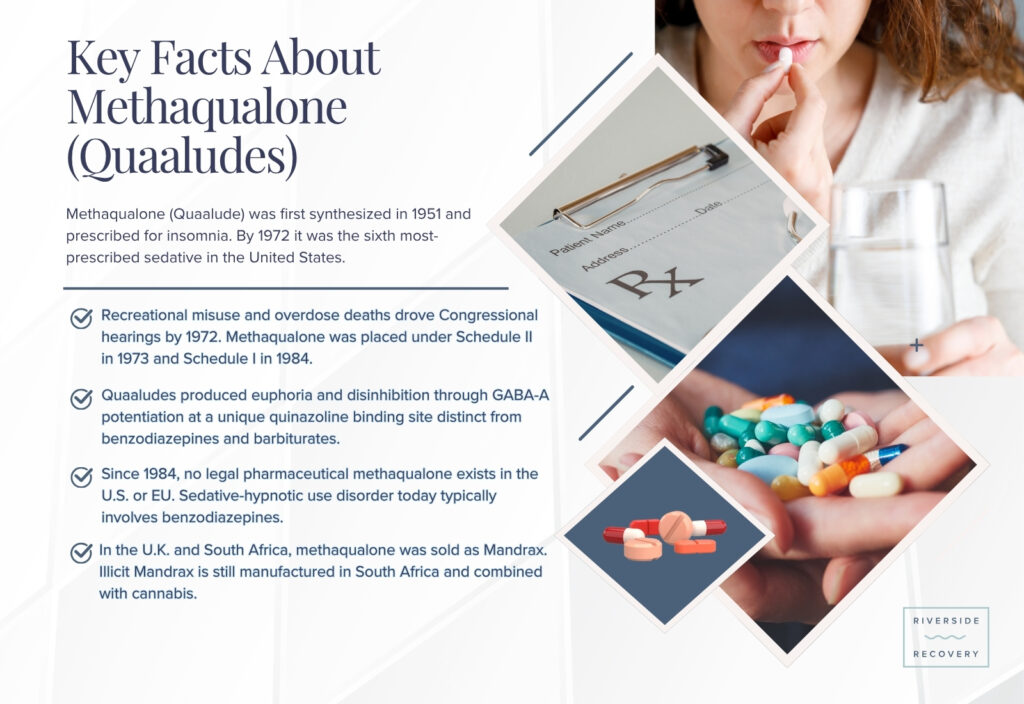
Quaaludes are a discontinued brand name for methaqualone, a synthetic central nervous system depressant that was initially developed as a safer alternative to barbiturates and ultimately banned due to severe abuse potential, dependence liability, and overdose risk.
Methaqualone: Chemical Classification and Origin
Methaqualone (2-methyl-3-(2-methylphenyl)-4(3H)-quinazolinone) was first synthesized by Indian researchers in 1951 and later sold as a prescription sedative-hypnotic. It was marketed under different brand names, including Quaalude in the United States and Mandrax in the United Kingdom.
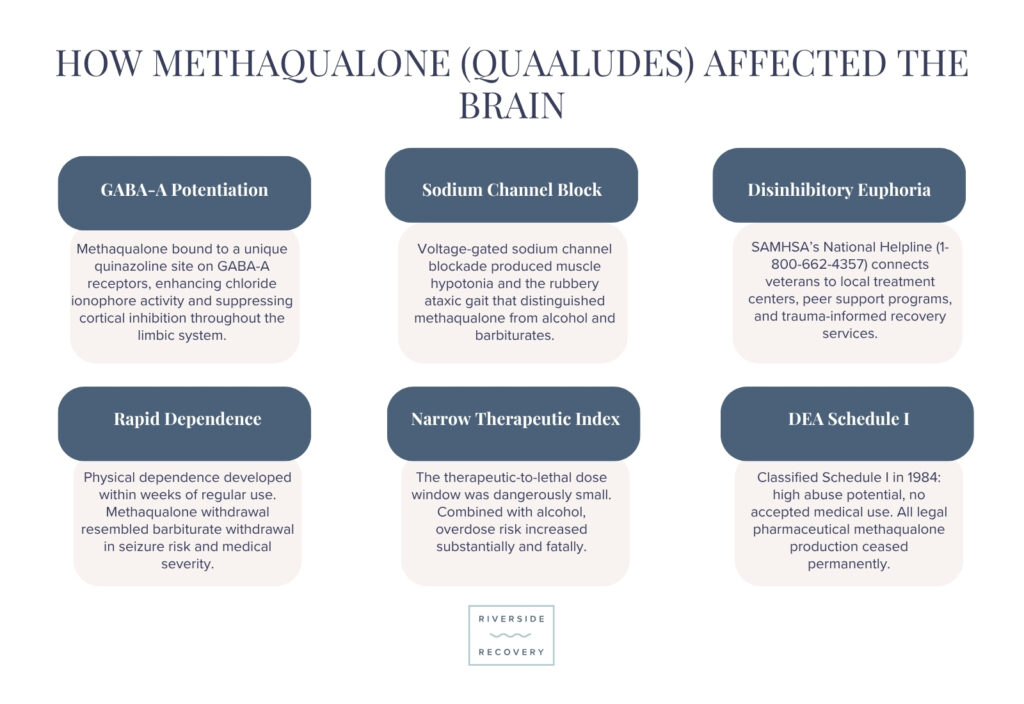
The drug was initially promoted as non-addictive and safer than barbiturates for treating insomnia and anxiety. Both claims proved incorrect. Methaqualone produces physical dependence with regular use, and its narrow therapeutic index made the difference between a therapeutic and a lethal dose dangerously small in the presence of alcohol or other CNS depressants.
Why Quaaludes Were Popular in the 1960s and 1970s
Quaaludes became one of the most widely misused recreational drugs of the 1970s due to their combination of euphoria, disinhibition, and the sensation users called “luding out,” a state of profound relaxation and disconnection from normal social inhibitions.
The drug’s street reputation as a social and sexual disinhibitor drove widespread misuse in party and club settings. Physicians initially prescribed methaqualone liberally for insomnia and anxiety before its abuse pattern became clinically recognized.
How Methaqualone (Quaaludes) Worked in the Brain
Methaqualone produces central nervous system depression through GABA-A receptor positive allosteric modulation combined with voltage-gated sodium channel and calcium channel inhibition, producing a pharmacological profile that overlaps with barbiturates but includes unique quinazoline-specific receptor effects.
GABA-A Receptor Potentiation Mechanism
Methaqualone binds to a distinct site on the GABA-A receptor complex, potentiating chloride ionophore activity and enhancing GABA-mediated inhibitory neurotransmission throughout the limbic system, cerebral cortex, and brainstem. This mechanism is structurally similar to barbiturate and benzodiazepine binding, but the methaqualone binding site differs pharmacologically from the benzodiazepine allosteric site.
GABA-A potentiation by methaqualone produces dose-dependent sedation, muscle relaxation, and anticonvulsant effects. At recreational doses, the suppression of cortical inhibitory circuits generates a disinhibited, euphoric state that users describe as more intense and more specifically pleasurable than alcohol or benzodiazepines. This disinhibitory euphoria profile is what drove its abuse potential.
Methaqualone vs. Barbiturates and Benzodiazepines
Methaqualone shares the GABA-A potentiation mechanism with barbiturates but differs in its binding site specificity and its additional sodium channel blocking properties.
| Feature | Methaqualone | Barbiturates | Benzodiazepines |
|---|---|---|---|
| Mechanism | GABA-A positive allosteric modulation + Na+ channel block | GABA-A positive allosteric modulation | GABA-A positive allosteric modulation (BZD site) |
| Binding site | Unique quinazoline site | Barbiturate site | Benzodiazepine site |
| Therapeutic index | Narrow | Very narrow | Wide |
| Overdose risk | High | Very high | Low (alone) |
| Euphoria profile | High (disinhibitory) | Moderate | Low to moderate |
| Physical dependence | Rapid | Rapid | Rapid |
| DEA Schedule | Schedule I | II–IV (varies) | IV |
Effects of Quaaludes: What Methaqualone Produced
Methaqualone produces a distinct progression of CNS depression effects that begin with disinhibitory euphoria and escalate to respiratory depression at overdose doses, with the therapeutic-to-lethal window narrowed further by concurrent alcohol use.
Common Effects at Recreational Doses
Effects of methaqualone at typical recreational doses include:
- Euphoria and disinhibition: GABA-A potentiation in the limbic system suppresses prefrontal cortical inhibition, producing a state of social and emotional disinhibition distinct from alcohol’s broader CNS depressant effect.
- Muscle relaxation and ataxia: Sodium channel blockade and GABA-A potentiation in the motor cortex and cerebellum produce muscle hypotonia, impaired coordination, and the characteristic “rubbery” gait associated with methaqualone intoxication.
- Sedation: Progressive dose-dependent CNS depression produces drowsiness transitioning to deep sedation at higher doses.
- Anterograde amnesia: Hippocampal GABA-A receptor potentiation impairs memory consolidation during intoxication, producing significant gaps in event memory consistent with the drug’s documented association with drug-facilitated sexual assault.
- Heightened sensory perception: Users historically reported paradoxical hypersensitivity to touch and sound during the early disinhibitory phase, a phenomenon attributed to differential GABA-A receptor subtype distribution across sensory processing cortices.
Severe Effects, Overdose, and Emergency Signs
Methaqualone overdose is a medical emergency requiring immediate intervention:
- Respiratory depression: GABA-A potentiation in the medullary respiratory centers reduces respiratory drive below the threshold required to maintain adequate blood oxygen saturation.
- Cardiovascular collapse: Direct myocardial depression and peripheral vasodilation produce hypotension, tachycardia, and potential cardiac arrest at supratoxic doses.
- Coma: Profound brainstem GABA-A receptor activation produces coma in overdose, and alcohol deepens it.
- Hyperreflexia and convulsions: Paradoxical neuroexcitatory effects occur at certain dose ranges due to differential GABA-A subunit effects, producing myoclonus and seizure activity.
- Vomiting with aspiration risk: Sedation combined with vomiting creates a high risk of aspiration pneumonia, historically a major contributor to methaqualone overdose mortality.
Long-Term Effects of Methaqualone Use
Long-term methaqualone use produced neurobiological and systemic damage including:
- GABA-A receptor downregulation: Sustained GABA-A potentiation triggers receptor internalization and reduced subunit expression, producing escalating tolerance and a withdrawal syndrome characterized by hyperexcitability, seizures, and autonomic instability.
- Severe physical dependence: Methaqualone withdrawal syndrome resembles barbiturate withdrawal in severity and seizure risk, making abrupt cessation medically dangerous without supervised tapering.
- Cognitive and memory impairment: Chronic hippocampal GABA-A receptor modulation produces lasting memory consolidation deficits that may persist beyond the acute withdrawal period.
Why Were Quaaludes Banned?
Methaqualone’s removal from legal pharmaceutical production resulted from a convergence of documented abuse patterns, overdose mortality data, and federal scheduling actions that incrementally restricted and ultimately eliminated legal access.
Timeline of the Quaalude Ban
The regulatory history of methaqualone in the United States followed this sequence:
- 1960s: Methaqualone is sold in the U.S. under the brand name Quaalude as a prescription sedative-hypnotic for insomnia.
- October 1973: Methaqualone placed under DEA Schedule II control, restricting prescribing and requiring controlled substance tracking.
- August 1984: DEA reclassifies methaqualone to Schedule I, the most restrictive classification, citing high abuse potential, no accepted medical use, and lack of accepted safety for use under medical supervision. Legal prescribing of Quaaludes in the United States ends.
- Present: Methaqualone, sold illegally as Mandrax, remains a common drug of misuse in South Africa, and illegal labs make related compounds such as mebroqualone and methylmethaqualone.
What Drug Was Called Mother’s Little Helper?
“Mother’s Little Helper” is a 1966 Rolling Stones song about a pill that busy mothers took to get through the day. The song does not name the drug, but it is widely understood to refer to diazepam (Valium), a benzodiazepine, not methaqualone. Both drugs later faced scrutiny over recreational misuse and overprescribing.
Are Quaaludes Still Made Today?
Quaaludes are no longer made or prescribed legally in the United States. The DEA moved methaqualone, the drug in Quaaludes, to Schedule I on August 27, 1984, which ended its legal medical use, so no pharmacy can fill a Quaalude prescription today.
Methaqualone still circulates illegally. Sold as Mandrax, it remains a common drug of misuse in South Africa, and illegal labs make related compounds such as mebroqualone and methylmethaqualone, according to a 2024 study in Nature Communications. A pill sold as a “Quaalude” today comes from an illegal source, so its contents and strength are unknown.
Treatment for Sedative-Hypnotic Use Disorder at Riverside Recovery of Tampa
Riverside Recovery of Tampa provides medically supervised detoxification and evidence-based treatment for sedative-hypnotic use disorder, benzodiazepine dependence, and co-occurring substance use disorders across a full clinical continuum. Same-day assessments are available.
Medical Detox and Residential Treatment
Sedative-hypnotic withdrawal carries seizure risk comparable to alcohol withdrawal. Riverside Recovery’s residential addiction treatment program includes 24-hour medical supervision, medically supervised benzodiazepine tapering, and continuous neurological monitoring for clients detoxifying from benzodiazepines or other sedative-hypnotic substances.
Medication-Assisted Treatment
Medication-assisted treatment at Riverside Recovery addresses the neurobiological dependence mechanisms of sedative-hypnotic use disorder, including medically supervised benzodiazepine tapering for clients with complex polysubstance presentations.
Dual Diagnosis Treatment
Sedative-hypnotic use disorder frequently co-occurs with anxiety disorders, major depressive disorder, and PTSD. Riverside Recovery’s dual diagnosis treatment addresses both the substance use disorder and the co-occurring psychiatric conditions that drive it, within an integrated clinical plan.
Addiction Therapy Programs
Riverside Recovery’s addiction therapy programs apply CBT and DBT to the cognitive distortions and avoidant behavioral patterns that sustain sedative-hypnotic misuse, with trauma-focused modalities available for clients whose sedative use disorder co-occurs with PTSD.
Frequently Asked Questions
What Type of Drug Is a Quaalude?
Quaalude is the brand name for methaqualone, a synthetic sedative-hypnotic classified as a DEA Schedule I controlled substance since 1984. Methaqualone acts as a central nervous system depressant through GABA-A receptor positive allosteric modulation, producing sedation, euphoria, and muscle relaxation comparable to barbiturates but with a narrower therapeutic index and higher abuse potential.
Is a Quaalude the Same as Xanax?
No, a Quaalude is not the same as Xanax. Methaqualone, the drug in Quaaludes, and alprazolam (Xanax), a benzodiazepine, both increase GABA-A receptor activity, but methaqualone binds to a different site on the receptor than benzodiazepines do, according to a 2015 study in Molecular Pharmacology. Xanax is a Schedule IV prescription medication, while methaqualone is a Schedule I drug with no accepted medical use.
What Are Quaaludes Called in the UK?
In the United Kingdom, methaqualone was sold under the brand name Mandrax, and British doctors prescribed it as a sleeping tablet in the 1960s and 1970s. Illicit Mandrax continues to be made and sold in South Africa.
Why Did People Like Quaaludes So Much?
Methaqualone produced a specific combination of disinhibitory euphoria, heightened tactile sensory perception, and social relaxation that users described as more pleasurable than alcohol or benzodiazepines. GABA-A receptor potentiation in the limbic system suppressed cortical inhibition while producing less sedation at lower doses compared to barbiturates, creating a window of alert disinhibition that drove recreational appeal before CNS depression dominated at higher doses.
What Drug Was Called Mother’s Little Helper?
“Mother’s Little Helper” is widely understood to refer to diazepam (Valium), a benzodiazepine, in the 1966 Rolling Stones song, not methaqualone. Both methaqualone and benzodiazepines became central to 1970s-era drug policy debates about sedative overprescribing.
References
- Drug Enforcement Administration. Drug scheduling. https://www.dea.gov/drug-information/drug-scheduling
- National Institute on Drug Abuse. Drugs A to Z. https://nida.nih.gov/research-topics/drugs-a-to-z
- American Psychiatric Association. (2022). Diagnostic and Statistical Manual of Mental Disorders, Fifth Edition, Text Revision (DSM-5-TR). American Psychiatric Publishing.
- Centers for Disease Control and Prevention. Overdose prevention. https://www.cdc.gov/drugoverdose/
- Inaba, D. S., & Cohen, W. E. (2014). Uppers, Downers, All Arounders: Physical and Mental Effects of Psychoactive Drugs (8th ed.). CNS Productions.
- Drug Enforcement Administration, Diversion Control Division. Scheduling actions, chronological order (methaqualone: 38 FR 27516, 1973; 49 FR 33870, 1984). https://deadiversion.usdoj.gov/schedules/orangebook/b_sched_chron.pdf
- Drug Enforcement Administration. Barbiturates drug fact sheet. https://campusdrugprevention.gov/sites/default/files/2024-12/Barbiturates-Drug-Fact-Sheet.pdf
- Hammer H, Bader BM, Ehnert C, et al. A multifaceted GABAA receptor modulator: functional properties and mechanism of action of the sedative-hypnotic and recreational drug methaqualone (Quaalude). Mol Pharmacol. 2015;88(2):401-420. doi: 10.1124/mol.115.099291.
- Chojnacka W, Teng J, Kim JJ, Jensen AA, Hibbs RE. Structural insights into GABAA receptor potentiation by Quaalude. Nat Commun. 2024;15:5244. doi: 10.1038/s41467-024-49471-y.
- Kacker IK, Zaheer SH. Potential analgesics. Part I. Synthesis of substituted 4-quinazolones. J Indian Chem Soc. 1951;28:344-346.
- Matthew H, Proudfoot AT, Brown SS, Smith AC. Mandrax poisoning: conservative management of 116 patients. Br Med J. 1968;2(5597):101-102. doi: 10.1136/bmj.2.5597.101.