


Depression that appears alongside heavy substance use presents two possibilities, and they look the same from the outside.
One is a mood disorder the substance produced. The other is a mood disorder that was already there. Telling them apart is not a matter of reading the symptoms more carefully, because the symptoms are identical. It is a matter of reconstructing a timeline and then waiting.
This article sets out how that distinction is actually made, how often each answer turns out to be correct, and why getting it wrong costs something in both directions.
Key Takeaways
- Substances can produce symptoms that are identical to those of a mental illness, so the distinction cannot be made from the presentation alone.
- SAMHSA states that a definitive diagnosis of an independent disorder may require treatment of the substance use disorder plus an abstinent period of weeks or months.
- Diagnoses made during active use are provisional by design and are meant to be reevaluated, not treated as settled.
- In a study of 242 treatment seekers with depression, 27.3 percent were substance-induced and 72.7 percent were independent.
- Independent depression scored higher on the Hamilton Depression Rating Scale than substance-induced depression, 16.2 against 10.4.
- Riverside Recovery of Tampa treats depression and bipolar disorder alongside a substance use disorder, and screens with the PHQ-9 and GAD-7 at intake.
What Makes a Mood Disorder Substance-Induced?
A substance-induced mood disorder is one the substance caused, which means the mood symptoms are expected to recede once the substance is gone and the acute withdrawal has passed. The category exists because substances do not merely worsen mood, they generate the full clinical picture.
SAMHSA puts the problem in unusually blunt terms in its treatment protocol for co-occurring disorders: “Licit and illicit drugs of misuse can cause symptoms that are identical to the symptoms of mental illness. Mental disorder diagnoses should be provisional and reevaluated constantly. Some mental disorders are really substance-induced mental disorders, meaning they are caused by substance use.”
Three words in that passage do the work. Identical, not similar. Provisional, not preliminary. And constantly reevaluated, which makes the diagnosis a process rather than a verdict.
The two presentations it takes
A substance-induced mood disorder imitates the mood disorder it resembles, and it appears in one of two forms:
- Depressive. Centered on depressed mood, or a markedly diminished interest or pleasure, matching the presentation of a depressive disorder.
- Manic or mixed. Centered on what the literature describes as “an elevated, expansive, or irritable mood”, matching a manic presentation.
How Do Clinicians Tell the Two Apart?
The distinction rests on sequence and behavior over time rather than on symptom severity, because both conditions can produce the same symptoms at the same intensity. Dakwar and colleagues, comparing the two in 242 treatment seekers, set out the specific inputs they used.
The three questions that decide it
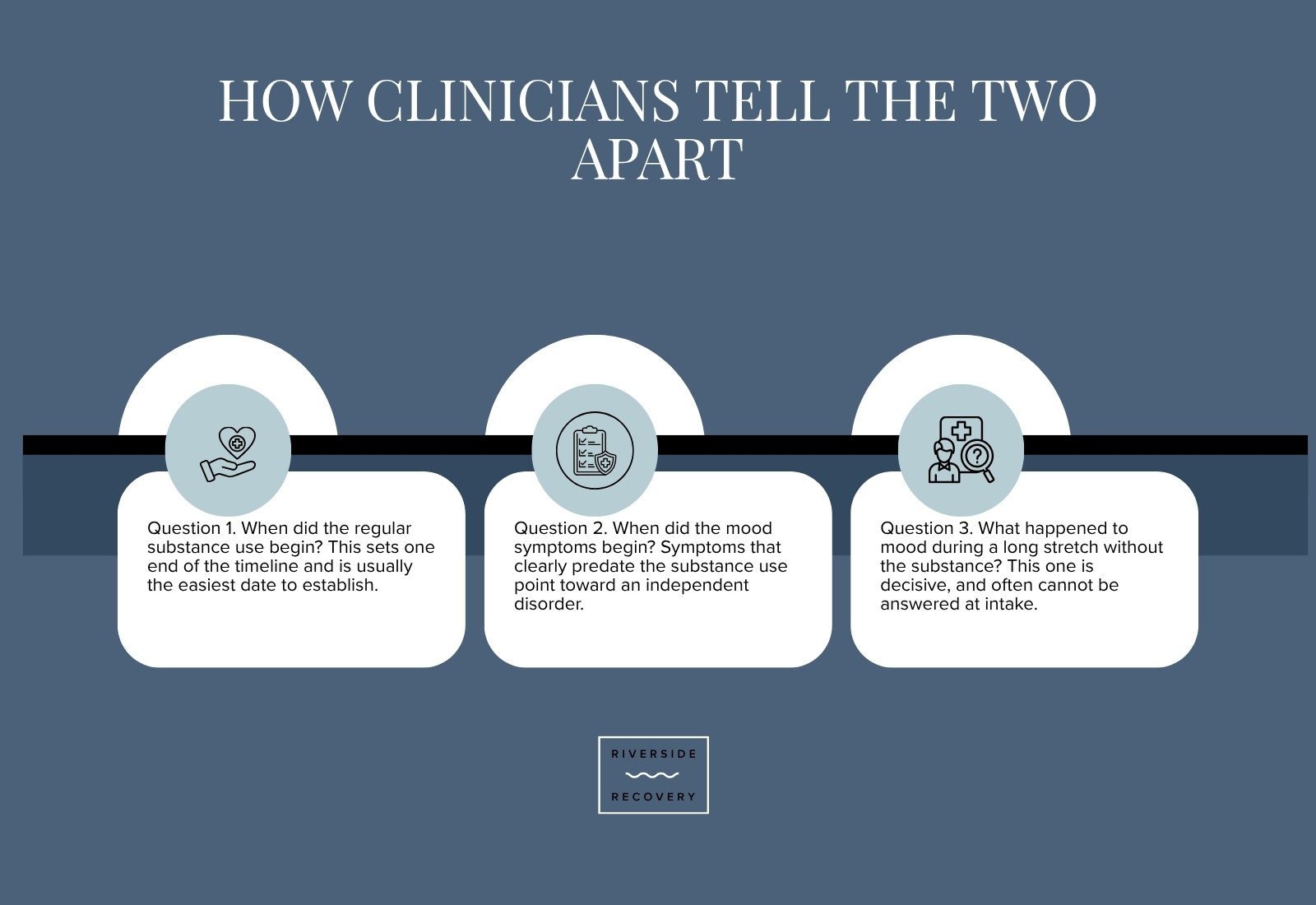
Their assessment turned on “first onset of regular substance use, first onset of mood disorder, and presence or absence of mood disorder during prolonged periods of abstinence.” Reframed as questions a clinician asks:
- When did the regular substance use begin? This establishes one end of the timeline.
- When did the mood symptoms begin? Symptoms that clearly predate the substance use point toward an independent disorder.
- What happened to the mood during any long stretch without the substance? This is the decisive one, because it is the only question that tests the hypothesis rather than reconstructing history.
The study defined an independent depression as one whose episodes “generally emerge outside the context of regular drug use, and that persist during periods of abstinence.” Persistence through abstinence is the signature.
Why the answer takes weeks or months
The third question is often unanswerable at intake, because many people arriving for treatment have not had a prolonged abstinent period to look back on. That is why the timescale is what it is.
SAMHSA states it directly: “Treatment of the SUD and an abstinent period of weeks or months may be required for a definitive diagnosis of an independent, co-occurring mental disorder.”
This is worth being plain about with anyone in the middle of it. A clinician who says the diagnosis is not yet settled after two weeks of abstinence is following the standard, not stalling.
How Often Is Depression Substance-Induced Rather Than Independent?
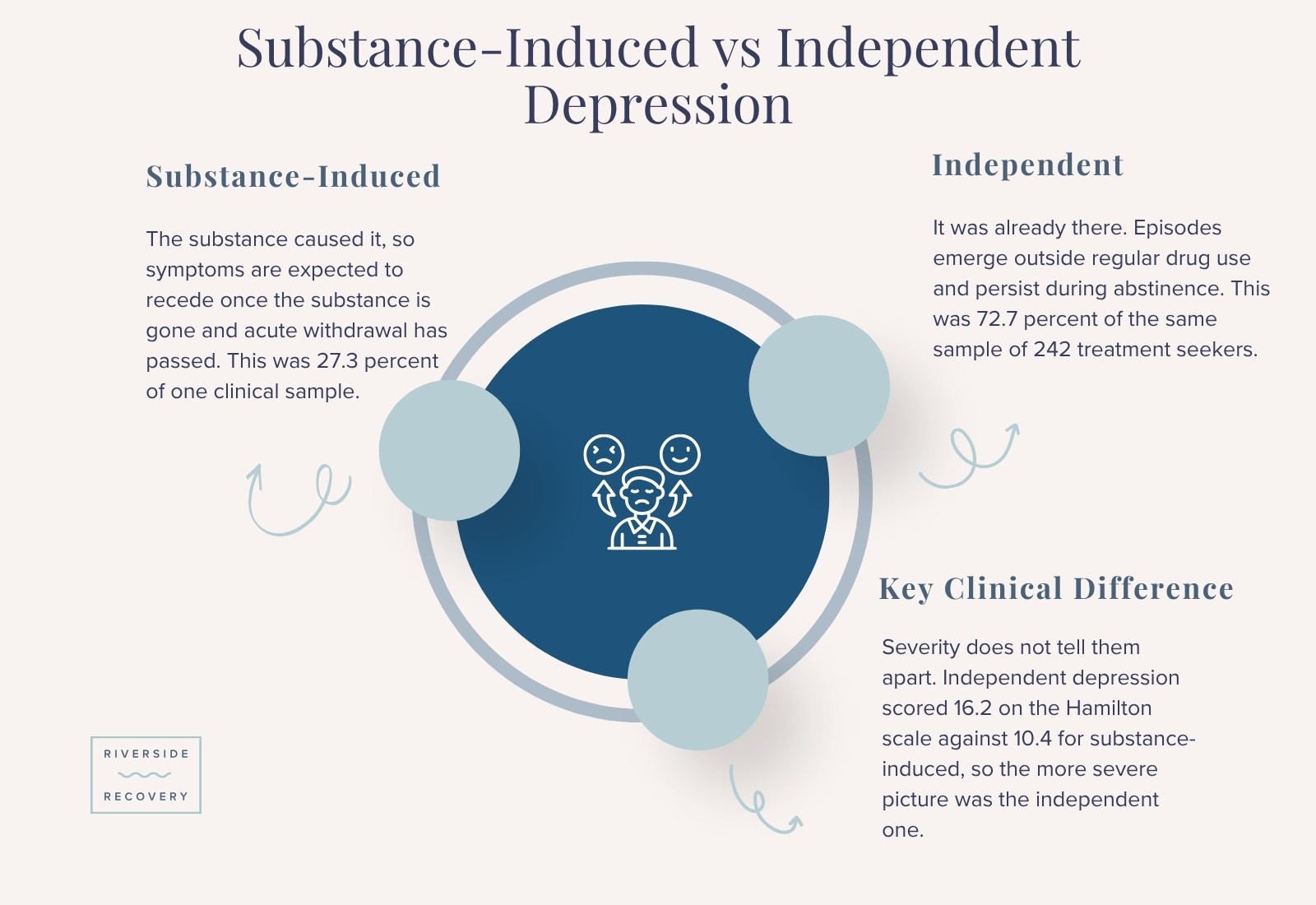
In a sample of 242 people seeking treatment for cannabis, cocaine or opioid dependence who also had depression, roughly one in four depressions was substance-induced and three in four was independent. The split was 66 individuals at 27.3 percent substance-induced against 176 at 72.7 percent independent.
That ratio runs against a common assumption. The intuitive expectation is that depression in someone using substances heavily is mostly the substances, and in this sample it mostly was not.
What differed between the two groups
The study found several differences, and the first is the one worth pausing on:
- Severity ran the other way. Independent depression scored 16.2 on the Hamilton Depression Rating Scale against 10.4 for substance-induced depression. The independent group was measurably more depressed.
- Gender split differed. Women made up 40.3 percent of the independent group and 24.2 percent of the substance-induced group.
- Co-occurring PTSD was more common in the independent group, at 12.5 percent against 5 percent.
The severity finding matters clinically. If a person’s depression is severe, that is not evidence that the substance is responsible. In this sample it was weak evidence of the opposite.
Which substance shifts the odds
The type of dependence was not neutral. Cannabis dependence “was highly associated with independent depression,” while cocaine dependence correlated with substance-induced depression.
That pattern is a prior rather than a rule. It shifts what a clinician expects before the timeline is reconstructed, and it does not replace reconstructing it.
Why Getting It Wrong Costs Something in Both Directions
Both misclassifications cause harm, which is why the question is treated as a decision point rather than a label applied at the end. SAMHSA describes the differentiation as “difficult to make but critically important, as it informs treatment decision making.”
Treating an independent disorder as substance-induced
If a genuinely independent depression is assumed to be the drugs, the plan becomes: get the person abstinent and the mood will follow. When it does not follow, the depression is left untreated through early recovery, at the point when the person has the least relief to show for the effort.
The person is then in the position of having done what was asked and still feeling no better, which is its own argument for returning to the substance.
Treating a substance-induced disorder as independent
The reverse error commits someone to long-term treatment for a condition that was going to resolve. That means a psychiatric medication maintained for a mood disorder that abstinence would have cleared, and a diagnosis carried on a record that does not describe them.
Neither error is obviously worse than the other, and that symmetry is the argument for provisional diagnosis. A provisional diagnosis can be revised in either direction. A confident one usually is not.
What Treatment Looks Like While the Question Is Still Open
Treatment does not wait for the diagnostic question to close, because the substance use disorder needs addressing regardless of which answer eventually arrives. Both possibilities share the same first step.
The abstinent period that produces the diagnosis is itself the treatment for one of the two possibilities. So the sequence is not diagnose then treat, it is treat, observe, and let the observation settle the diagnosis.
Smith and Randall, reviewing a related comorbidity, reached the general conclusion that “recommendations to treat both anxiety and AUDs therefore appear warranted on both theoretical and empirical grounds.” Treating both is the position that survives either outcome.
Treatment at Riverside Recovery of Tampa
Riverside Recovery of Tampa treats depression and bipolar disorder when either occurs alongside a substance use disorder. The facility screens for mood and anxiety symptoms at intake using the PHQ-9 and the GAD-7, so symptoms are measured at arrival rather than estimated later, which gives the later reassessment something to compare against.
The facility does not admit primary mental health diagnoses without co-occurring substance use, and treats adults aged 18 and over only.
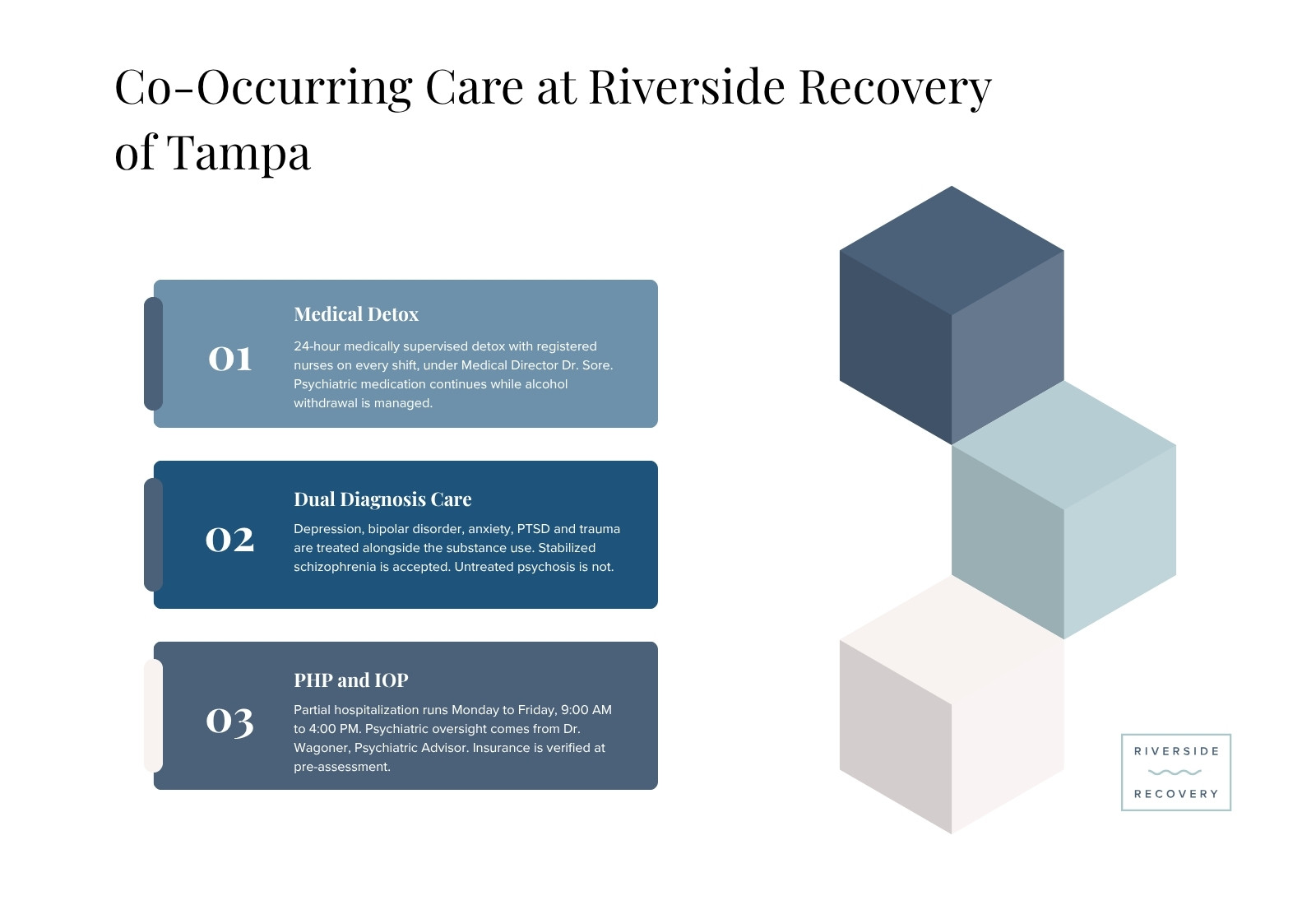
Our depression treatment page covers how a depressive presentation is assessed and treated alongside substance use, and our bipolar disorder treatment page covers the same for a manic or mixed presentation.
Related patterns are worth reading directly. Short-lived anxiety as blood alcohol falls is covered in our article on hangxiety, the mood-disorder version of this overlap in bipolar and alcohol, and a comparable naming problem in panic attack vs anxiety attack.
Frequently Asked Questions
How long does substance-induced depression last?
SAMHSA indicates that an abstinent period of weeks or months may be needed before an independent disorder can be diagnosed definitively, which is the same window over which a substance-induced presentation would be expected to recede. A specific single-month figure appears in a reference that is now archived and is more precise than current guidance supports.
How do doctors know if depression is caused by drugs or alcohol?
They reconstruct when the regular substance use began, when the mood symptoms began, and what the mood did during any prolonged period without the substance. The third is decisive, and it is often the one that cannot be answered at intake.
Is substance-induced depression less serious than regular depression?
Not by symptom severity. In a study of 242 treatment seekers, the independent group scored 16.2 on the Hamilton Depression Rating Scale and the substance-induced group 10.4, so severity pointed the opposite way from the intuition.
Can a substance-induced mood disorder turn into a permanent one?
The studies reviewed here did not measure whether a substance-induced diagnosis later reclassifies as independent, so this article does not answer it. What they do establish is that diagnoses made during active use are provisional and are meant to be reevaluated.
Should I stop my antidepressant if my depression might be substance-induced?
No, and not on the basis of an article. Stopping a psychiatric medication is a decision for the prescriber who wrote it, and the diagnostic question is exactly the kind of thing that gets resolved with a clinician over weeks rather than settled independently.
Which substances most often cause depressive symptoms?
Alcohol, cocaine and opioids all feature in the research on substance-induced depression. In the Dakwar study, cocaine dependence correlated with substance-induced depression while cannabis dependence was associated with independent depression instead.
Does Riverside Recovery of Tampa treat this?
Riverside Recovery of Tampa treats depression and bipolar disorder when they occur alongside a substance use disorder. It does not admit primary mental health diagnoses without co-occurring substance use, and it treats adults aged 18 and over only.
References
- Substance Abuse and Mental Health Services Administration (2020). Chapter 4, Mental and Substance-Related Disorders: Diagnostic and Cross-Cutting Topics. Substance Use Disorder Treatment for People With Co-Occurring Disorders, TIP 42. https://www.ncbi.nlm.nih.gov/books/NBK571021/
- Dakwar, E., et al. (2011). A Comparison of Independent Depression and Substance-Induced Depression in Cannabis, Cocaine, and Opioid Dependent Treatment Seekers. The American Journal on Addictions, 20(5), 441-446. https://pmc.ncbi.nlm.nih.gov/articles/PMC3600842/
- Smith, J.P., & Randall, C.L. (2012). Anxiety and Alcohol Use Disorders: Comorbidity and Treatment Considerations. Alcohol Research: Current Reviews, 34(4), 414-431. https://pmc.ncbi.nlm.nih.gov/articles/PMC3860396/
- Revadigar, N., & Gupta, V. (2022). Substance-Induced Mood Disorders. StatPearls, NCBI Bookshelf NBK555887. Archived, provided for historical reference only. https://www.ncbi.nlm.nih.gov/books/NBK555887/
- 988 Suicide and Crisis Lifeline. Substance Abuse and Mental Health Services Administration. https://988lifeline.org/
Medically reviewed by Dr. Sore, Medical Director at Riverside Recovery of Tampa, emergency board certified and addiction certified. Last reviewed September 2026.
This article is for information only and does not substitute for diagnosis or treatment by a qualified clinician. Do not start, stop, or change a psychiatric medication without speaking to the prescriber who wrote it. If you are in crisis, call or text 988 to reach the Suicide and Crisis Lifeline.