


A panic attack is a defined clinical event with countable criteria, and an anxiety attack is an everyday phrase for anxiety that builds rather than surges, which is why only one of the two appears in a medical record.
The distinction is speed and threshold. A panic attack arrives abruptly and peaks within minutes, and it requires four or more of thirteen specific symptoms.
The distinction matters most when substances are involved, because a panic attack caused by alcohol or a drug is not panic disorder.
Key Takeaways
- A panic attack is an abrupt surge of intense fear that peaks within minutes and carries four or more of thirteen defined symptoms.
- An anxiety attack has no diagnostic threshold, so the phrase describes an experience rather than a clinical finding.
- Panic disorder requires recurrent unexpected attacks plus a month or more of worry about further attacks and a change in behavior.
- Panic disorder is only diagnosed once the attacks are shown not to be attributable to a substance, which is SAMHSA criterion C.
- An estimated 2.7% of United States adults had panic disorder in the past year, according to the National Institute of Mental Health.
What Is a Panic Attack?
A panic attack is an abrupt surge of intense fear or discomfort that reaches a peak within minutes and carries four or more of thirteen defined physical and cognitive symptoms. StatPearls gives that definition and sets the four-symptom threshold.
The thirteen symptoms are published as a numbered set, and any four of them are enough:
- Palpitations, pounding heart, or accelerated heart rate
- Sweating
- Trembling or shaking
- Sensations of shortness of breath or smothering
- Feeling of choking
- Chest pain or discomfort
- Nausea or abdominal distress
- Feeling dizzy, unsteady, lightheaded, or faint
- Derealization or depersonalization
- Fear of losing control
- Fear of dying
- Numbness or tingling sensations
- Chills or hot flushes
Why the ten-minute figure is out of date
Most pages on this subject still say a panic attack peaks within ten minutes. That was the DSM-IV wording. DSM-5 broadened it to reaches a peak within minutes, and a page quoting ten minutes as the current criterion is quoting a superseded one.
What Do People Mean by an Anxiety Attack?
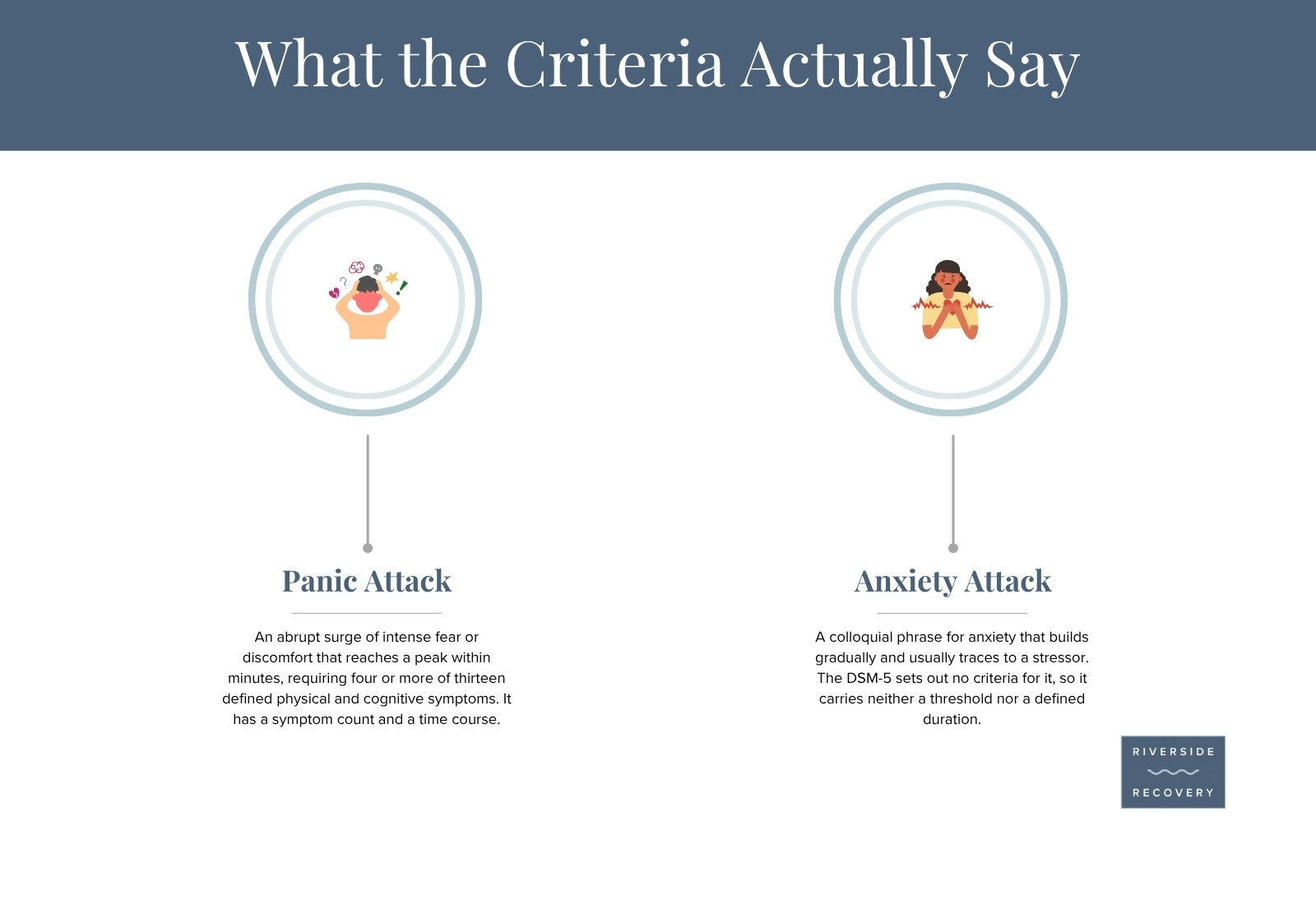
An anxiety attack is a colloquial term for a period of mounting anxiety, and no diagnostic criteria define it, so the phrase carries no symptom count and no time course. That absence is the difference, not a judgment about severity.
What people usually describe with the phrase differs from a panic attack in four ways:
- Onset builds over minutes or hours rather than surging.
- Trigger is usually identifiable, such as a deadline or a confrontation.
- Intensity varies and often stays below the ceiling a panic attack reaches.
- Duration can stretch across a whole day rather than peaking and subsiding.
The DSM-5 defines a panic attack, and it defines panic disorder, generalized anxiety disorder and substance-induced anxiety disorder. It sets out no comparable criteria for an anxiety attack, which is why the two terms are not interchangeable on a chart.
How Do You Tell the Two Apart?
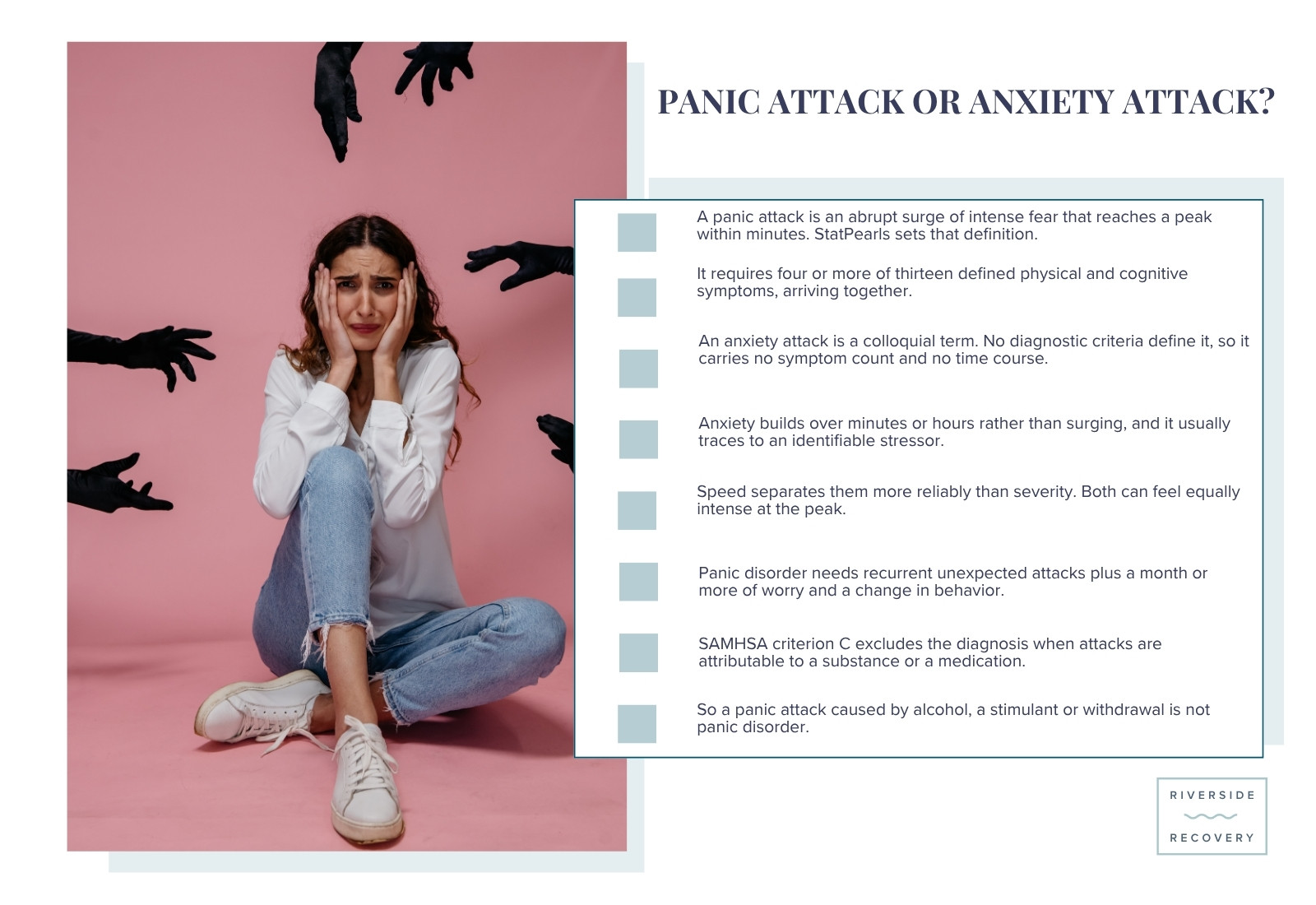
Speed separates them more reliably than severity, because a panic attack surges to a peak within minutes while mounting anxiety climbs gradually and often has an obvious cause. Three features do most of the work.
- Onset. Abrupt and unexpected points to a panic attack; gradual and traceable to a stressor points to anxiety building.
- Symptom count. Four or more of the thirteen, arriving together, meets the panic attack threshold.
- Aftermath. Fear of the next attack, and behavior changed to avoid it, is the pattern that turns attacks into a disorder.
Panic disorder is the diagnosis, not the attack. StatPearls describes it as recurrent unexpected panic attacks followed by one month or more of persistent concern over having more attacks. A change in behavior to avoid the situation the person attributes the attack to is part of the same criterion.
What Should You Do During a Panic Attack?
Wait it out somewhere safe, breathe slowly, and remind yourself the surge peaks within minutes, because the physical sensations are frightening rather than dangerous in themselves. Five things help in the moment.
- Sit down, because dizziness and faintness are on the symptom list.
- Slow the out-breath, since over-breathing drives the tingling and lightheadedness.
- Name the experience as a panic attack, which shortens the spiral of fearing a catastrophe.
- Stay where you are if it is safe, rather than adding the fear of the place to the fear of the attack.
- Skip caffeine and alcohol afterwards, because both act on the same arousal the attack has just raised.
What the 3-3-3 rule is, and what it is not
The 3-3-3 rule asks a person to name three things they see, three they hear, and three parts of the body they can move. It is a self-help grounding technique that interrupts attention, not a clinical protocol, and it has no diagnostic or prescribing status. The treatment with named first-line status is different: StatPearls records that SSRIs are considered the first-line treatment option for patients with panic disorder.
When to get emergency help
Call 911 for chest pain, and let a clinician rule out a cardiac cause rather than assuming a panic attack.
Chest pain and a pounding heart sit on the panic symptom list and on the cardiac one, and the overlap is the reason panic attacks are so often first seen in an emergency department. StatPearls also names hyperthyroidism and vestibular dysfunction as conditions that produce panic-like episodes, so recurrent attacks warrant a medical work-up rather than a self-diagnosis.
For emotional crisis or suicidal thoughts, the 988 Suicide and Crisis Lifeline is reachable by calling 988, texting 988, or using the chat service at 988lifeline.org. The 988 Lifeline provides Spanish-language service and American Sign Language support for Deaf and hard of hearing callers.
When Do Alcohol and Drugs Cause Panic Attacks?
Alcohol, stimulants and withdrawal states all provoke panic attacks directly, and when they are the cause the diagnosis is not panic disorder. SAMHSA states the exclusion as a criterion rather than a caveat.
Exhibit 4.9 of SAMHSA’s TIP 42 is the treatment improvement protocol for people with co-occurring disorders. It gives criterion C in full: the disturbance is not attributable to the physiological effects of a substance, for example a drug of abuse or a medication, or another medical condition.
StatPearls puts the same boundary the other way round. Although panic attacks may originate from the direct effects of substance use, medications, or a general medical condition, they must not derive solely from these.
Why the distinction changes the treatment
Two people can describe an identical attack and need different care. If the attacks are substance-induced, the substance is the target and the attacks recede as use stops. If the attacks are independent, they persist through abstinence and need treating in their own right. Nobody can tell which is which from the attack alone, which is why a full substance history is part of assessing panic.
Anxiety that arrives specifically as blood alcohol falls has its own pattern, set out in the guide to hangxiety, and the wider withdrawal course is covered in the reference on alcohol withdrawal syndrome.
How Common Is Panic Disorder?
An estimated 2.7% of United States adults had panic disorder in the past year and 4.7% experience it at some point in their lives, according to the National Institute of Mental Health. Those figures come from the National Comorbidity Survey Replication.
The past-year figure is not evenly spread. It is 3.8% among females and 1.6% among males, and it varies across four age bands:
- Ages 18 to 29: 2.8%
- Ages 30 to 44: 3.7%
- Ages 45 to 59: 3.1%
- Ages 60 and over: 0.8%
What Do People Get Wrong About Panic Attacks?
Three beliefs about panic attacks contradict the published criteria: that an anxiety attack is a milder diagnosis, that one attack means panic disorder, and that a panic attack always follows something stressful.
Each one is answered by the criteria themselves:
- Misconception: an anxiety attack is a milder version of the same diagnosis. Evidence: only one of the two has criteria. A panic attack has a symptom count and a time course; an anxiety attack has neither, so the pair are not two grades of one thing.
- Misconception: having a panic attack means a person has panic disorder. Evidence: the diagnosis requires recurrent unexpected attacks plus a month or more of worry and a change in behavior. A single attack does not meet it.
- Misconception: panic attacks always follow an obvious trigger. Evidence: the criteria specify recurrent unexpected attacks. An attack with no identifiable cause is the more characteristic presentation, and a clear trigger points instead toward anxiety building.
How Is Panic Disorder Treated Alongside a Substance Use Disorder?
Both conditions are treated in one plan, because a substance that provokes panic and panic that drives drinking hold each other in place. Smith and Randall concluded that recommendations to treat both anxiety and alcohol use disorders appear warranted on both theoretical and empirical grounds.
The sequence in a co-occurring presentation runs in a specific order:
- Stabilize the substance use, so the substance-induced possibility is removed rather than assumed.
- Reassess the panic once use has stopped, since attacks that recede were substance-driven.
- Treat what remains, with SSRIs as the named first-line option and structured therapy alongside.
Treatment at Riverside Recovery of Tampa
Riverside Recovery of Tampa treats panic disorders alongside a substance use disorder, and screens anxiety with the GAD-7 during the biopsychosocial assessment. Riverside Recovery of Tampa does not admit primary mental health conditions without co-occurring substance use, and Riverside Recovery of Tampa serves adults aged 18 and over only.
Where drinking or drug use is daily or heavy, withdrawal is managed first through medical detox, because withdrawal states provoke the same attacks the assessment is trying to attribute. Readers whose attacks continue through abstinence should look at panic disorder and substance use treated together.
Coping techniques have a place alongside treatment rather than instead of it, and one worked example is set out in the piece on panic journaling.
Frequently Asked Questions
Can a panic attack feel like a heart attack?
Yes. Chest pain, a pounding heart, sweating and shortness of breath appear on the panic symptom list and on the cardiac one. Chest pain needs a clinician to rule out a cardiac cause rather than a self-diagnosis.
How long does a panic attack last?
A panic attack reaches its peak within minutes, which is the criterion DSM-5 sets. The subsiding phase varies between people, and lingering exhaustion after the peak is common.
Is an anxiety attack less serious than a panic attack?
Neither is a severity grade of the other. A panic attack has defined criteria and an anxiety attack does not, so the comparison is between a clinical event and an everyday description.
Do you need medication for panic disorder?
Not always, and the decision belongs to a prescriber. StatPearls records SSRIs as the first-line treatment option for panic disorder, and structured therapy is used alongside or instead depending on the presentation.
Can panic attacks stop on their own?
An individual attack peaks and subsides without intervention. Recurrent unexpected attacks with a month or more of worry about further attacks meet the threshold for panic disorder and warrant assessment.
Does caffeine cause panic attacks?
Stimulants provoke panic attacks directly, and StatPearls names substance and medication effects among the origins clinicians must rule out. Cutting stimulant intake is a standard first step when attacks are being assessed.
References
- Panic Disorder. StatPearls, National Center for Biotechnology Information Bookshelf NBK430973. ncbi.nlm.nih.gov/books/NBK430973
- Substance Use Disorder Treatment for People With Co-Occurring Disorders. Substance Abuse and Mental Health Services Administration, TIP No. 42, Updated 2020, Exhibit 4.9. ncbi.nlm.nih.gov/books/NBK571021
- Panic Disorder. National Institute of Mental Health. nimh.nih.gov/health/statistics/panic-disorder
- Impact of the DSM-IV to DSM-5 Changes on the National Survey on Drug Use and Health. National Center for Biotechnology Information Bookshelf NBK519704, Table 3.10. ncbi.nlm.nih.gov/books/NBK519704
- Smith, J.P., & Randall, C.L. (2012). Anxiety and Alcohol Use Disorders: Comorbidity and Treatment Considerations. Alcohol Research: Current Reviews, 34(4), 414-431. pmc.ncbi.nlm.nih.gov/articles/PMC3860396
- 988 Suicide & Crisis Lifeline. Substance Abuse and Mental Health Services Administration. 988lifeline.org