



Most pages about OCD and alcohol stop at the observation that drinking makes obsessive-compulsive disorder worse. That is true, and it is not the useful part.
The useful part is narrower. Alcohol interferes with one specific mental process, and that process is the exact one the first-line treatment for OCD is built to produce. Understanding which process, and why, changes what a person does about it.
This article follows that thread: how often the two conditions occur together, which one usually arrives first, what exposure and response prevention asks of a person, and why alcohol sits directly across that mechanism.
Does Drinking Make OCD Worse?
Alcohol interferes with fear extinction, which is the learning process that exposure and response prevention depends on, while leaving the brain’s capacity to acquire fear intact. That asymmetry is the finding worth carrying, and Bisby and colleagues measured it directly in a double-blind, placebo-controlled study of 64 people.
Their result: “Fear acquisition was unimpaired following alcohol, whereas extinction learning was slower, requiring further extinction trials.”
Alcohol does not blunt the ability to learn fear. It blunts the ability to unlearn it. For a condition treated by systematically unlearning fear responses, that is the worst possible place for a substance to act.
Why Alcohol Feels Like It Works on Obsessions
Alcohol reduces the distress an obsession produces in the moment, which is the same short-term relief a compulsion delivers, and the relief is what makes both behaviors persist. The pattern is easiest to see in a published case description of a related comorbidity.
Buckner and colleagues, documenting treatment for co-occurring social anxiety and alcohol use disorder, described a patient who “used alcohol prior to social situations to manage anticipatory anxiety” and found that “his alcohol use created a vicious cycle in which after drinking in a social situation, his social anxiety would increase.”
The structure of that cycle transfers. Something raises distress, alcohol lowers it, the lowering is learned, and the underlying fear is never contradicted because the person never stayed with it long enough to find out it was survivable.
Relief is not the same as improvement
An obsession is a thought that generates distress. A compulsion is a behavior that discharges the distress without addressing the thought. Alcohol occupies the same functional position: it discharges the distress and leaves the obsession’s premise unchallenged.
This is why a person can drink for years and find their OCD unchanged or worse. Nothing in the drinking ever tests whether the feared outcome actually happens.
Which Comes First, OCD or the Drinking?
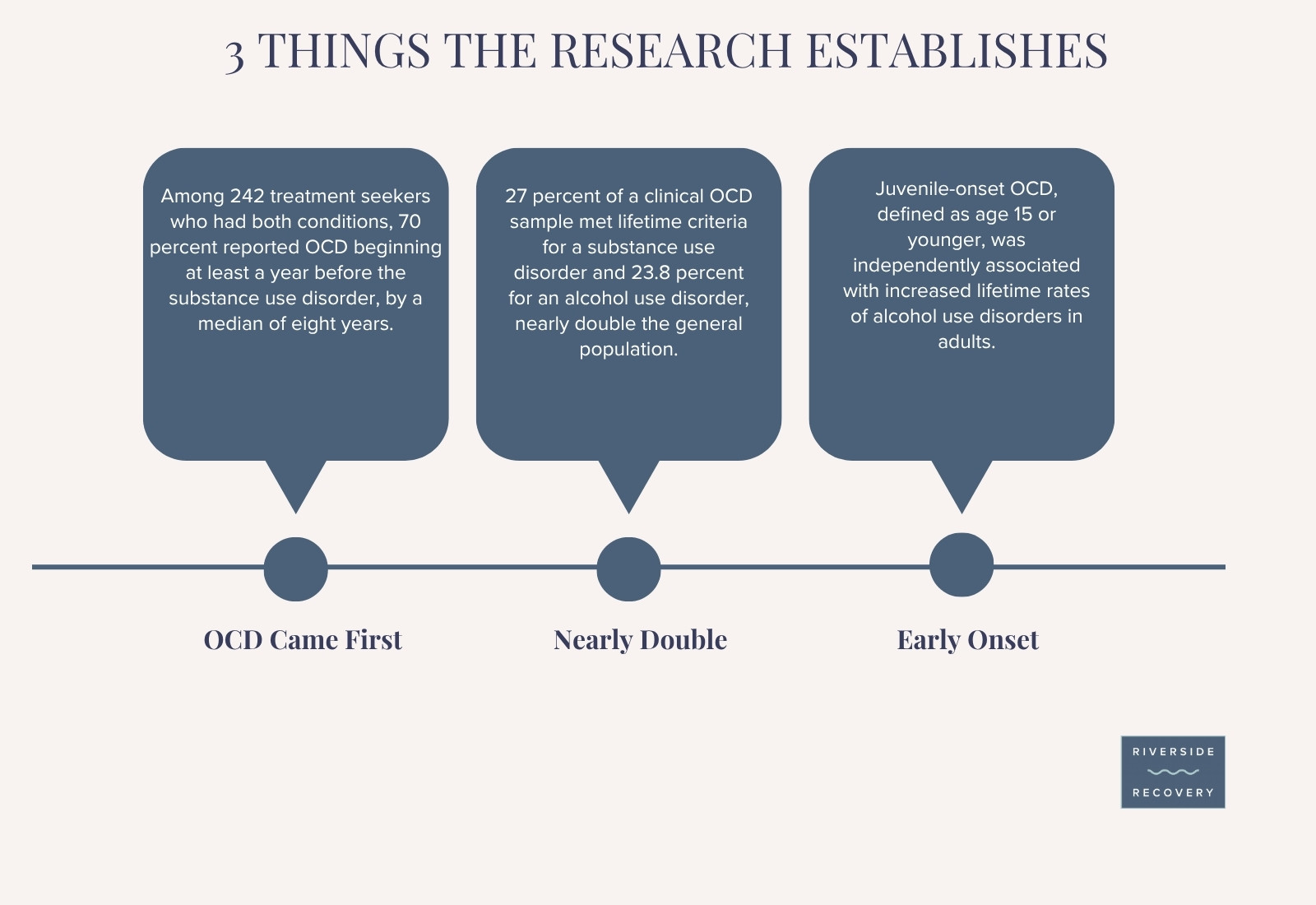
In a clinical sample of 323 people treated for OCD, 70 percent of those who also had a substance use disorder reported that the OCD came first, by a median of eight years. Mancebo and colleagues recorded it precisely: “70% (n=61) of participants with OCD+SUD reported that OCD onset preceded SUD onset by at least one year (range 1-27 years, median= 8 years).”
Eight years is a long time to manage a condition without a diagnosis. That number reframes the comorbidity: in most cases this is not a drinking problem that produced obsessive thinking, it is untreated OCD that eventually acquired a second disorder.
How common the overlap is
The same study found that “27% (n=87) of the sample met lifetime DSM-IV criteria for a substance use disorder,” with 23.8 percent meeting criteria for an alcohol use disorder specifically. Compared against the wider population, the authors reported that “rates of SUDs in this sample were nearly double the lifetime prevalence of SUDs reported in the U.S. general population.”
- 27 percent of the OCD sample met lifetime criteria for any substance use disorder.
- 23.8 percent met lifetime criteria for an alcohol use disorder.
- 70 percent of those with both reported OCD arriving first, by at least a year.
- Nearly double the general-population rate, in the authors’ comparison.
Early-onset OCD is a marker worth knowing
The study also found that “juvenile-onset of OCD (defined as age 15 or younger) was independently associated with increased lifetime rates of alcohol use disorders.” That is a fact about adults who have carried OCD since adolescence, and it means an adult presenting with both conditions has often been managing symptoms since their teens.
How Alcohol Interferes With Exposure and Response Prevention
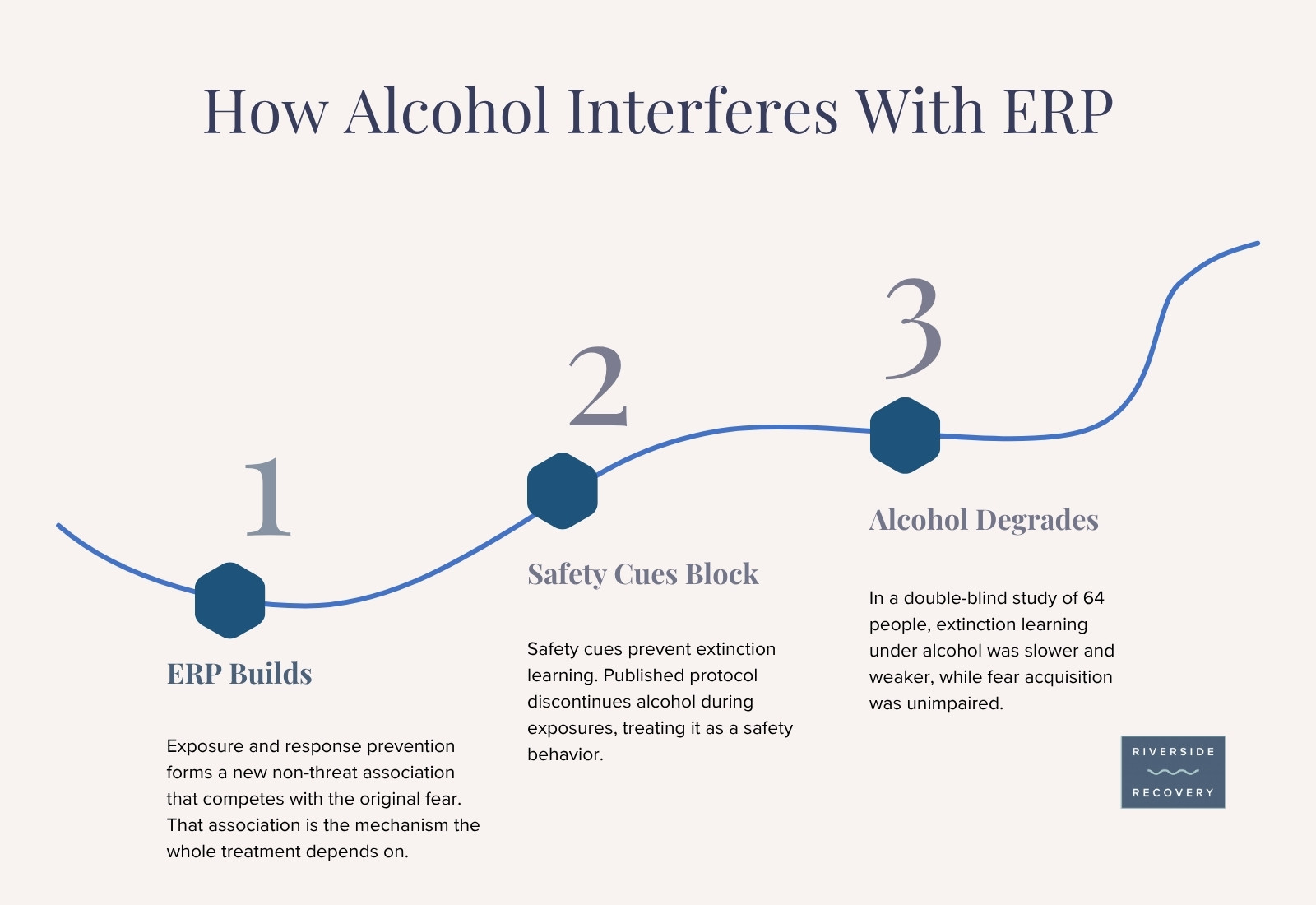
Exposure and response prevention works by building a new non-threat association that competes with the original fear, and alcohol degrades exactly that association-building step. Establishing why requires three pieces, and they connect cleanly.
What ERP asks a person to do
Thampy and colleagues state the treatment position plainly: “Serotonin reuptake inhibitors (SSRIS) and cognitive behavior therapy (CBT), comprising exposure and response prevention (ERP), are the first line of treatment for obsessive compulsive disorders (OCD).”
The mechanism is a learning process. “Inhibitory learning theory (ILT) explains the process of extinction,” the same authors write. “New nonthreat associations are formed during exposure, which inhibits the original threat association.”
In practice, a person contacts what triggers the obsession and deliberately does not perform the compulsion. The distress rises, then falls on its own, and the brain records that the feared outcome did not arrive.
Why alcohol counts as a safety behavior
ERP does not only prohibit the compulsion. It prohibits anything that shortcuts the distress, because a shortcut prevents the new association from forming. Thampy and colleagues put it directly: “Safety cues prevent extinction learning and preventing safety signals and behaviors improves outcomes.”
Alcohol is treated as one of those behaviors in published protocol. Buckner and colleagues describe “discontinuing alcohol use during exposures (in a manner consistent with the I-CBT manual for the discontinuation of more broadly defined safety behaviors).” Alcohol is not an unrelated habit that happens to co-occur. In an exposure-based treatment it is categorized alongside the compulsion itself.
What the alcohol and extinction study found
Bisby and colleagues gave 64 participants either alcohol or a placebo, double-blind, and ran a two-day fear-conditioning task. The result: “Extinction learning under alcohol was slower, weaker and less context-specific, resulting in persistent fear at test that generalized to the extinction viewpoint.”
The fear also came back. “Conditioned responses returned on day-2 and were generalized across acquisition and extinction viewpoints, even after fear had been successfully extinguished.” The authors’ own clinical reading was hedged: “From a clinical perspective, use of alcohol by vulnerable individuals could disrupt important associations required to reduce unwanted fears and anxiety.”
What these studies did not measure
Being straight about the limits matters here, because the chain above is mechanistic rather than a single outcome trial.
- Bisby studied healthy volunteers in a virtual reality fear-conditioning task, not people with OCD undergoing ERP.
- Buckner is a case description of social anxiety with alcohol use disorder, not a controlled OCD trial.
- No study in this set measured ERP outcomes as a function of how much a participant drank.
What the evidence supports is that alcohol impairs the learning process ERP relies on, and that exposure protocols already treat drinking as a behavior to discontinue. What it does not establish is a measured percentage by which drinking reduces ERP success. Anyone stating that number is going beyond the research.
Why Treating Only the Drinking Leaves OCD in Place
Stopping drinking removes the substance that impairs extinction learning, but it does not deliver the exposure work that produces the new association in the first place. Sobriety clears an obstacle rather than completing a treatment.
The onset data makes the point sharper. If OCD preceded the drinking by a median of eight years, then removing the alcohol returns a person to the condition they were managing before, not to health. The obsessions were there first and they do not resolve because the coping mechanism was withdrawn.
Smith and Randall, reviewing anxiety and alcohol comorbidity, reached the structural conclusion that “recommendations to treat both anxiety and AUDs therefore appear warranted on both theoretical and empirical grounds.”
ERP is effective, and it is not universally effective
Overselling the treatment would be its own failure. Thampy and colleagues report that “a sizeable number of patients do not respond to treatment optimally (14%-31%), and among those who respond, nearly 50%-60% experience at least a partial return of fear.”
Partial return of fear is common and expected, which is one reason ERP is delivered with a clinician rather than attempted alone, and one reason relapse planning is part of the treatment rather than an admission of failure.
How Is Co-Occurring OCD and Alcohol Use Disorder Treated in Tampa?
Riverside Recovery of Tampa treats OCD when it occurs alongside a substance use disorder, as part of dual diagnosis care rather than as a standalone mental health admission. The facility treats adults aged 18 and over, and a substance use disorder has to be present alongside the OCD.
That scope limit is worth stating plainly rather than burying. Someone seeking treatment for OCD alone needs a different provider, and someone whose drinking has become its own disorder alongside the OCD is who this programming is built for.
What treatment involves when both conditions are present
Riverside Recovery screens for mental health symptoms at intake using the PHQ-9 and the GAD-7, and the same therapist carries a client from detox through residential care rather than handing them off between levels.
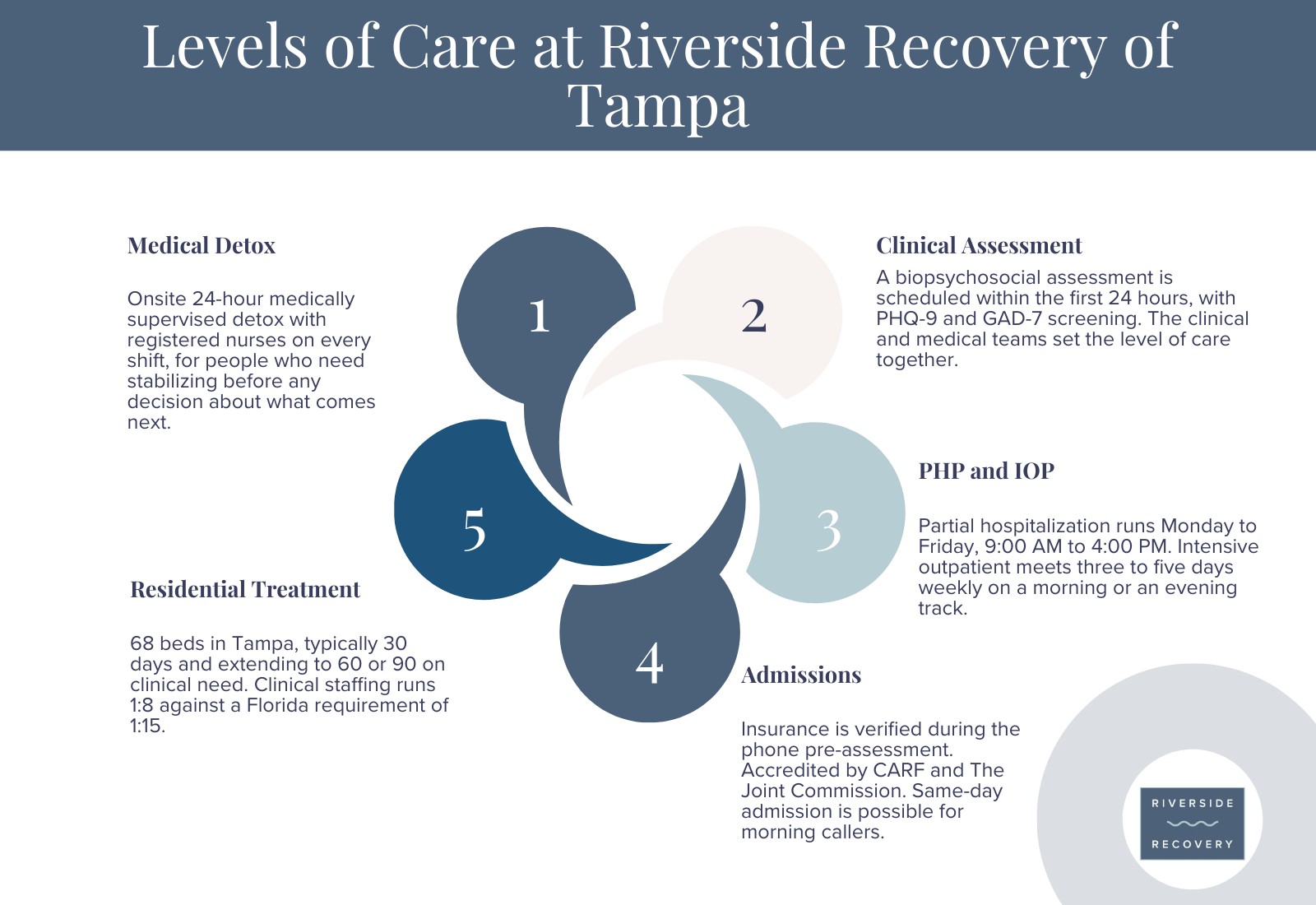
- Screening at intake. The PHQ-9 and GAD-7 are administered so mental health symptoms are measured rather than assumed.
- Therapist continuity. Clients keep the same primary therapist from detox through residential care.
- Individual and group therapy. Programming includes weekly individual sessions alongside group work.
- Integrated medical and clinical teams. A clinical team of 16 works alongside the medical providers rather than in parallel to them.
- Extended benzodiazepine tapers. Tapers run 30 or more days, against an industry standard of five to ten.
Our OCD treatment page sets out the levels of care available and how mental health treatment runs alongside substance use care. The broader dual diagnosis treatment page covers how co-occurring conditions are assessed at intake.
Related patterns come up often enough to be worth reading about directly. The anxiety that follows heavy drinking is covered in our article on hangxiety, the difference between attack types in panic attack vs anxiety attack, and the mood-disorder version of the same overlap in bipolar and alcohol.
Frequently Asked Questions
Does alcohol make OCD symptoms worse?
Alcohol impairs fear extinction, the learning process that reduces obsessive fear, while leaving fear acquisition unaffected. In a double-blind study of 64 people, extinction learning under alcohol was “slower, weaker and less context-specific,” and fear returned the following day even after it had been successfully extinguished.
Can you do exposure therapy while still drinking?
Published protocol says no. Buckner and colleagues describe discontinuing alcohol use during exposures, treating it the same way as any other safety behavior, because safety cues prevent the extinction learning exposure is designed to create.
Which usually starts first, OCD or alcohol use disorder?
OCD, in most cases. Among participants who had both, 70 percent reported OCD beginning at least a year before the substance use disorder, with a median gap of eight years and a range from one to 27 years.
How common is alcohol use disorder in people with OCD?
In a clinical sample of 323 people treated for OCD, 23.8 percent met lifetime criteria for an alcohol use disorder and 27 percent for any substance use disorder. The authors described those rates as nearly double the general-population lifetime prevalence.
Is exposure and response prevention the standard treatment for OCD?
Yes. SSRIs and cognitive behavior therapy comprising exposure and response prevention are described as the first line of treatment for OCD. Response is not universal: 14 to 31 percent of patients do not respond optimally, and 50 to 60 percent of responders experience at least a partial return of fear.
Will my OCD go away if I stop drinking?
Stopping drinking removes a substance that interferes with extinction learning, which helps, but it does not perform the exposure work itself. Given that OCD usually preceded the drinking by years, sobriety generally returns a person to the OCD they had before rather than resolving it.
Does Riverside Recovery of Tampa treat OCD?
Yes, when it co-occurs with a substance use disorder. The facility treats adults aged 18 and over and does not accept primary mental health diagnoses, so OCD is treated within dual diagnosis care alongside substance use treatment.
References
- Mancebo, M.C., Grant, J.E., Pinto, A., Eisen, J.L., & Rasmussen, S.A. (2008). Substance use disorders in an obsessive compulsive disorder clinical sample. Journal of Anxiety Disorders. https://pmc.ncbi.nlm.nih.gov/articles/PMC2705178/
- Thampy, M., et al. (2025). Inhibitory Learning-based Exposure Response Prevention Therapy in Obsessive-compulsive Disorder. Indian Journal of Psychological Medicine, 48(1), 70-77. https://pmc.ncbi.nlm.nih.gov/articles/PMC12237942/
- Bisby, J.A., et al. (2015). Extinction learning is slower, weaker and less context specific after alcohol. Neurobiology of Learning and Memory. https://pmc.ncbi.nlm.nih.gov/articles/PMC4655873/
- Buckner, J.D., et al. (2008). Treating Comorbid Social Anxiety and Alcohol Use Disorders: Combining Motivation Enhancement Therapy With Cognitive-Behavioral Therapy. Clinical Case Studies, 7(3), 208-223. https://pmc.ncbi.nlm.nih.gov/articles/PMC2857733/
- Smith, J.P., & Randall, C.L. (2012). Anxiety and Alcohol Use Disorders: Comorbidity and Treatment Considerations. Alcohol Research: Current Reviews, 34(4), 414-431. https://pmc.ncbi.nlm.nih.gov/articles/PMC3860396/
- 988 Suicide and Crisis Lifeline. Substance Abuse and Mental Health Services Administration. https://988lifeline.org/