


Alcohol does not sit alongside bipolar disorder. It changes the illness, and the research on the overlap describes a different clinical picture than either condition produces on its own.
People who live with both conditions reach episodes earlier, recover from them more slowly, and cycle between them more often. That pattern is consistent enough across studies that clinicians treat the combination as its own presentation rather than as two problems sharing a calendar.
This article covers what the overlap does to the course of bipolar disorder, how common it is, what the medication research actually found, and what the numbers behind those findings do and do not say.
Key Takeaways
- Lifetime comorbidity of bipolar disorder and alcohol use disorder falls in the range of 40 to 70 percent, and that range holds for bipolar I and bipolar II alike.
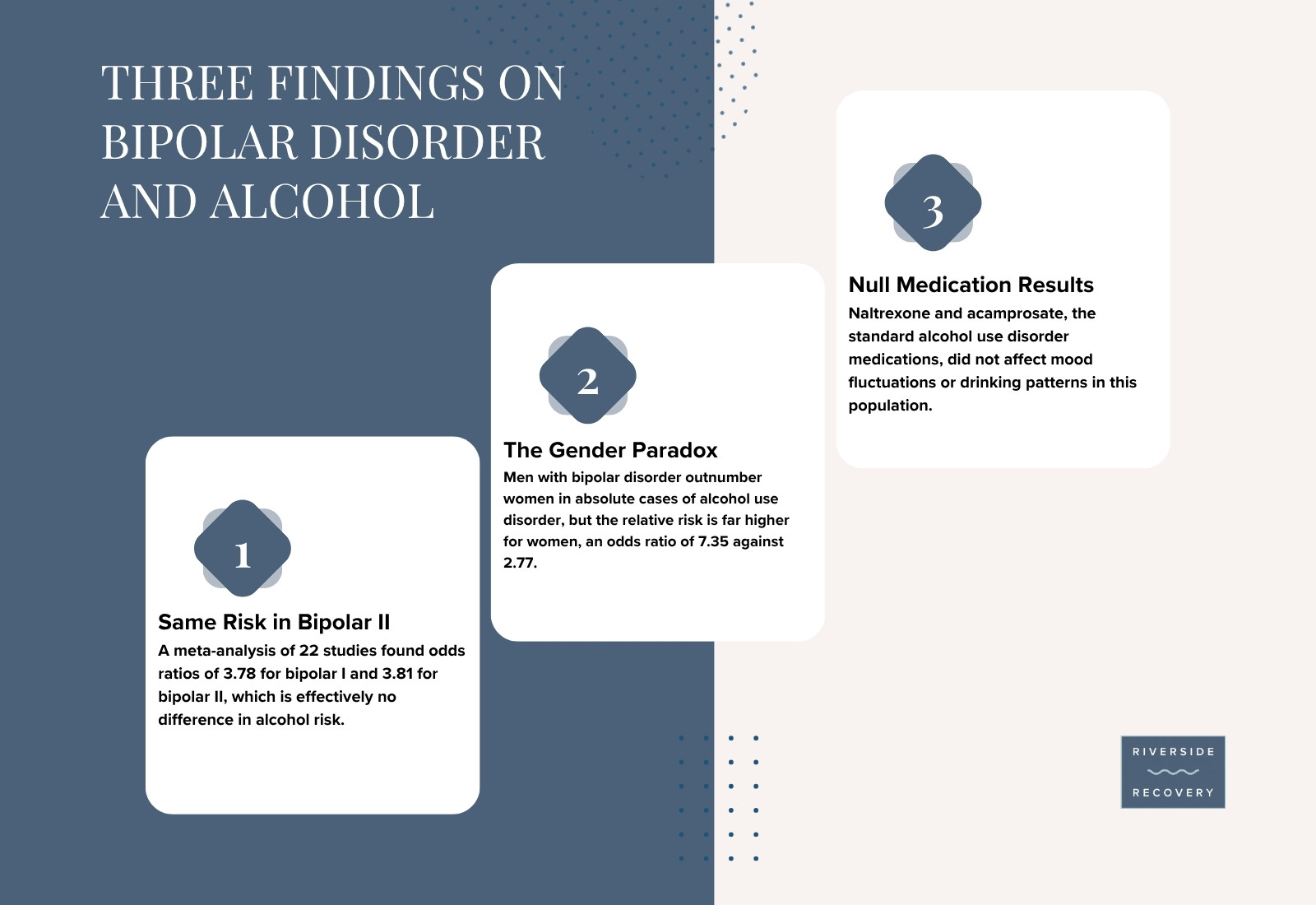
- A meta-analysis of 22 studies found essentially identical alcohol risk for bipolar I and bipolar II, which contradicts the common assumption that bipolar II is the milder diagnosis.
- Men with bipolar disorder outnumber women in absolute cases of alcohol use disorder, but the relative risk is substantially higher for women.
- Alcohol use disorder in bipolar disorder associates with earlier onset, delayed recovery, more frequent mood switches, rapid cycling, and mixed states.
- Naltrexone and acamprosate, the standard medications for alcohol use disorder, did not affect mood fluctuations or drinking patterns in the studies this research reviewed.
- Integrated treatment addresses both conditions in the same setting with one multi-professional team rather than sequencing them.
What Happens When Bipolar Disorder and Heavy Drinking Overlap?
Alcohol use disorder alters the trajectory of bipolar disorder rather than running parallel to it, producing an earlier onset, slower recovery from episodes, and more frequent switching between mood states. Grunze and colleagues, reviewing the comorbidity in Frontiers in Psychiatry, describe the two conditions as disorders that “significantly influence each other’s severity and prognosis with a more complicated course of both disorders.”
That phrasing matters. The review does not say alcohol accompanies bipolar disorder or worsens the experience of it. It says each condition changes the prognosis of the other, which is a claim about mechanism and outcome rather than about discomfort.
The overlap changes the shape of the illness
Someone with bipolar disorder alone and someone with both conditions can carry the same diagnosis on paper and follow very different courses. The differences the research documents cluster around timing and stability: when episodes begin, how long they take to resolve, and how quickly mood shifts from one pole to the other.
Treatment adherence sits inside that pattern too. The same review reports lower adherence to treatment among patients with both conditions, which compounds the instability rather than simply coinciding with it.
When to get help right now
Suicidal ideation appears in the research as one of the features that intensifies when the two conditions overlap. A Brazilian study cited in the Grunze review recorded at least one suicide attempt in 68 percent of bipolar patients with alcohol use disorder, compared with 35 percent of bipolar patients without it.
- Call or text 988 to reach the Suicide and Crisis Lifeline, which operates 24 hours a day across the United States.
- Call 911 if someone is in immediate danger, unresponsive, or cannot be kept safe where they are.
- Go to the nearest emergency department if a manic or mixed episode is escalating and the person cannot be safely supervised.
These figures describe risk across a population. They do not predict what happens to any individual person, and both conditions respond to treatment.
How Often Do Bipolar Disorder and Alcohol Use Disorder Occur Together?
Estimates for lifetime comorbidity of bipolar disorder and alcohol use disorder fall in the range of 40 to 70 percent, according to the Grunze review, and that range applies to both bipolar I and bipolar II disorder. The National Epidemiologic Survey on Alcohol and Related Conditions found a 58 percent lifetime prevalence of co-occurring alcohol use disorders among people examined for bipolar I disorder, which sits inside that range.
The Epidemiologic Catchment Area Program, an earlier study, put the figure lower. Among patients with bipolar type I disorder, 46 percent had a lifetime history of an alcohol use disorder.
Bipolar II carries the same alcohol risk as bipolar I
Bipolar II disorder is frequently described as the less severe form of the condition, on the reasoning that hypomania is less disruptive than full mania. The alcohol data does not support extending that reasoning to comorbidity risk.
The Grunze review reports that “a recent meta-analysis of 22 studies showed no difference between BD-I (OR 3.78) and BD-II (OR 3.81).” Twenty-two studies pooled together found the odds of alcohol use disorder nearly identical across the two diagnoses.
The risk pattern differs for women and men
The review describes a male preponderance in the comorbidity, which is the figure most summaries report. It also reports something that runs the other direction, and that most summaries omit.
“The relative risk of suffering from AUD was significantly greater for women with BD [odds ratio (OR) = 7.35] than for men (OR = 2.77).” Both statements are true at once. More men with bipolar disorder develop alcohol use disorder in absolute numbers, while bipolar disorder multiplies a woman’s risk by a considerably larger factor.
Why Does Alcohol Destabilize Bipolar Mood Cycling?
Alcohol use disorder associates with a specific and repeatedly documented set of changes to the course of bipolar disorder, spanning onset, recovery time, switching frequency, and episode type. The Grunze review lists them together, which is how they appear below.
What alcohol changes in the course of bipolar disorder
- Earlier onset. Mood episodes begin at a younger age in patients who also have alcohol use disorder.
- Delayed recovery from episodes. Episodes resolve more slowly once they start.
- More frequent mood switches. Transitions between depressive and manic states occur more often.
- Rapid cycling. The pattern of repeated mood episodes recurring within a single year appears more frequently.
- Mixed states. Presentations carrying depressive and manic features simultaneously become more common.
- More severe depression and suicidal ideation. The depressive pole intensifies.
- Lower adherence to treatment. Patients follow treatment plans less consistently.
Read as a group, these items point at the same underlying problem. Alcohol interferes with the stability that bipolar treatment is built to produce, so the treatment has to work against a moving baseline.
Is Drinking in Bipolar Disorder Really Self-Medication?
The self-medication account explains part of the relationship but not its direction, because the research shows influence running both ways rather than from mood symptoms to drinking alone. The Grunze review documents each direction separately.
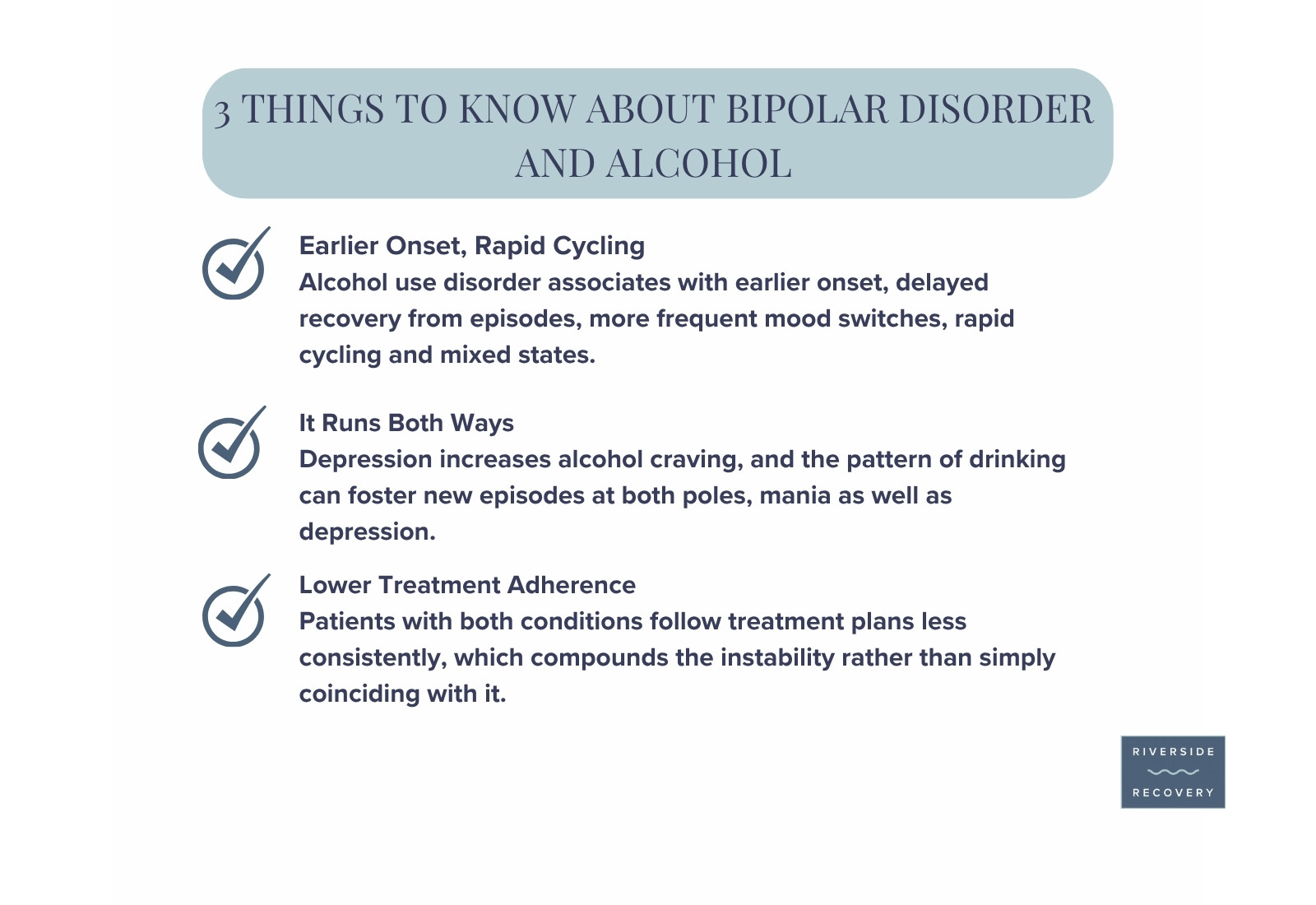
In one direction, mood drives drinking. “Depression increases alcohol craving in BD patients with AUD,” which is the self-medication pattern most people describe when they talk about drinking to manage a depressive episode.
In the other direction, drinking drives mood. “The pattern and frequency of AUD can foster new episodes of BD, both mania and depression.” Alcohol use precipitates episodes at both poles, not only the depressive one.
Alcohol’s own after-effects feed that loop. The anxiety that follows a heavy drinking session, commonly called hangxiety, can drive further drinking on its own, independently of a mood episode.
The practical consequence is that treating only the mood disorder leaves one arm of the loop running. Someone whose bipolar disorder is well managed can still have episodes generated by their drinking, and someone whose drinking stops can still face craving driven by an untreated depressive episode.
Why attribution is genuinely difficult
Diagnostic criteria have shifted on exactly this question. The DSM-5 reclassified a presentation that DSM-IV had assigned elsewhere: “Mania that emerge after antidepressant treatment can be classified as bipolar I disorder diagnosis in the DSM-5, whereas this was a substance-induced manic disorder in DSM-IV.”
That change means the same clinical event carried different diagnostic labels under different editions of the manual. Attributing a mood episode to a substance or to an underlying disorder is a judgment that requires history, timing, and a clinician, and it is not something a person can reliably sort out about themselves during an episode.
Telling symptom states apart is a recurring problem across co-occurring conditions, and it is the same difficulty that makes a panic attack vs anxiety attack hard to distinguish without a clinician.
How Do Alcohol and Bipolar Medications Interact?
Research on medication in this comorbidity produced one positive finding and several null results, including null results for the two medications most commonly prescribed for alcohol use disorder on its own. The Grunze review summarizes the position directly.
What the research found
“Adding valproate to lithium may reduce alcohol consumption whereas studies with antipsychotics or naltrexone and acamprosate did not affect mood fluctuations or drinking patterns.”
Three findings sit inside that sentence:
- Valproate added to lithium may reduce alcohol consumption, which is the one positive medication signal the review reports.
- Naltrexone and acamprosate did not affect mood fluctuations or drinking patterns in the studies reviewed, despite both being established treatments for alcohol use disorder without bipolar disorder.
- Antipsychotics produced the same null result on both mood fluctuation and drinking in this comorbidity.
What this does not mean
A null result in a comorbid population is not evidence against a medication generally. Naltrexone and acamprosate carry substantial evidence in alcohol use disorder without bipolar disorder, and antipsychotics carry substantial evidence in bipolar disorder without alcohol use disorder. The finding is narrower than it first sounds: these agents did not resolve the comorbidity by addressing one side of it.
No one should change or stop a psychiatric medication based on a research summary. Mood stabilizers and antipsychotics require supervised adjustment, and stopping alcohol abruptly after sustained heavy drinking carries its own risks that a prescriber needs to assess. If withdrawal is the immediate concern, our page on alcohol withdrawal covers the timeline and the point at which medical supervision becomes necessary.
What Did the Research Actually Measure?
Every figure in this article comes from a study with a specific design, and the two most common misreadings involve treating an odds ratio as a percentage and treating a range as an average. Both distortions make the numbers sound more precise than they are.
An odds ratio is not a percentage
The figure OR 7.35 for women does not mean 7.35 percent, and it does not mean 735 percent of women with bipolar disorder develop alcohol use disorder. An odds ratio compares the odds of an outcome in one group against another, so 7.35 describes how much bipolar disorder multiplies the odds relative to women without it.
The same applies to OR 3.78 and OR 3.81 for bipolar I and bipolar II. Those numbers are close to each other, which is the point being made, and neither is a prevalence figure.
Why the comorbidity figure is a range
The 40 to 70 percent span reflects real disagreement between studies rather than uncertainty in a single measurement. NESARC reported 58 percent for bipolar I. The Epidemiologic Catchment Area Program reported 46 percent for bipolar type I. Different sampling methods, different diagnostic criteria, and different survey years produce different figures.
Any page that reports a single number for this comorbidity has collapsed that range into a point estimate the underlying research does not support.
How Is Co-Occurring Bipolar Disorder and Alcohol Use Disorder Treated?
Integrated treatment addresses both conditions in the same setting with one team, which the Grunze review identifies as the current standard rather than treating them in sequence. The review states that “modern treatment concepts acknowledge the interplay between these disorders using an integrated therapy approach where both disorders are tackled in the same setting by a multi-professional team.”
Three elements of that description carry weight. Both disorders are treated, they are treated in the same setting, and one multi-professional team handles them.
Therapies with the strongest evidence
The review names two psychotherapies as carrying the best evidence in this specific comorbidity:
- Cognitive behavioral therapy (CBT). Addresses the thought and behavior patterns that sustain both drinking and mood instability.
- Integrated group therapy (IGT). Developed specifically for co-occurring bipolar disorder and substance use disorder, and treats both in the same group rather than in separate tracks.
Research on anxiety and alcohol reaches the same structural conclusion. Smith and Randall, writing in Alcohol Research: Current Reviews, concluded that “recommendations to treat both anxiety and AUDs therefore appear warranted on both theoretical and empirical grounds,” which reflects the same finding across a different comorbidity.
Treatment for co-occurring bipolar disorder in Tampa
Riverside Recovery of Tampa treats bipolar disorder when it occurs alongside a substance use disorder, as part of its dual diagnosis programming. The facility does not accept primary mental health admissions, so a substance use disorder has to be present alongside the mood disorder.
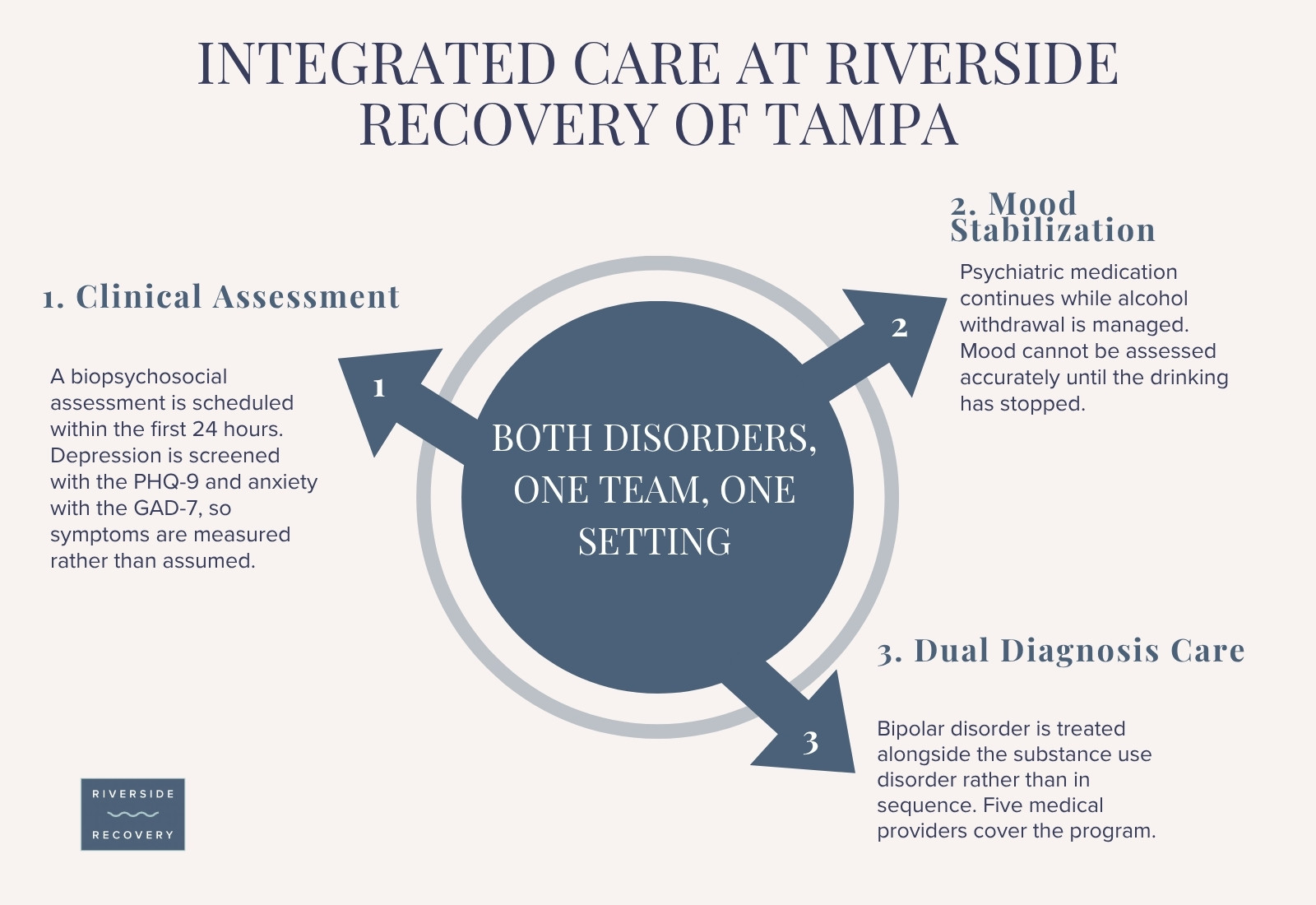
Our bipolar disorder treatment page sets out the levels of care available and how mood stabilization runs alongside substance use treatment. For someone still drinking heavily, medical detox is typically the first step, because withdrawal has to be managed before mood can be assessed accurately.
Frequently Asked Questions
Can you drink alcohol while taking a mood stabilizer?
That decision belongs to the prescriber who wrote the prescription, because it depends on the specific medication, the dose, and the person’s history. What the comorbidity research establishes is that drinking associates with more frequent mood switching, rapid cycling, and slower recovery from episodes, which works directly against what a mood stabilizer is prescribed to achieve.
Does alcohol trigger manic episodes?
The Grunze review reports that the pattern and frequency of alcohol use disorder can foster new episodes of bipolar disorder, “both mania and depression.” Alcohol is associated with episodes at both poles rather than only the depressive one, which is the more commonly assumed direction.
Is bipolar II less risky for alcohol use disorder than bipolar I?
No. A meta-analysis of 22 studies found odds ratios of 3.78 for bipolar I and 3.81 for bipolar II, which is effectively no difference. The severity distinction between the two diagnoses does not carry over to alcohol risk.
Should alcohol use disorder be treated before bipolar disorder?
Current treatment concepts favor addressing both in the same setting with one multi-professional team rather than sequencing them. Sequential treatment leaves one side of a bidirectional relationship untreated, and the research documents influence running in both directions.
Why did naltrexone not work in these studies?
The review reports that studies with naltrexone and acamprosate did not affect mood fluctuations or drinking patterns in this comorbid population. It does not explain the mechanism, and it does not mean these medications lack evidence in alcohol use disorder generally, where both are established treatments.
Can a mood episode be caused by drinking rather than by bipolar disorder?
Yes, and separating the two is a clinical judgment rather than a self-assessment. The DSM-5 changed how one such presentation is classified, moving antidepressant-emergent mania from substance-induced manic disorder in DSM-IV to a bipolar I diagnosis, which shows how much the attribution depends on criteria and history.
Does Riverside Recovery of Tampa treat bipolar disorder?
Yes, when it co-occurs with a substance use disorder. The facility treats adults aged 18 and over and does not accept primary mental health diagnoses, so bipolar disorder is treated as part of dual diagnosis care alongside substance use treatment.
References
- Grunze, H., Schaefer, M., Scherk, H., Born, C., & Preuss, U.W. (2021). Comorbid Bipolar and Alcohol Use Disorder: A Therapeutic Challenge. Frontiers in Psychiatry, 12, 660432. https://pmc.ncbi.nlm.nih.gov/articles/PMC8021702/
- Smith, J.P., & Randall, C.L. (2012). Anxiety and Alcohol Use Disorders: Comorbidity and Treatment Considerations. Alcohol Research: Current Reviews, 34(4), 414-431. https://pmc.ncbi.nlm.nih.gov/articles/PMC3860396/
- Impact of the DSM-IV to DSM-5 Changes on the National Survey on Drug Use and Health. Substance Abuse and Mental Health Services Administration, NCBI Bookshelf NBK519704. https://www.ncbi.nlm.nih.gov/books/NBK519704/
- 988 Suicide and Crisis Lifeline. Substance Abuse and Mental Health Services Administration. https://988lifeline.org/