



Black tar heroin is a dark, sticky form of illicitly manufactured heroin produced primarily in Mexico. It is distributed across the western United States, characterized by a crude extraction process that leaves acetylating agents, plant residues, and unpredictable excipients that make it chemically and medically distinct from white powder heroin.
Its low purity, variable potency, and contamination profile create overdose and infection risks that exceed white powder heroin on nearly every clinical measure. Understanding what black tar heroin is and why it carries unique dangers is critical for both people who use it and the clinicians who treat them.
Key Takeaways
- Black tar heroin is a Schedule I controlled substance produced by incomplete acetylation of morphine, leaving a sticky residue containing acetic acid, cutting agents, and biological contaminants not present in refined white powder heroin.
- Synthetic opioids other than methadone, overwhelmingly illicitly manufactured fentanyl, were involved in 73,838 of the 107,941 drug overdose deaths recorded in the United States in 2022. Heroin is counted separately, as a semi-synthetic opioid rather than a synthetic one.
- Black tar heroin is uniquely associated with wound botulism (Clostridium botulinum infection), necrotizing fasciitis, and tetanus due to anaerobic bacteria thriving in its impure, injected form.
- The unpredictable potency of black tar heroin, which may also be adulterated with illicitly manufactured fentanyl, makes dose titration impossible and overdose risk higher per use event than white powder heroin.
- Medication-assisted treatment with buprenorphine or methadone substantially reduces all-cause and overdose mortality while a patient stays in treatment, with pooled analyses reporting roughly half the mortality rate seen off treatment, according to clinical outcome data.
What Is Black Tar Heroin?
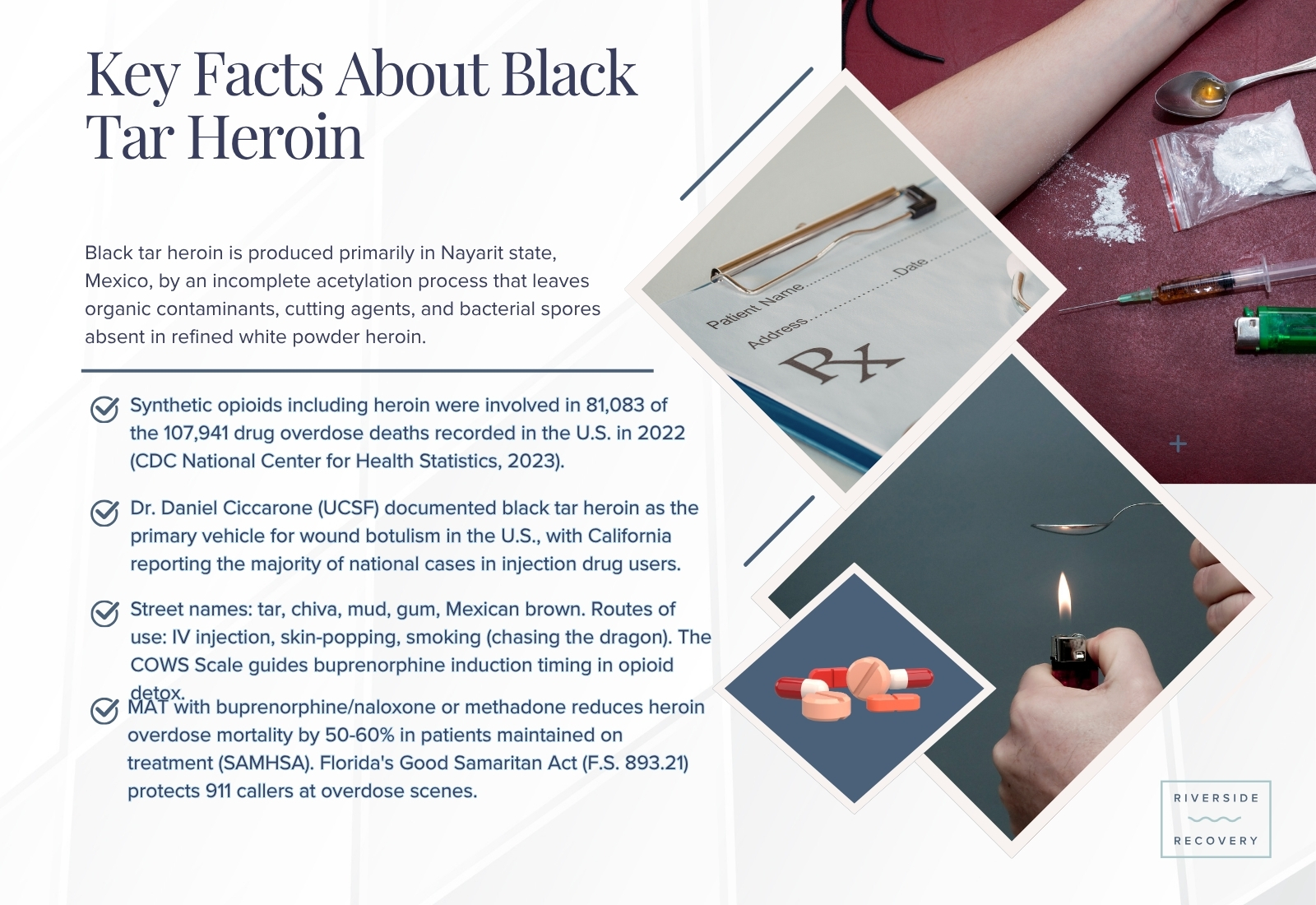
Black tar heroin is a crude, incompletely refined form of diacetylmorphine (heroin) produced primarily in Nayarit state, Mexico. It uses a simplified morphine acetylation process that prioritizes speed and yield over chemical purity. The result is a heterogeneous substance with a dark brown to black color, tar-like or rock-like consistency, and a distinctive vinegar odor from residual acetic anhydride used in the acetylation process.
How Black Tar Heroin Is Produced
White powder heroin requires a multi-step extraction and purification process using chloroform, ammonia, and other solvents to isolate diacetylmorphine HCl. Black tar heroin skips these purification steps, producing a product with 25 to 80 percent diacetylmorphine purity alongside residual morphine, acetylmorphine intermediates, and organic debris from crude processing.
- Acetylation without purification: Morphine is acetylated with acetic anhydride but not subsequently washed, leaving unreacted acetic acid, monoacetylmorphine, and manufacturing byproducts in the final product
- Variable purity: Black tar heroin purity ranges from under 25 percent to over 80 percent diacetylmorphine depending on the specific production batch, creating unpredictable potency per gram that makes consistent dosing impossible
- Cutting agents: Black tar heroin is typically mixed with lactose, burned cornstarch, coffee, chocolate powder, or soil to increase weight and reduce cost, with each adding its own contamination profile
Street Names for Black Tar Heroin
Black tar heroin is distributed under several street names that reflect its appearance, origin, and regional distribution patterns documented by DEA intelligence reports.
- Tar, chiva, mud, gum: Common names across the U.S. southwest and west coast distribution zones supplied by Mexican trafficking organizations
- Brown sugar, brown, Mexican brown: Names used to distinguish it from white powder heroin in markets where both circulate
- Smack, horse, boy: Generic heroin terms applied to black tar in regions where white powder is unavailable
Why Is Black Tar Heroin More Dangerous than White Powder Heroin?
Black tar heroin produces the same mu-opioid receptor agonism and euphoria as refined heroin but introduces distinct medical hazards through its impurity profile, injection-specific bacterial contamination risks, and distribution overlap with illicitly manufactured fentanyl.
Wound Botulism and Anaerobic Infection Risk
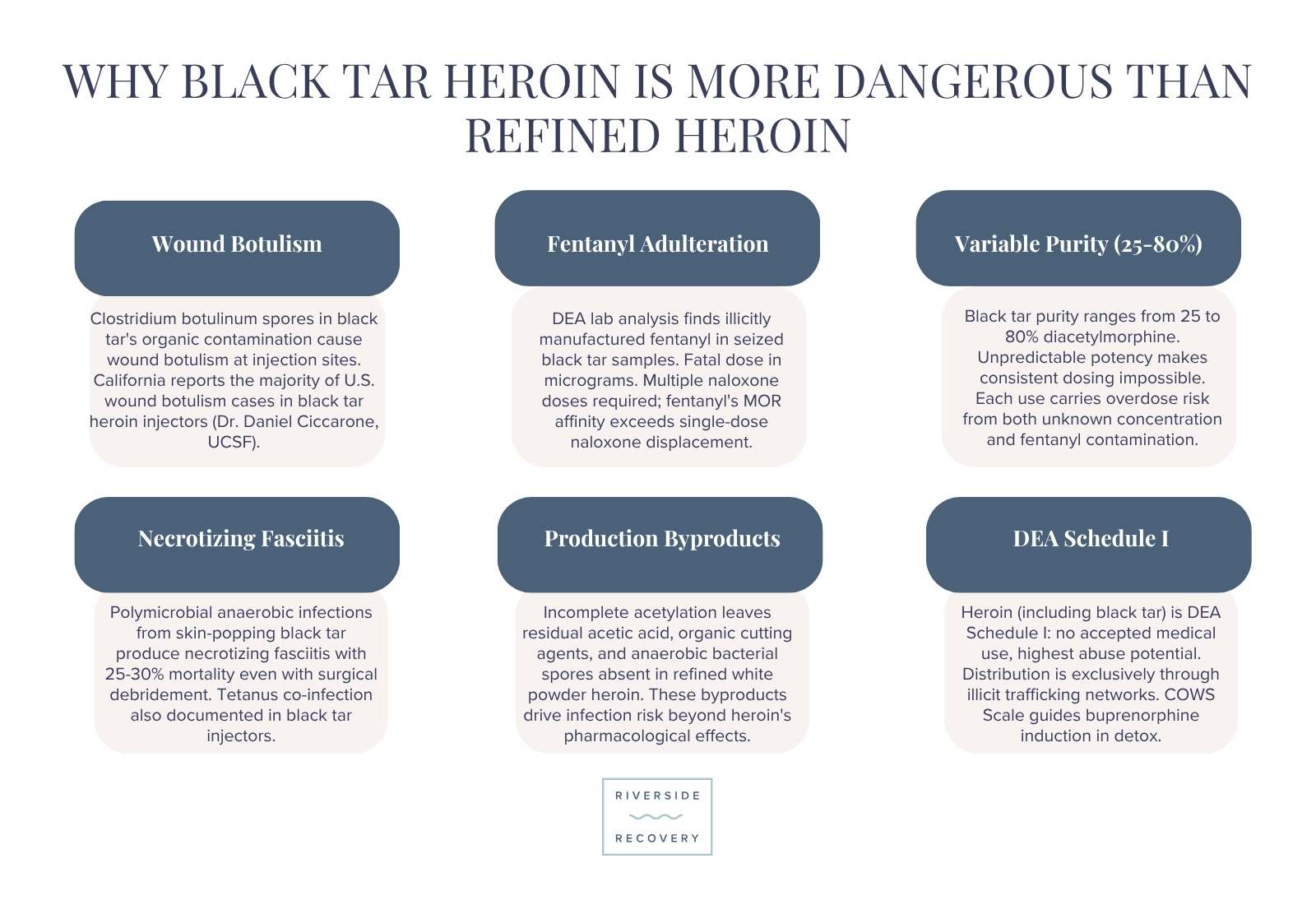
Dr. Daniel Ciccarone at the University of California San Francisco has documented that black tar heroin is the primary vehicle for wound botulism in the United States, with California reporting the majority of U.S. wound botulism cases in people who inject black tar heroin through skin-popping or muscle-popping rather than intravenous injection.
- Wound botulism mechanism: Clostridium botulinum spores present in black tar heroin’s organic contamination proliferate in the anaerobic environment of subcutaneous injection sites, producing botulinum toxin that travels to the neuromuscular junction and blocks acetylcholine release, causing descending flaccid paralysis and respiratory failure
- Necrotizing fasciitis: Polymicrobial anaerobic infections from black tar heroin injection sites produce necrotizing fasciitis, a rapidly spreading soft tissue infection with 25 to 30 percent mortality even with surgical debridement
- Tetanus co-infection: Clostridium tetani spores in black tar heroin cutting agents cause tetanus in people who skin-pop, a condition nearly eliminated in the general population but persistently reported in heroin-injecting populations
Fentanyl Adulteration and Potency Unpredictability
Black tar heroin’s street distribution increasingly overlaps with illicitly manufactured fentanyl, either as a direct adulterant or as a substitute product sold as heroin. Fentanyl is 50 to 100 times more potent than morphine at the mu-opioid receptor, which is a statement about the dose required for a given effect rather than about binding affinity alone, and it compresses the therapeutic-to-lethal dose window to a margin that produces fatal respiratory depression within minutes in opioid-naive or tolerant-reduced individuals.
- Fentanyl adulteration: DEA laboratory analysis of seized black tar heroin samples has identified fentanyl, carfentanil, and acetylfentanyl as adulterants, introducing synthetic opioid overdose risk even to heroin-tolerant users
- Naloxone dose stacking: Fentanyl-adulterated black tar heroin overdoses require multiple sequential naloxone doses because fentanyl’s mu-opioid receptor affinity exceeds standard single-dose naloxone displacement capacity
- Test strip utility: Fentanyl test strips detect fentanyl in dissolved black tar heroin samples; a negative result does not rule out all fentanyl analogs, but strip testing reduces overdose risk in harm reduction contexts
How Heroin Affects the Brain and Body
Heroin, including black tar heroin, produces its pharmacological effects by rapidly crossing the blood-brain barrier and binding mu-opioid receptors throughout the central and peripheral nervous system with greater speed than other opioids due to its lipophilicity.
Neurobiological Mechanism
Diacetylmorphine is a prodrug metabolized to 6-monoacetylmorphine and morphine after crossing the blood-brain barrier. 6-monoacetylmorphine produces intense, rapid mu-opioid receptor agonism in the ventral tegmental area, driving dopamine release into the nucleus accumbens that produces the euphoric rush reported as the defining feature of heroin’s reinforcing effect.
- Rush onset: Intravenous heroin produces peak CNS effect within 7 to 8 seconds; smoked or snorted black tar heroin produces peak effect within 5 to 15 minutes
- Medullary respiratory suppression: Mu-opioid receptor activation in the medullary respiratory center suppresses hypercapnic ventilatory drive, producing the respiratory depression that causes overdose death
- Neuroadaptation timeline: Physical dependence develops within 2 to 4 weeks of daily heroin use through NMDA receptor upregulation and mu-opioid receptor downregulation that produces tolerance and withdrawal on cessation
Signs of Black Tar Heroin Use
Black tar heroin produces the same opioid intoxication signs as refined heroin but leaves additional physical markers from its injection-specific use patterns and wound infection complications.
- Opioid intoxication signs: Pinpoint pupils (miosis), sedation, slowed speech, respiratory rate below 12 breaths per minute, and muscle relaxation
- Injection site evidence: Track marks, skin abscesses, cellulitis, or soft tissue swelling at injection sites; “popper lesions” from subcutaneous injection may indicate black tar heroin specifically
- Withdrawal signs (COWS Scale): Mydriasis (dilated pupils), piloerection, diaphoresis, yawning, rhinorrhea, nausea, myalgia, and restlessness measured on the Clinical Opiate Withdrawal Scale (COWS)
Black Tar Heroin Overdose: Signs That Require 911
Opioid overdose from black tar heroin follows the same clinical progression as refined heroin overdose but carries higher risk of non-responsive overdose due to fentanyl adulteration and reduced time from intoxication to respiratory failure.
Emergency Warning Signs
- Unresponsiveness: Cannot be awakened by voice, sternal rub, or painful stimuli; call 911 immediately and administer naloxone
- Agonal breathing: Slow, irregular gasping with prolonged pauses between breaths signals imminent respiratory failure
- Cyanosis: Blue or gray discoloration of lips, fingertips, or face from hypoxic respiratory failure; indicates minutes to irreversible organ damage
Naloxone Administration
Naloxone (Narcan) reverses heroin overdose through competitive mu-opioid receptor displacement. Black tar heroin overdoses, particularly those involving fentanyl adulteration, frequently require multiple naloxone doses administered every 2 to 3 minutes until breathing normalizes. Florida’s Good Samaritan Act (F.S. 893.21) provides legal immunity to individuals who call 911 and administer naloxone at an overdose scene.
Opioid Use Disorder Treatment at Riverside Recovery of Tampa
Opioid use disorder from heroin use, including opioid addiction, meets full DSM-5-TR criteria for a chronic neurobiological condition requiring structured medical and behavioral intervention. At Riverside Recovery of Tampa, heroin detox and treatment programs address the complete clinical picture including comorbid wound infections, hepatitis C, and co-occurring psychiatric conditions.
Medical Detox
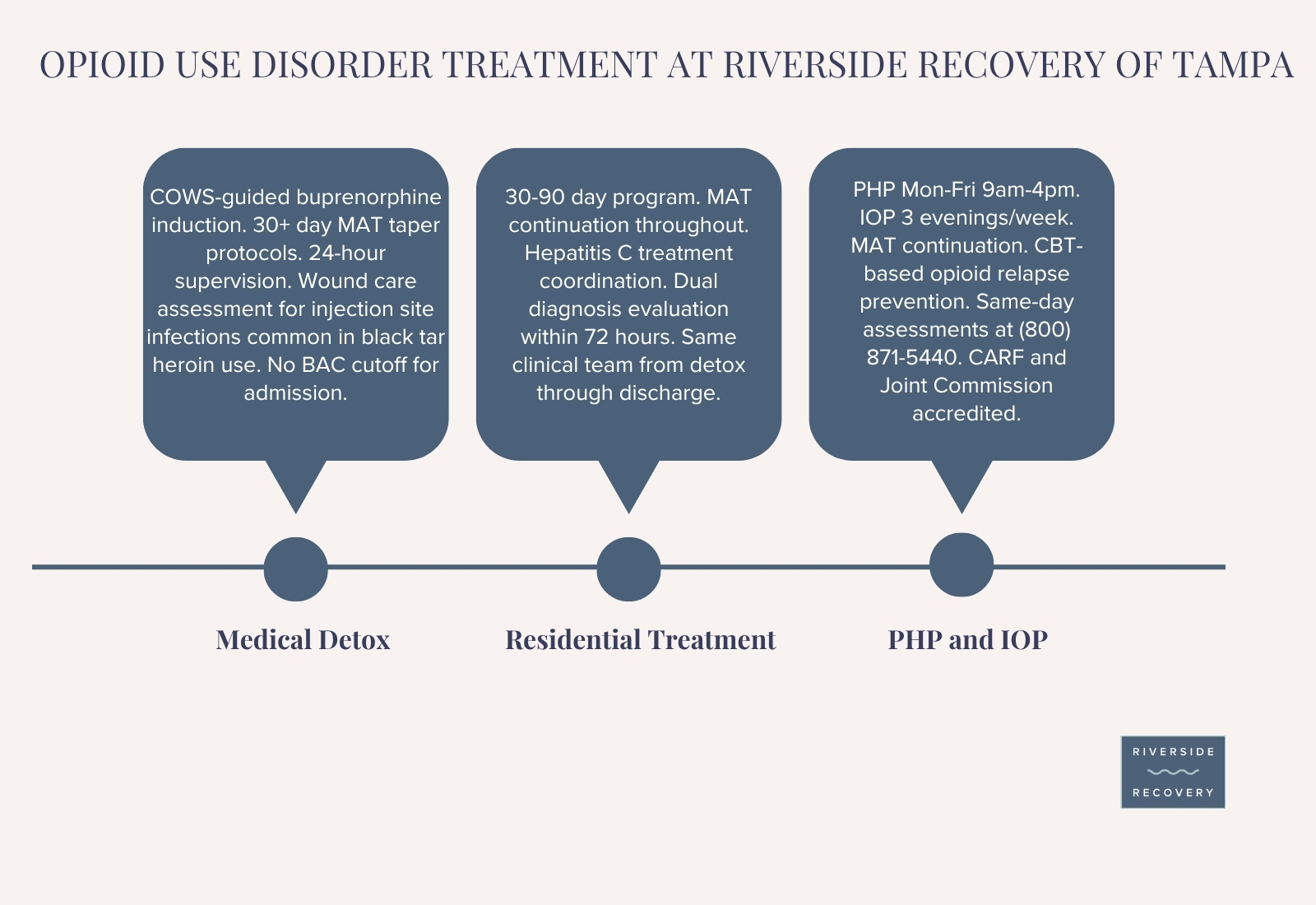
Medical detox uses COWS-guided buprenorphine/naloxone induction and methadone maintenance under 24-hour clinical supervision, with wound care consultations and infectious disease assessment for patients presenting with injection site complications common in black tar heroin users. No BAC cutoff applies; patients presenting with active opioid intoxication are admitted immediately.
Residential and Step-Down Care
Residential treatment provides 30 to 90 days of structured care with MAT continuation, hepatitis C treatment coordination, and dual diagnosis assessment for co-occurring PTSD and mood disorders common in opioid use disorder populations. Step-down through Day/Night Treatment and IOP maintains MAT and recovery support. All programs offer same-day assessments at (800) 871-5440.
Frequently Asked Questions
What is black tar heroin?
Black tar heroin is an incompletely refined form of diacetylmorphine produced primarily in Mexico, characterized by a dark, sticky or rock-like consistency from residual acetic acid and organic cutting agents left by a crude production process. It contains 25 to 80 percent diacetylmorphine alongside manufacturing byproducts and bacterial contaminants not found in refined white powder heroin.
Why is black tar heroin more dangerous?
Black tar heroin is more dangerous because of its unpredictable potency, fentanyl adulteration risk, and unique wound infection complications including wound botulism, necrotizing fasciitis, and tetanus from anaerobic bacteria in its organic contamination. Its purity variability makes consistent dosing impossible, and its distribution network increasingly overlaps with illicitly manufactured fentanyl.
What does black tar heroin look like?
Black tar heroin ranges from a dark brown to black color with a sticky tar-like texture or a harder rock-like consistency depending on how dry the product is. It has a strong vinegar odor from residual acetic anhydride. In contrast, white powder heroin appears as a white or off-white fine powder with little to no odor.
Can you smoke black tar heroin?
Yes. Black tar heroin is commonly smoked by “chasing the dragon” (heating on aluminum foil and inhaling the vapor), which avoids the wound infection risks of injection but still produces full mu-opioid receptor agonism and overdose risk. Smoking delays peak effect to 5 to 15 minutes compared to 7 to 8 seconds for intravenous use but carries the same addiction potential.
How long does black tar heroin withdrawal last?
Black tar heroin withdrawal typically begins within 8 to 24 hours of the last use, peaks at 48 to 72 hours, and acute symptoms resolve within 7 to 10 days. COWS-guided buprenorphine induction initiated when COWS scores reach 8 to 12 significantly shortens the peak withdrawal period and reduces the risk of relapse during the acute phase.
What are the signs of a black tar heroin overdose?
Signs include unresponsiveness to stimulation, slow or absent breathing (fewer than 6 breaths per minute), pinpoint pupils, cyanosis of lips or fingertips, and complete muscle limpness. Fentanyl-adulterated black tar heroin produces these signs within 60 to 90 seconds of intravenous administration. Call 911 immediately, administer naloxone, and perform rescue breathing.
Is black tar heroin the same as regular heroin?
No. Both contain diacetylmorphine as the active drug, but black tar heroin is produced by a crude process leaving contaminants, cutting agents, and anaerobic bacterial spores not present in refined white powder heroin. Black tar heroin also has lower and more variable purity (25 to 80 percent) compared to white powder heroin, and is specific to Mexican trafficking routes rather than South American or Asian supply chains.
References
- Ciccarone, D. H., Bamberger, J. D., Kral, A. H., Edlin, B. R., Hobart, C. J., Moon, A., Murphy, E. L., Bourgois, P., Cohen, J. B., & Edlin, B. R. (2001). Soft tissue infections among injection drug users San Francisco, California, 1996–2000. Morbidity and Mortality Weekly Report, 50(19), 381–384.
- Centers for Disease Control and Prevention. (2018). Wound botulism among persons who use black tar heroin Washington, 2017–2018. MMWR Morb Mortal Wkly Rep, 67(45), 1247–1248.
- Centers for Disease Control and Prevention, National Center for Health Statistics. (2023). Drug overdose deaths in the United States, 2001–2022. NCHS Data Brief No. 491.
- Drug Enforcement Administration. (2023). National Drug Threat Assessment 2023. U.S. Department of Justice.
- Substance Abuse and Mental Health Services Administration. (2023). National Survey on Drug Use and Health, 2022 results. U.S. Department of Health and Human Services.
- Lafferty, W. E., et al. (2000). Heroin and black tar heroin in the United States: Behavioral risks and patterns of use. American Journal of Drug and Alcohol Misuse, 26(4), 633–645.
- American Psychiatric Association. (2022). Diagnostic and Statistical Manual of Mental Disorders, Fifth Edition, Text Revision (DSM-5-TR). American Psychiatric Publishing.