
Trazodone and alcohol both depress the central nervous system, and taken together they depress it further than either does alone through three separate mechanisms. Most people asking about this combination are taking trazodone for sleep during early recovery from drinking, a situation that has been studied directly in a randomized trial of 173 people. The pharmacology comes first, because it explains both the risk and the timing question underneath it.
Key Takeaways
- Trazodone is a serotonin antagonist and reuptake inhibitor approved by the FDA for major depressive disorder, not for insomnia. Prescribing it for sleep is off-label, legal and routine.
- A randomized, double-blind, placebo-controlled trial of 173 people found trazodone improved sleep after alcohol detoxification, but the trazodone group showed less improvement in days abstinent than placebo.
- Drinks per drinking day rose once the study medication stopped, and the sleep benefit did not outlast the prescription.
- Three mechanisms drive the interaction: histamine H1 blockade, alpha-1 adrenergic blockade, and competition for cytochrome P450 3A4 in the liver.
- Riverside Recovery of Tampa pairs 24-hour medically supervised detox with psychiatric care from Dr. Ryan Wagoner, MD, Psychiatric Advisor, and Erin Ikenberry, PA-C, CAQ-Psychiatry, Assistant Medical Director.
What Is Trazodone?
Trazodone is a serotonin antagonist and reuptake inhibitor, a class abbreviated SARI. The FDA approved it for major depressive disorder. Prescribers use it widely for insomnia at doses well below the antidepressant range. StatPearls notes trazodone is not FDA-approved for sleep disorders due to insufficient clinical data to justify its use as a sedative agent.
The dose separation explains the two uses. StatPearls gives immediate-release antidepressant dosing as 50 to 100 mg two or three times daily, to a maximum of 400 mg daily for outpatients and 600 mg daily for inpatients. Sleep dosing typically runs 25 mg to 100 mg at bedtime. At that lower range, histamine H1 blockade dominates and produces sedation without meaningful antidepressant effect.
Sedation begins within roughly one hour and peaks around two hours. Antidepressant effects take weeks. That gap between immediate sedation and delayed mood effect is the reason trazodone became a default sleep prescription in addiction medicine.
Each of those receptor actions is also a point where alcohol interferes.
Why Do Trazodone and Alcohol Interact?
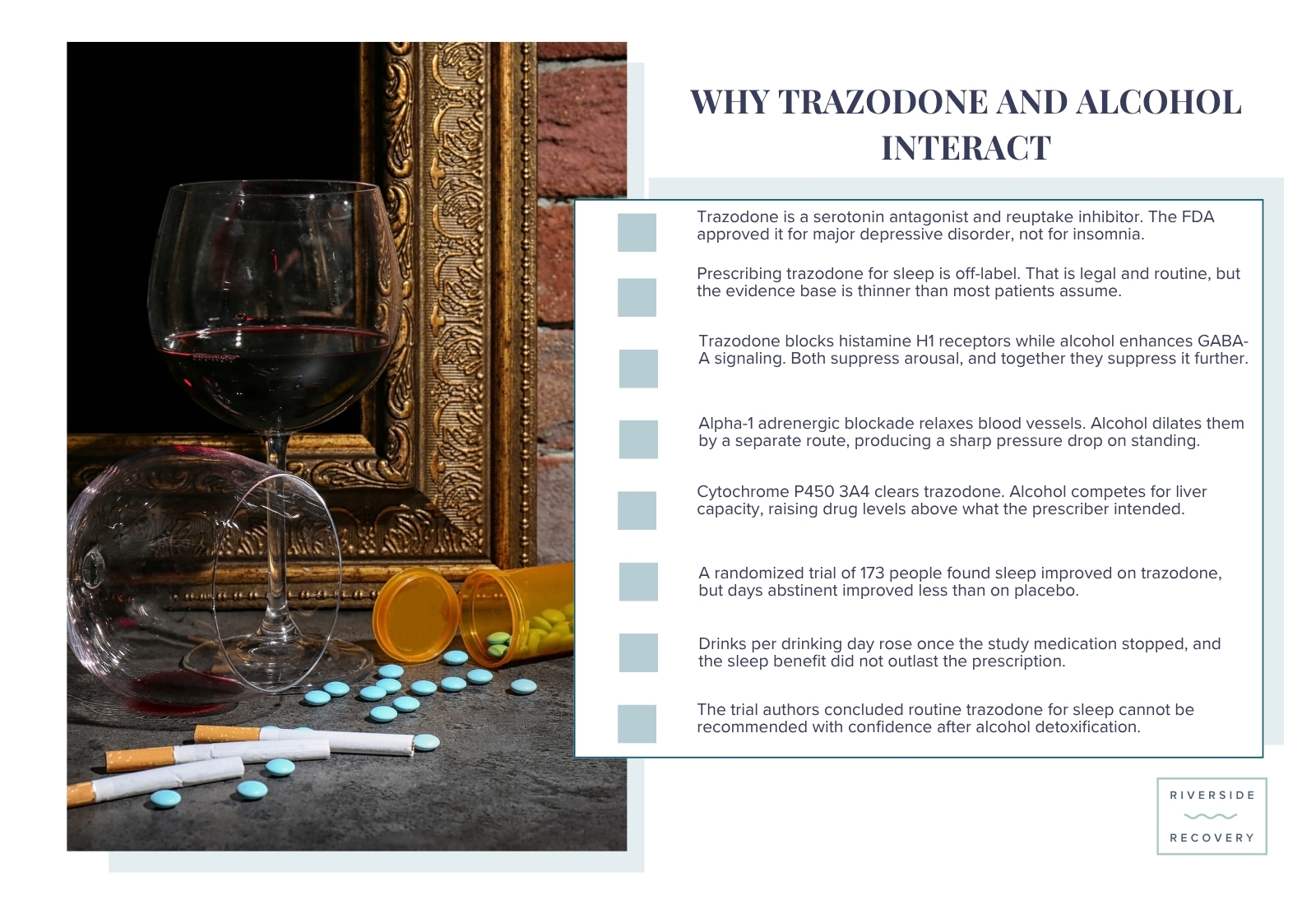
Trazodone and alcohol interact through three mechanisms. Trazodone blocks histamine H1 receptors while alcohol enhances GABA-A signaling, and both suppress arousal. Alpha-1 adrenergic blockade drops blood pressure. Alcohol competes for cytochrome P450 3A4, the enzyme that clears trazodone.
How does the sedation compound?
Trazodone blocks histamine H1 receptors, which is the same mechanism that makes older antihistamines sedating. Alcohol enhances signaling at GABA-A receptors, the brain’s primary inhibitory system. StatPearls states directly that trazodone increases the central nervous system depression induced by alcohol and benzodiazepines, and increases the risk of falls and injury.
Why does blood pressure drop?
Alpha-1 adrenergic blockade relaxes blood vessels. Alcohol dilates them by a separate route. Standing up after combining the two produces a sharp pressure drop, and falls rather than overdose are the most frequent injury from this combination. The mechanism parallels what happens when mixing Zoloft and alcohol, though the receptor profile differs.
What does the liver competition do?
Cytochrome P450 3A4 clears trazodone. Alcohol competes for that enzyme capacity, so trazodone levels rise above what the prescriber intended. The patient receives a higher effective dose than the label describes without changing a single tablet.
Those mechanisms explain the acute risk. The trial evidence addresses a different question, which is whether the prescription helps at all.
What Does the Trial Evidence Show?
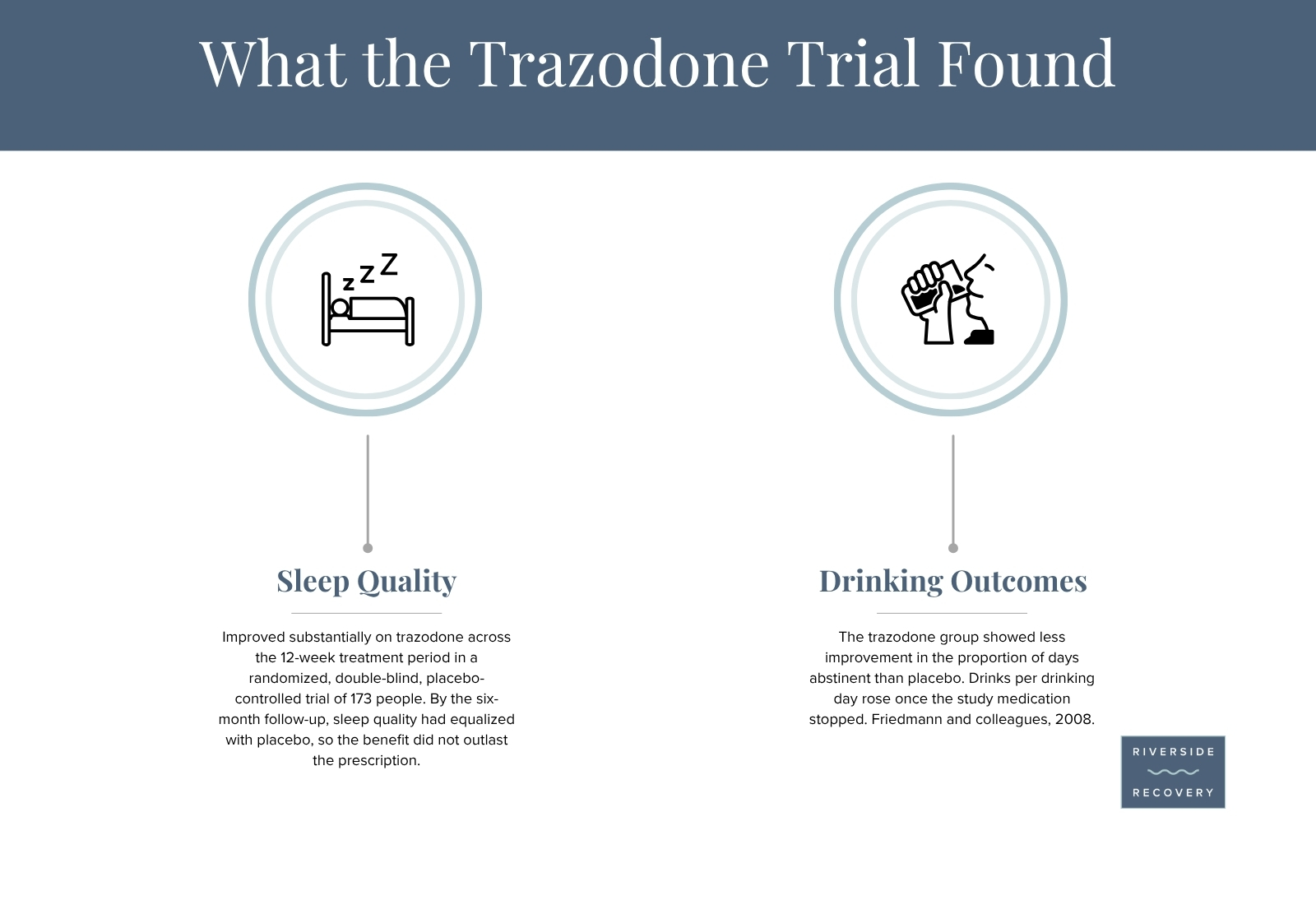
Friedmann and colleagues ran a randomized, double-blind, placebo-controlled trial of 173 people after alcohol detoxification in 2008. Sleep quality improved substantially on trazodone across 12 weeks. The trazodone group showed less improvement in the proportion of days abstinent than placebo.
Two findings matter beyond the headline. By the six-month follow-up, sleep quality had equalized with placebo, so the benefit did not outlast the prescription. Drinks per drinking day rose once the study medication stopped.
The trial authors concluded that routine trazodone for sleep cannot be recommended with confidence after alcohol detoxification. That conclusion sits against a prescribing pattern that treats it as a default, which is the gap worth knowing before starting it.
Patients who already take it nightly then face a practical question about timing.
How Long After Taking Trazodone Can You Drink?
No interval makes drinking safe for someone taking trazodone nightly. The terminal elimination half-life is 5 to 9 hours, so nightly dosing means the drug is never fully absent. Prescribing information advises avoiding alcohol entirely during treatment.
StatPearls gives the terminal elimination half-life of trazodone as 5 to 9 hours, so a single dose takes roughly two days to clear completely. A nightly prescription never reaches that point, because the next dose arrives first.
Risk scales with dose rather than disappearing at low amounts. One drink measurably increases impairment, dizziness and fall risk, and individual response varies with body size, tolerance and other medications. People weighing an over-the-counter alternative should note that mixing melatonin and alcohol carries its own interaction rather than avoiding the problem.
Can you take trazodone after drinking alcohol?
Taking trazodone on a night when drinking has already happened reverses the order without reducing the risk. Alcohol is still clearing, and adding trazodone stacks sedation and blood pressure effects on top of it. The safer action is skipping that night’s dose and telling the prescriber, rather than taking it late to compensate.
What are the serious risks of trazodone itself?
Beyond the alcohol interaction, StatPearls lists orthostatic hypotension, syncope, QT prolongation, Torsade de pointes and priapism among trazodone’s risks. Priapism is a urological emergency requiring immediate care. QT prolongation arises from trazodone’s interaction with hERG potassium channels, and alcohol adds cardiac strain on top of it.
Is 25 mg or 50 mg of trazodone safe with alcohol?
Risk is lower at 25 mg and 50 mg than at antidepressant doses, and it is not absent. Those low doses are exactly where histamine H1 blockade dominates, so sedation is the main effect present and alcohol amplifies it directly. Alpha-1 blockade drives blood pressure effects at the same range. Neither dose has a threshold below which combining is safe.
For anyone drinking heavily and taking trazodone, stopping the alcohol raises a separate and more urgent risk.
Can Trazodone Help With Alcohol Withdrawal?
Trazodone is not a first-line treatment for alcohol withdrawal. Benzodiazepines remain the standard because they prevent withdrawal seizures, which trazodone does not. Trazodone treats a symptom of withdrawal rather than the dangerous physiology underneath it.
Alcohol withdrawal produces tremor, sweating, anxiety and elevated heart rate in the first 72 hours, and can escalate to seizures and delirium tremens. Sedation does not prevent that escalation. Anyone drinking heavily and daily needs medically supervised withdrawal rather than a sleep aid.
Insomnia during that period is expected rather than a treatment failure. Alcohol suppresses REM sleep, and the rebound after stopping disrupts sleep for weeks to months while sleep architecture normalizes.
That distinction shapes how insomnia gets treated once the acute risk has passed.
How Is Insomnia Treated in Alcohol Recovery?
Cognitive behavioral therapy for insomnia, abbreviated CBT-I, is the first-line treatment for chronic insomnia in the American College of Physicians guideline. It outperforms medication over the long term and carries no interaction with alcohol or with psychiatric prescribing.
CBT-I works through sleep restriction, stimulus control and cognitive restructuring rather than sedation, so the gains persist after the treatment ends. That contrasts directly with the Friedmann finding, where the trazodone benefit disappeared once the prescription stopped.
Medication still has a role where insomnia is severe or where a co-occurring condition drives it. Untreated major depressive disorder produces insomnia directly, and treating the depression frequently resolves the sleep problem without a dedicated sleep drug. That assessment belongs to a prescriber who can see both conditions at once.
Getting both assessed together is what determines whether trazodone belongs in the plan at all.
Where Can You Get Treatment in Tampa?
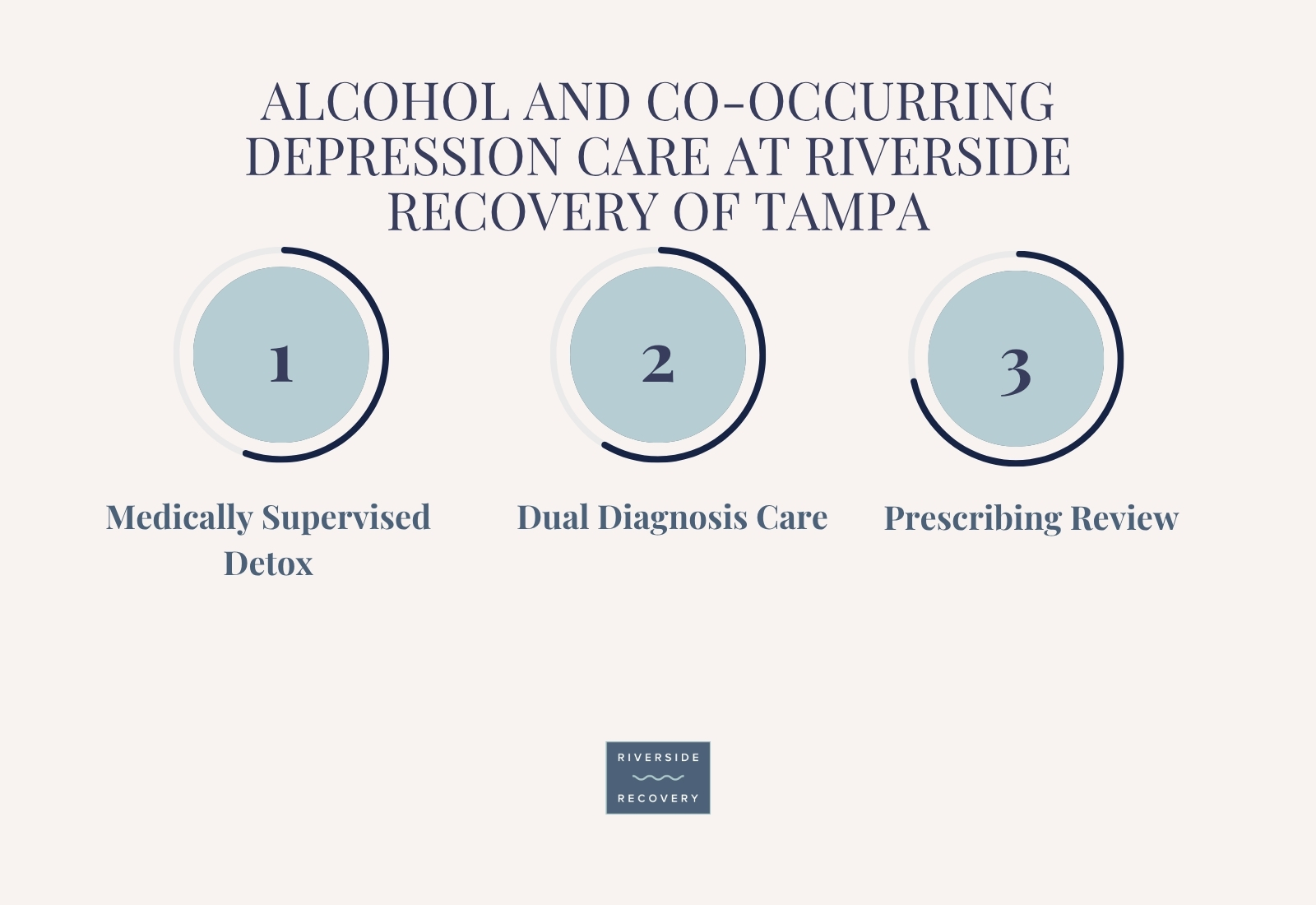
Riverside Recovery of Tampa treats alcohol use disorder alongside co-occurring depression, with psychiatric prescribing overseen by the medical team. Medical Director Dr. Michael Sore, MD is certified in addiction medicine and serves as an evaluator for Florida’s IPN and PRN programs.
Psychiatric medication is not stopped during detox. Trazodone or any antidepressant continues treating the underlying condition while alcohol withdrawal is managed separately, under 24-hour medically supervised care with registered nurses on every shift.
Prescribing review matters specifically here, because a trazodone prescription started for sleep during active drinking deserves reassessment once the drinking stops. The clinical team runs five medical providers and a sixteen-member clinical staff at 1:8 staffing against a Florida requirement of 1:15. Treatment for alcohol use disorder continues through residential, partial hospitalization and intensive outpatient care.
Insurance is verified during a phone pre-assessment, and same-day admission is possible for morning callers.
“A trazodone prescription that started during active drinking was solving a problem the drinking created. Once the alcohol stops, that problem changes shape. Every patient here gets a psychiatric evaluation from a psychiatric provider rather than a medication review bolted onto detox, and they keep the same therapist from detox through residential. That continuity is what lets us tell a real sleep disorder apart from alcohol still leaving the system.”
Dr. Ryan Wagoner, MD, Psychiatric Advisor, Riverside Recovery of Tampa
Frequently Asked Questions
Can trazodone be used with alcohol?
No. Both depress the central nervous system, and combining them intensifies sedation, drops blood pressure and raises overdose risk. Prescribing information advises avoiding alcohol entirely during trazodone treatment.
Is trazodone addictive?
Trazodone carries no DEA schedule and does not produce classic dependence. Stopping abruptly after long use causes discontinuation symptoms, so tapering under medical supervision is standard.
Does trazodone calm you down right away?
Sedation begins within about an hour and peaks around two hours. Antidepressant effects take weeks. That gap is why trazodone gets prescribed for sleep despite its approved indication being depression.
What are the three medications used to treat alcohol use disorder?
Naltrexone, acamprosate and disulfiram hold FDA approval. Naltrexone reduces reward, acamprosate helps stabilize brain chemistry after drinking stops, and disulfiram produces an unpleasant reaction if alcohol is consumed.
Why do I still not sleep after quitting drinking?
Alcohol suppresses REM sleep, and the rebound after stopping disrupts sleep for weeks to months. This is expected in early recovery and improves as sleep architecture normalizes.
Is one drink on trazodone dangerous?
Risk scales with dose but is not zero at one drink. Impairment, dizziness and fall risk increase measurably, and individual response varies with body size, tolerance and other medications.
Does insurance cover treatment at Riverside Recovery of Tampa?
Insurance is verified during the phone pre-assessment before arrival. The facility is accredited by CARF and The Joint Commission.
References
- Trazodone, StatPearls
- Friedmann et al. (2008) Trazodone for sleep disturbance after alcohol detoxification, Alcoholism: Clinical and Experimental Research 32(9) 1652-1660
- Qaseem et al. (2016) Management of Chronic Insomnia Disorder in Adults, Annals of Internal Medicine 165(2) 125-133
- Alcohol’s Effects on the Body, National Institute on Alcohol Abuse and Alcoholism