



Sobriety fatigue is real, and it is one of the most common and least discussed reasons people struggle to maintain early recovery from alcohol use disorder.
Feeling exhausted after quitting drinking is not a sign that something is wrong with you. It is the predictable neurobiological consequence of your brain recalibrating after chronic ethanol exposure.
Alcohol artificially suppresses the central nervous system for months or years. When that suppression is removed, the brain requires weeks to months to restore normal dopaminergic function, sleep architecture, and adrenal regulation. During that restoration period, fatigue dominates.
Most people expect quitting alcohol to immediately improve energy. When the opposite happens, hopelessness sets in and relapse risk spikes. Understanding why sobriety fatigue occurs, how long it lasts, and what measurably accelerates recovery is the clinical foundation for staying sober through the first critical months.
Key Takeaways
- Sobriety fatigue is a recognized physiological phenomenon driven by dopaminergic dysfunction, disrupted sleep architecture, and HPA axis dysregulation following cessation of chronic alcohol use.
- In the 2024 National Survey on Drug Use and Health, 27.9 million people ages 12 and older, or 9.7% of that age group, had alcohol use disorder in the past year. Fatigue is among the most reported early recovery complaints across this population.
- Sleep disturbance outlasts acute withdrawal by a long margin. Brower, writing in Alcohol Research and Health, reports sleep abnormalities persisting through months and even years of abstinence, with reduced slow-wave sleep documented in people abstinent for as long as 719 days, which is why fatigue continues well beyond detox.
- Protracted or post-acute withdrawal, which includes persistent fatigue, mood dysregulation and cognitive fog, is a recognized clinical picture that follows the acute withdrawal stage. The research literature describes it as not yet clearly defined, and no reliable prevalence figure has been established. Around half of people with alcohol use disorder experience withdrawal symptoms when they reduce or stop drinking.
- Structured clinical treatment accelerates sobriety fatigue recovery by addressing the underlying neurobiological, nutritional, and psychiatric deficits that sustain it.
What Is Sobriety Fatigue?
Sobriety fatigue describes the persistent low energy, mental fog, and physical exhaustion that emerges in the days, weeks, and months following alcohol cessation, driven by the brain’s neurochemical recalibration after chronic ethanol suppression.
Why Quitting Alcohol Causes Fatigue, Not Energy
Chronic alcohol use restructures the brain’s neurochemical equilibrium. Ethanol’s GABA-A receptor potentiation and NMDA receptor inhibition suppress neural activity for the duration of alcohol use disorder.
When ethanol is removed, the brain does not immediately return to pre-addiction baseline. It rebounds into a state of neural hyperactivity that the central nervous system then works to suppress through downregulated neurotransmitter production. This compensatory suppression depletes the dopaminergic, serotonergic, and noradrenergic systems responsible for motivation, alertness, and sustained energy.
The result is not simply tiredness. It is a neurobiological energy deficit that persists until receptor sensitivity normalizes and endogenous neurotransmitter production restores to pre-addiction function.
The Difference Between Acute Withdrawal Fatigue and Sobriety Fatigue
Acute alcohol withdrawal produces fatigue as part of the autonomic hyperactivity syndrome occurring in the first 24 to 72 hours after last drink. This is distinct from sobriety fatigue, which begins after the acute withdrawal phase resolves and persists for weeks to months beyond it.
Acute withdrawal fatigue is driven by the adrenergic storm of GABA rebound. Sobriety fatigue is driven by the slower process of dopaminergic receptor resensitization, sleep architecture reconstruction, and nutritional repletion. Both are physiological rather than motivational, but they require entirely different management approaches.
How Alcohol Disrupts the Brain’s Energy Systems
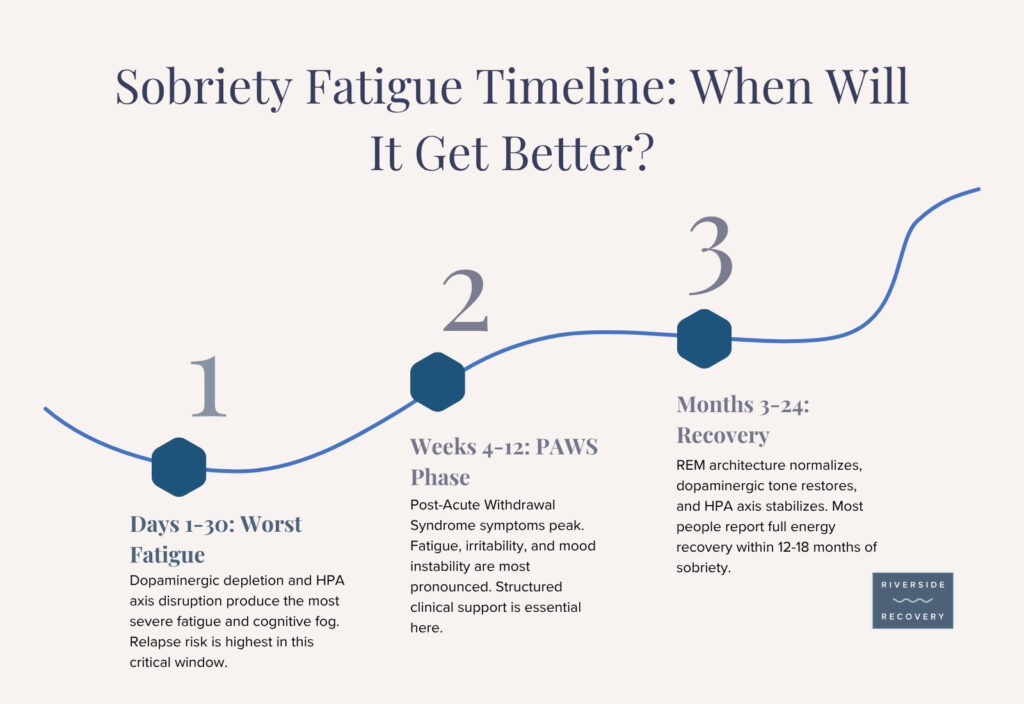
Alcohol exhausts the brain’s energy regulation systems through simultaneous suppression of dopaminergic reward signaling, destruction of sleep architecture, dysregulation of the HPA axis, and depletion of B vitamins essential for mitochondrial energy production.
Dopaminergic Reward Pathway Depletion
Chronic ethanol exposure elevates dopamine release in the nucleus accumbens far beyond the range produced by naturally rewarding activities. The brain responds by downregulating dopamine receptor density and endogenous dopamine production to prevent overstimulation.
When alcohol is removed, these downregulated dopamine receptors create a state of anhedonia in which normal activities produce insufficient dopaminergic reward to generate motivation or energy. The mesolimbic dopamine pathway, which drives purposeful behavior and sustained mental effort, operates below baseline until receptor resensitization occurs. This process takes weeks to months and is the neurobiological substrate of sobriety fatigue.
Alcohol-Induced Sleep Architecture Disruption
Alcohol is widely misused as a sleep aid because ethanol’s GABA-A potentiation accelerates sleep onset. However, ethanol suppresses REM sleep while increasing slow-wave sleep in the first half of the night and producing REM rebound fragmentation in the second half.
Chronic reliance on alcohol for sleep onset produces a sleep cycle that never completes its restorative functions. REM sleep performs memory consolidation, emotional processing, and neurological repair. Chronic REM suppression from alcohol use disorder leaves the nervous system in a state of cumulative sleep debt that does not resolve until REM architecture normalizes after sobriety, a process that is gradual and, on the evidence in Alcohol Research and Health, may remain incomplete after years of abstinence.
HPA Axis Dysregulation and Cortisol Disruption
Chronic alcohol exposure dysregulates the hypothalamic-pituitary-adrenal (HPA) axis, producing elevated baseline cortisol secretion during active alcohol use disorder. When alcohol is removed, the HPA axis overcorrects, producing blunted cortisol response at times when the body requires elevated cortisol for energy mobilization.
Normal cortisol peaks in the early morning to provide the alerting and energy-mobilizing signal that drives wakefulness. In early sobriety, HPA axis dysregulation flattens this morning cortisol peak. The result is a morning energy deficit that is physiological in origin rather than motivational, and that normalizes progressively over months of abstinence.
Sobriety Fatigue Timeline: How Long Does It Last?
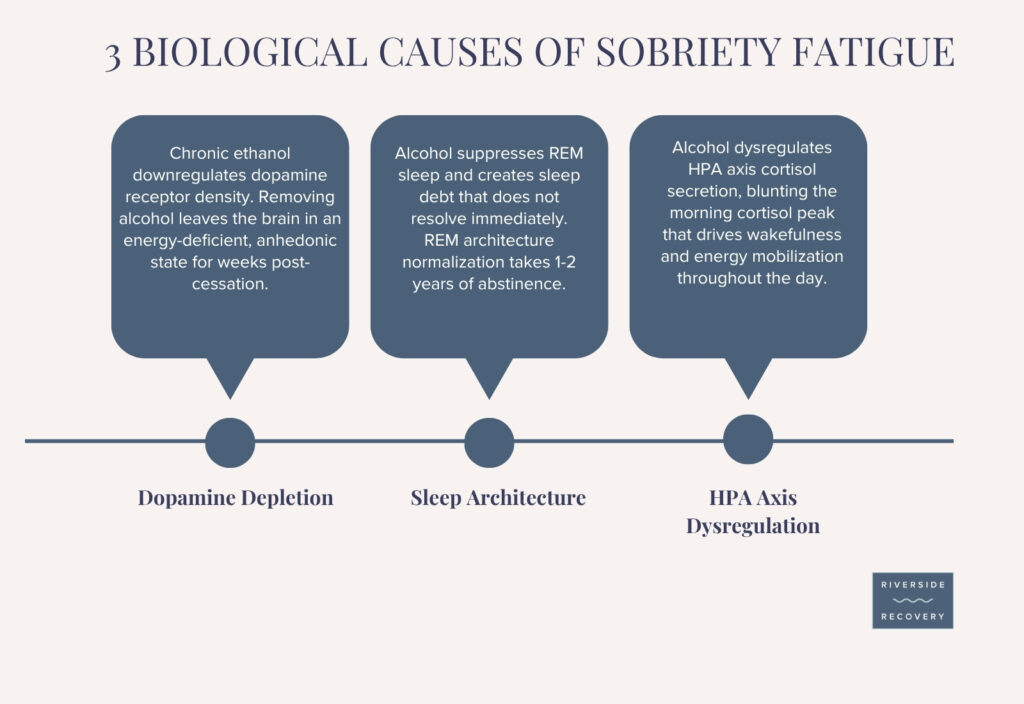
The duration of sobriety fatigue varies by the severity and duration of alcohol use disorder, individual neurological reserve, and whether structured clinical support is in place, but most people experience the worst fatigue within the first 90 days.
- Days 1 to 7 (Acute withdrawal): Acute alcohol withdrawal syndrome (AWS) produces insomnia, autonomic hyperactivity, and physical exhaustion. Fatigue in this stage is adrenergically driven and requires medical supervision.
- Days 7 to 30 (Early sobriety fatigue): The acute withdrawal phase resolves, but dopaminergic depletion and HPA axis dysregulation produce persistent low energy, anhedonia, and cognitive fog. Sleep may feel non-restorative despite adequate hours.
- Weeks 4 to 12 (Sub-acute PAWS phase): Post-Acute Withdrawal Syndrome (PAWS) symptoms peak. Fatigue, irritability, concentration deficits, and mood instability are most pronounced. Relapse risk is highest in this window.
- Months 3 to 6 (Progressive normalization): Dopaminergic receptor resensitization produces gradual improvement in motivation and energy. Sleep quality measurably improves. Fatigue decreases but does not fully resolve for most people.
- Months 6 to 24 (Full neurological recovery): REM sleep architecture normalizes, HPA axis function stabilizes, and dopaminergic tone restores toward pre-addiction baseline. Most individuals report full energy restoration by 12 to 18 months of sustained abstinence.
Symptoms of Sobriety Fatigue: What Normal Looks Like vs. What Needs Attention
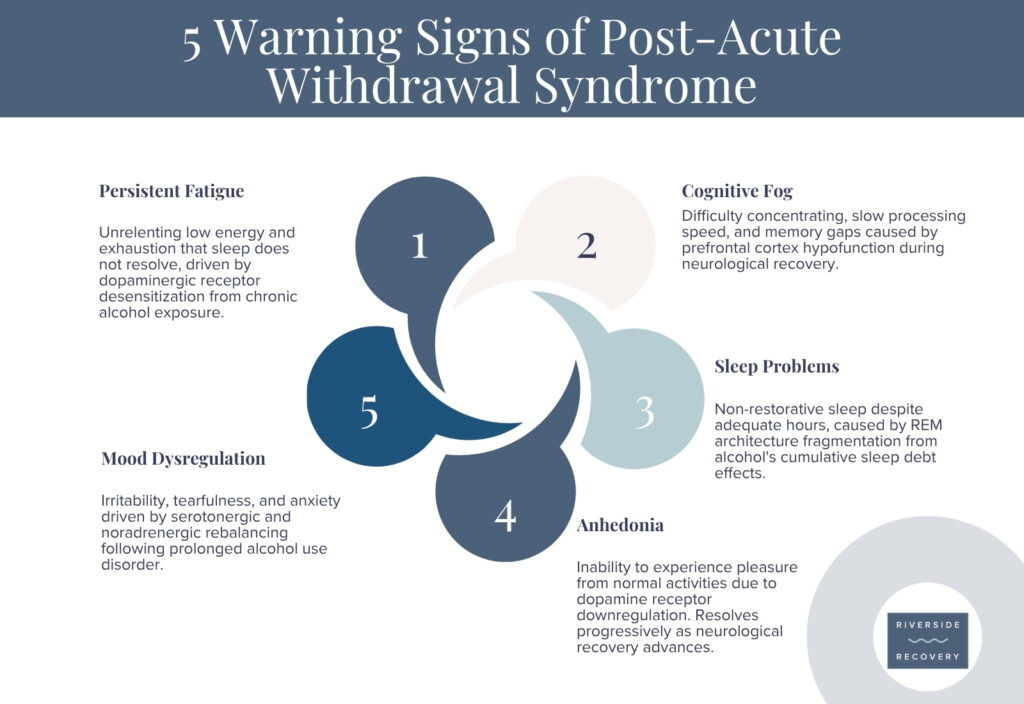
Sobriety fatigue produces a predictable symptom cluster that differs from clinically significant depression or other pathology requiring separate evaluation and treatment.
Common Symptoms of Sobriety Fatigue
Expected symptoms in early sobriety include:
- Persistent low energy: Generalized physical and mental fatigue that is not relieved by sleep and worsens with cognitive effort.
- Anhedonia: Diminished ability to experience pleasure from activities that previously generated positive affect, driven by dopaminergic receptor downregulation.
- Cognitive fog: Difficulty concentrating, slow information processing, and short-term memory lapses produced by sleep deprivation and prefrontal cortex hypofunction.
- Hypersomnia: Sleeping 10 to 12 hours or more without feeling rested, reflecting the nervous system’s attempt to recover sleep debt accumulated during active alcohol use disorder.
- Mood lability: Emotional dysregulation including irritability, tearfulness, and anxiety produced by serotonergic and noradrenergic system rebalancing.
When Sobriety Fatigue Requires Clinical Evaluation
Certain patterns require evaluation by a clinical provider rather than watchful waiting, because they may indicate a co-occurring condition that requires independent treatment:
- Fatigue persisting beyond 3 months without improvement may indicate co-occurring major depressive disorder, hypothyroidism, anemia, or Wernicke-Korsakoff syndrome from thiamine depletion.
- Suicidal ideation or hopelessness requires immediate psychiatric evaluation and crisis intervention regardless of its relationship to sobriety fatigue.
- Weight loss exceeding 10% of body weight combined with fatigue warrants nutritional and medical evaluation for alcohol-related malnutrition or liver disease.
- Cognitive decline that does not improve by week 12 may indicate alcohol-related brain damage requiring neuropsychological evaluation.
- Fatigue with peripheral neuropathy or ataxia warrants emergent evaluation for Wernicke’s encephalopathy, a thiamine-deficiency emergency.
Long-Term Consequences of Untreated Sobriety Fatigue
When sobriety fatigue is not recognized as a physiological process and managed clinically, the outcomes predictably include relapse and worsening neurological status.
Long-term consequences include:
- Relapse driven by fatigue-mediated cravings: Dopaminergic depletion produces intense cravings for alcohol as the fastest available source of dopamine elevation, making unmanaged sobriety fatigue a direct relapse trigger.
- Thiamine deficiency progression: Chronic alcohol use depletes thiamine (vitamin B1); unaddressed deficiency progresses from sobriety fatigue to Wernicke’s encephalopathy and permanent Korsakoff syndrome memory impairment.
- Co-occurring depression consolidation: Post-Acute Withdrawal Syndrome that transitions into a full major depressive episode produces substantially worse outcomes than AUD alone, requiring dual diagnosis treatment.
How to Manage Sobriety Fatigue: Evidence-Based Approaches
Sobriety fatigue resolves faster with structured clinical intervention than with abstinence alone, because the underlying neurobiological deficits driving it respond to specific nutritional, behavioral, and therapeutic interventions.
Thiamine and Nutritional Repletion
Chronic alcohol use disorder depletes thiamine (vitamin B1), magnesium, zinc, folate, and vitamins B6 and B12. All of these micronutrients are essential cofactors in mitochondrial energy production and neurological repair.
Thiamine supplementation at clinical doses is the first-line intervention for preventing Wernicke’s encephalopathy and accelerating neurological recovery in alcohol use disorder. Magnesium depletion is common in chronic alcohol use disorder, with a meta-analysis finding both total and ionised circulating magnesium markedly reduced. It independently produces fatigue, muscle weakness and sleep disruption that resolves with repletion.
Sleep Hygiene and Circadian Rhythm Restoration
REM sleep architecture restoration accelerates with consistent sleep-wake timing, darkness exposure during sleep, and avoidance of stimulants after 2 PM. Cognitive Behavioral Therapy for Insomnia (CBT-I) produces measurable improvements in sleep quality in early AUD recovery, with effects superior to pharmacological sleep aids that further suppress REM.
Physical exercise timed to morning or early afternoon activates the HPA axis cortisol peak appropriately, restoring the diurnal cortisol rhythm that early sobriety fatigue suppresses. Aerobic exercise 30 minutes daily accelerates dopaminergic normalization by increasing BDNF (brain-derived neurotrophic factor) expression in the hippocampus.
Structured Clinical Treatment and PAWS Management
Post-Acute Withdrawal Syndrome requires active clinical management, not passive waiting. Structured treatment in an outpatient or residential setting provides the psychiatric monitoring, nutritional support, and evidence-based behavioral therapy that accelerate neurological recovery from alcohol use disorder.
Treatment for Alcohol Use Disorder at Riverside Recovery of Tampa
Riverside Recovery of Tampa provides medically supervised alcohol detoxification, nutritional assessment, psychiatric care, and evidence-based behavioral therapy for alcohol use disorder across a full continuum of care. Same-day assessments are available.
Medical Detox and Residential Treatment
Riverside Recovery’s residential addiction treatment program provides 24-hour medically supervised detoxification for alcohol use disorder, with HPA axis monitoring, thiamine repletion protocols, and continuous psychiatric assessment throughout the acute and sub-acute withdrawal phases.
Dual Diagnosis Treatment
Many individuals experiencing sobriety fatigue present with co-occurring major depressive disorder or PTSD that predates or develops during early recovery. Riverside Recovery’s dual diagnosis treatment addresses both the alcohol use disorder and co-occurring psychiatric conditions within an integrated clinical plan.
Medication-Assisted Treatment
Medication-assisted treatment at Riverside Recovery includes naltrexone and Vivitrol for alcohol use disorder, reducing ethanol cravings during the PAWS phase when dopaminergic depletion makes relapse risk highest.
Intensive Outpatient Program
Riverside Recovery’s intensive outpatient addiction treatment provides structured day and evening clinical programming for clients managing sobriety fatigue and Post-Acute Withdrawal Syndrome while maintaining work, school, or family responsibilities.
Frequently Asked Questions
How Long Does Sobriety Fatigue Last?
Acute sobriety fatigue is most intense in the first 4 to 12 weeks after alcohol cessation. Post-Acute Withdrawal Syndrome (PAWS) symptoms, including persistent fatigue, cognitive fog, and mood lability, can persist for 6 to 24 months, depending on the severity of alcohol use disorder and whether structured clinical treatment supports neurological recovery.
Can Alcohol Cause Chronic Fatigue?
Yes. Chronic alcohol use disorder produces permanent changes to dopaminergic reward circuitry, sleep architecture, and HPA axis function that generate fatigue both during active use and in early recovery. Alcohol-induced thiamine deficiency compounds neurological fatigue through impaired mitochondrial energy production in neural tissue.
Why Is Sobriety So Tiring?
Sobriety is tiring because the brain spent months or years relying on ethanol to manage neurochemical equilibrium. When alcohol is removed, dopaminergic tone falls below baseline, sleep architecture is fragmented, and the HPA axis struggles to produce normal diurnal cortisol peaks. Fatigue is the predictable physiological result of this recalibration process.
When Should I Worry About Fatigue in Recovery?
Sobriety fatigue that does not gradually improve by week 12, that is accompanied by suicidal ideation, or that presents alongside peripheral neuropathy, significant cognitive decline, or rapid weight loss requires immediate clinical evaluation. These patterns may indicate a co-occurring medical or psychiatric condition requiring treatment beyond standard AUD recovery support.
References
- National Institute on Alcohol Abuse and Alcoholism. Alcohol use disorder. https://www.niaaa.nih.gov/publications/brochures-and-fact-sheets/understanding-alcohol-use-disorder
- Brower, K. J. (2001). Alcohol’s effects on sleep in alcoholics. Alcohol Research and Health, 25(2), 110–125.
- American Psychiatric Association. (2022). Diagnostic and Statistical Manual of Mental Disorders, Fifth Edition, Text Revision (DSM-5-TR). American Psychiatric Publishing.
- National Institute on Alcohol Abuse and Alcoholism. Beyond hangovers: Understanding alcohol’s impact on your health. https://www.niaaa.nih.gov/alcohols-effects-health/alcohols-effects-body
- Centers for Disease Control and Prevention. Alcohol use and your health. https://www.cdc.gov/alcohol/fact-sheets/alcohol-use.htm