

A blue Percocet is a legitimate 5 mg oxycodone/acetaminophen tablet manufactured by Endo Pharmaceuticals.
However, blue oxy pills sold outside a licensed pharmacy and labeled as “Percocet” or “M30” are overwhelmingly likely to be counterfeit tablets containing illicitly manufactured fentanyl, not oxycodone.
The Drug Enforcement Administration’s One Pill Can Kill campaign reported the seizure of over 60 million fentanyl-laced counterfeit pills in 2024 alone. DEA laboratory analysis found that 2 out of every 5 seized pills with fentanyl contained a potentially lethal dose.
At Riverside Recovery of Tampa, Medical Director Dr. Michael Sore, board-certified in both emergency medicine and addiction medicine, has treated opioid overdose cases involving counterfeit pills for over three decades. The clinical patterns his team sees during medically supervised detox reflect exactly what the DEA data describes: patients arriving after unknowingly ingesting fentanyl-laced tablets they believed were prescription oxycodone.
Key Takeaways
- A legitimate blue Percocet is a 5 mg oxycodone/325 mg acetaminophen tablet manufactured by Endo Pharmaceuticals, imprinted with “PERCOCET” on one face and “5” at the center, scored on the reverse.
- According to the DEA, 2 out of every 5 seized fentanyl-containing pills carry a potentially lethal dose; in 2024, over 60 million such pills were seized from the illicit drug supply.
- Illicitly manufactured fentanyl (IMF) is 100 times more potent than morphine and 50 times more potent than heroin; a dose of 2 milligrams, the size of a few grains of salt, can be fatal.
- Counterfeit blue M30 pills are visually indistinguishable from legitimate oxycodone tablets; the only safe source of oxycodone is a licensed pharmacy with a valid prescription.
- Opioid use disorder (OUD) affects approximately 2.7 million Americans, according to SAMHSA, and is treatable with medication-assisted treatment, behavioral therapy, and structured clinical care.
What Is a Blue Percocet?
A blue Percocet is a 5 mg oxycodone hydrochloride and 325 mg acetaminophen tablet, manufactured by Endo Pharmaceuticals and dispensed by licensed pharmacies as a Schedule II controlled substance for moderate-to-severe pain management.
Blue Percocet 5mg: Legitimate Pill Identification
Legitimate brand-name Percocet 5 mg tablets carry the following physical identifiers verified against the FDA-approved drug label:
- Shape: Round
- Color: Blue
- Imprint (front): “PERCOCET” printed around the edge with “5” at the center
- Imprint (back): Scored horizontally through the middle
- Manufacturer: Endo Pharmaceuticals
- DEA Schedule: Schedule II controlled substance (highest abuse potential classification for an approved medication)
- Active ingredients: Oxycodone hydrochloride 5 mg + acetaminophen 325 mg
Legitimate tablets are uniform in color, smooth-surfaced, and consistently imprinted with no spelling variations, blurring, or off-center lettering. Any deviation from these specifications indicates a likely counterfeit.

Blue M30 Oxycodone: Identification and Risk Profile
The blue M30 pill is a distinct product from Percocet. Legitimate M30 tablets contain 30 mg of oxycodone hydrochloride without acetaminophen and are manufactured by Mallinckrodt Pharmaceuticals.
- Shape: Round
- Color: Blue
- Imprint (front): “M” inside a square
- Imprint (back): “30” above a score line
- Active ingredient: Oxycodone hydrochloride 30 mg only (no acetaminophen)
- DEA Schedule: Schedule II
The M30 format has become the most frequently counterfeited opioid tablet in the United States illicit drug supply. Counterfeit M30s are visually indistinguishable from legitimate tablets in the hands of untrained observers, including the users purchasing them.
Percocet and Oxycodone Strength by Color: Reference Chart
| Color | Strength | Format | Manufacturer | Contains Acetaminophen? |
|---|---|---|---|---|
| Blue | 5 mg oxycodone | Round (brand Percocet) | Endo Pharmaceuticals | Yes, 325 mg |
| Pink | 2.5 mg oxycodone | Oval | Endo Pharmaceuticals | Yes, 325 mg |
| Peach/Orange | 7.5 mg oxycodone | Oval | Endo Pharmaceuticals | Yes, 500 mg |
| Yellow | 10 mg oxycodone | Oval | Endo Pharmaceuticals | Yes, 325 mg |
| White | 5 mg oxycodone (generic) | Round, imprint “512” | Various generics | Yes, 325 mg |
| Blue (M30) | 30 mg oxycodone | Round, imprint M/30 | Mallinckrodt | No |
| White (OxyContin 10) | 10 mg oxycodone extended-release | Round | Purdue Pharma | No |
Why Counterfeit Blue Pills Contain Fentanyl
Illicitly manufactured fentanyl (IMF) has displaced oxycodone as the primary adulterant in counterfeit prescription pills because its extreme potency allows drug trafficking organizations to produce thousands of doses from a small quantity of raw material that is inexpensive to synthesize.
How Fentanyl Gets Into Fake Pills
Mexican and domestic drug trafficking organizations source fentanyl precursor chemicals primarily from China and synthesize IMF in clandestine laboratories. Counterfeit pill presses stamp the resulting powder into tablets that visually replicate legitimate oxycodone products, including the correct color, shape, and imprint codes.
The mixing of fentanyl into pill substrate is not uniform. DEA forensic analysis confirms that fentanyl distribution within counterfeit tablets is inconsistent, meaning two pills with identical appearance from the same batch can contain vastly different fentanyl concentrations. This “hot spot” phenomenon is a primary driver of fentanyl overdose death in patients who have previously survived the same dose.
Fentanyl Binding Affinity vs. Oxycodone
Fentanyl binds mu-opioid receptors with approximately 50 to 100 times greater affinity than oxycodone. This difference in mu-opioid receptor binding affinity means that a dose of illicitly manufactured fentanyl equivalent to only 2 milligrams produces opioid-induced respiratory depression sufficient to cause death in a non-tolerant individual.
Oxycodone produces analgesia and euphoria through mu-opioid receptor agonism primarily in the spinal cord, thalamus, and limbic system. Fentanyl’s extreme lipophilicity enables faster blood-brain barrier penetration than oxycodone, accelerating respiratory depression onset and narrowing the window for emergency Naloxone (Narcan) administration.
How to Identify Fake Blue Percocet Pills
Counterfeit blue pills are designed to pass visual inspection, but physical imperfections in illicit manufacturing consistently produce detectable differences from pharmacy-dispensed legitimate tablets.
Visual Indicators of Counterfeit Pills
Characteristics that suggest a pill is counterfeit include:
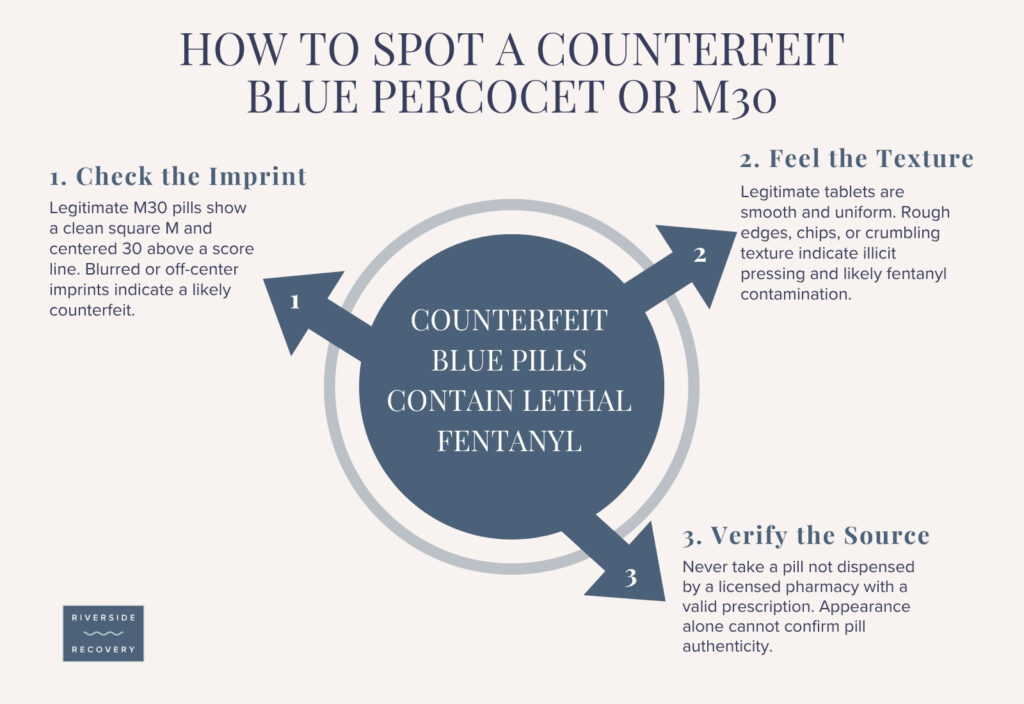
- Rough or uneven edges: Legitimate pharmaceutical tablets are stamped with high-pressure commercial presses that produce clean, uniform edges. Counterfeit presses leave visible roughness, chips, or burring.
- Blurred, off-center, or inconsistent imprinting: The “M” and “30” on counterfeit M30s are frequently misaligned, incorrectly spaced, or poorly defined compared to original Mallinckrodt tablets.
- Crumbling or chalky texture: Counterfeit pill binders use substandard excipients that produce tablets that crumble or powder when handled, unlike the firm, smooth surface of legitimate tablets.
- Inconsistent color intensity: Legitimate tablets show uniform color throughout the cross-section. Counterfeit tablets may display uneven dye distribution visible at chip sites.
- No imprint or incorrect imprint code: Any pill without a clear imprint code, or with an imprint code that does not match an FDA-listed legitimate product, should be treated as counterfeit.
The definitive safe message is: if the pill did not come from a licensed pharmacy with a valid prescription, assume it is counterfeit regardless of visual appearance.
Overdose Warning Signs and Emergency Response
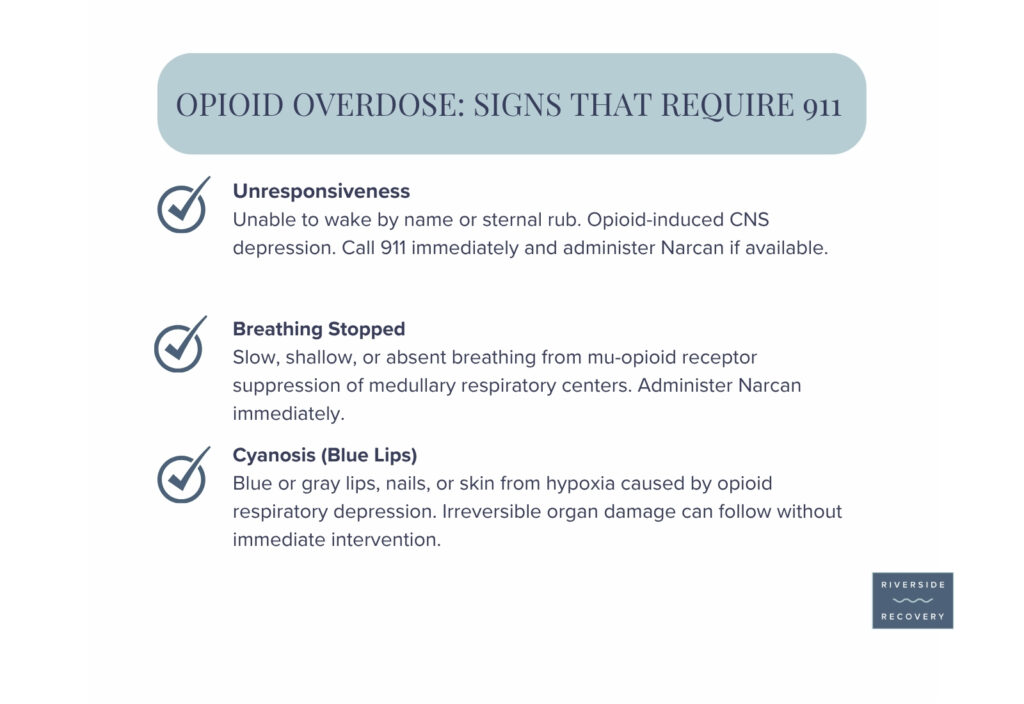
Fentanyl overdose progresses faster than oxycodone overdose due to the drug’s lipophilicity and superior mu-opioid receptor binding affinity. Recognize these signs immediately:
- Unresponsiveness or unconsciousness: Unable to wake the person by calling their name or sternal rub.
- Slow, shallow, gurgling, or stopped breathing: Respiratory rate below 12 breaths per minute or audible gurgling (“death rattle”) indicating partial airway obstruction.
- Blue or grayish lips, fingernails, or skin (cyanosis): Opioid-induced respiratory depression reduces blood oxygen saturation, producing cyanotic discoloration in peripheral tissues.
- Pinpoint pupils: Mu-opioid receptor activation in the Edinger-Westphal nucleus produces bilateral miosis even in low-light conditions.
- Limpness: Opioid-induced muscle hypotonia produces complete physical unresponsiveness to stimulation.
If any of these signs are present: Call 911 immediately. Administer Naloxone (Narcan) if available. Position the person on their side to prevent aspiration. Remain with them until emergency services arrive.
Naloxone (Narcan) competes with fentanyl for mu-opioid receptor binding and reverses respiratory depression within 2 to 5 minutes of administration. Multiple doses may be required because fentanyl’s high receptor binding affinity outlasts standard naloxone dosing in some cases.
Long-Term Consequences of Oxycodone and Fentanyl Misuse
Repeated mu-opioid receptor agonism produces neuroadaptive changes that escalate opioid use disorder severity over time. These consequences include:
- Physical dependence: Chronic opioid receptor agonism downregulates endogenous opioid peptide production, requiring continued external opioid exposure to prevent the Clinical Opioid Withdrawal Scale (COWS)-quantified withdrawal syndrome.
- Tolerance: Sustained mu-opioid receptor activation triggers receptor internalization and downstream G-protein signaling desensitization, requiring escalating opioid doses to achieve equivalent analgesic and euphoric effects.
- Opioid use disorder (OUD): DSM-5-TR diagnostic criteria for OUD include compulsive opioid-seeking behavior, continued use despite significant harm, and clinically significant tolerance and withdrawal.
- Overdose mortality: The risk of fatal overdose increases with every episode of opioid misuse, particularly with illicitly sourced pills where fentanyl concentration is unpredictable.
Opioid Use Disorder Treatment at Riverside Recovery of Tampa
Riverside Recovery of Tampa provides medically supervised detoxification, medication-assisted treatment, and evidence-based clinical programming for opioid use disorder across a full continuum of care. Same-day assessments are available.
Medical Detox and Residential Treatment
Residential addiction treatment at Riverside Recovery includes on-site medically supervised detoxification for opioid use disorder, with 24-hour nursing coverage, physician oversight, and COWS-guided withdrawal management for clients with oxycodone or fentanyl dependence.
Medication-Assisted Treatment
Riverside Recovery’s medication-assisted treatment program provides Suboxone (buprenorphine/naloxone) and Sublocade (extended-release buprenorphine) for opioid use disorder, suppressing withdrawal symptoms and cravings while blocking the reinforcing effects of additional opioid use.
“The clients we admit after counterfeit pill exposure often don’t realize they’ve developed fentanyl dependence, not oxycodone dependence, and that changes the detox protocol entirely. Fentanyl’s receptor binding is different, withdrawal onset is faster, and the medical management has to account for that from hour one,” – says Dr. Michael Sore, MD, Medical Director at Riverside Recovery of Tampa.
Intensive Outpatient Program
Intensive outpatient addiction treatment at Riverside Recovery delivers structured group and individual therapy for clients with opioid use disorder who are medically stabilized and transitioning back to daily life with continued clinical accountability.
Dual Diagnosis Treatment
A significant proportion of individuals with opioid use disorder present with co-occurring depression, anxiety disorders, or PTSD. Riverside Recovery’s dual diagnosis treatment program treats both the substance use disorder and co-occurring mental health conditions simultaneously within a single integrated clinical plan.
Frequently Asked Questions
What Strength Is a Blue Percocet?
A blue Percocet is a 5 mg oxycodone and 325 mg acetaminophen tablet manufactured by Endo Pharmaceuticals. The 5 mg strength is the lowest standard Percocet dose and is identified by its round blue shape and “PERCOCET/5” imprint. Blue oxycodone M30 tablets contain 30 mg of oxycodone without acetaminophen and are an entirely different product.
What Is a Blue Percocet Pill?
A blue Percocet pill is a brand-name analgesic tablet containing 5 mg of oxycodone hydrochloride and 325 mg of acetaminophen, classified as a DEA Schedule II controlled substance. When encountered outside a licensed pharmacy without a prescription, a blue pill resembling Percocet is most likely a counterfeit tablet containing illicitly manufactured fentanyl.
What Color Percocet Is the Strongest?
The highest-strength Percocet tablet is 10 mg oxycodone/325 mg acetaminophen, which is yellow and oval-shaped. However, blue oxycodone M30 tablets contain 30 mg of oxycodone without acetaminophen and represent a higher dose than any standard Percocet formulation. Counterfeit M30s containing fentanyl carry no predictable dose and carry the highest overdose risk of any opioid encountered in the illicit supply.
What Is Percocet Used For?
Percocet is FDA-approved for the management of moderate-to-severe acute pain that requires opioid analgesia, typically for short-term post-surgical, injury, or disease-related pain. It is not indicated for long-term chronic pain management due to its Schedule II classification, high physical dependence potential, and the risk of developing opioid use disorder with sustained therapeutic exposure.
References
- Drug Enforcement Administration. One Pill Can Kill. https://www.dea.gov/onepill
- Drug Enforcement Administration. Fake prescription pills. https://www.dea.gov/factsheets/fake-prescription-pills
- U.S. Food and Drug Administration. Counterfeit medicine. https://www.fda.gov/drugs/buying-using-medicine-safely/counterfeit-medicine
- Endo Pharmaceuticals. (2006). Percocet prescribing information. U.S. Food and Drug Administration. https://www.accessdata.fda.gov/drugsatfda_docs/label/2006/040330s015lbl.pdf
- National Institute on Drug Abuse. Opioids. https://nida.nih.gov/research-topics/opioids
- Substance Abuse and Mental Health Services Administration. (2023). National Survey on Drug Use and Health (NSDUH). https://www.samhsa.gov/data/
- American Psychiatric Association. (2022). Diagnostic and Statistical Manual of Mental Disorders, Fifth Edition, Text Revision (DSM-5-TR). American Psychiatric Publishing.