


If you are thinking about suicide or in emotional crisis, help is available right now, free and confidential, 24 hours a day.
- Call or text 988 to reach the 988 Suicide & Crisis Lifeline, or chat at 988lifeline.org.
- Text HOME to 741741 to reach the Crisis Text Line.
- If someone is in immediate danger, call 911 or go to the nearest emergency room.
We isolate out of shame because withdrawal is one of the four recognized ways people cope with shame, and hiding feels safer than being seen by anyone who might confirm what we already believe about ourselves.
Those of us living with addiction can find ourselves isolating from our loved ones, from our friends and family members, from our communities and from the world around us. We isolate for many reasons, and one of the deepest is shame. Understanding that addiction is an illness does not stop the feeling. Shame and isolation reinforce each other, and the cycle tightens the longer it runs.
Why Do We Isolate Ourselves Out of Shame?
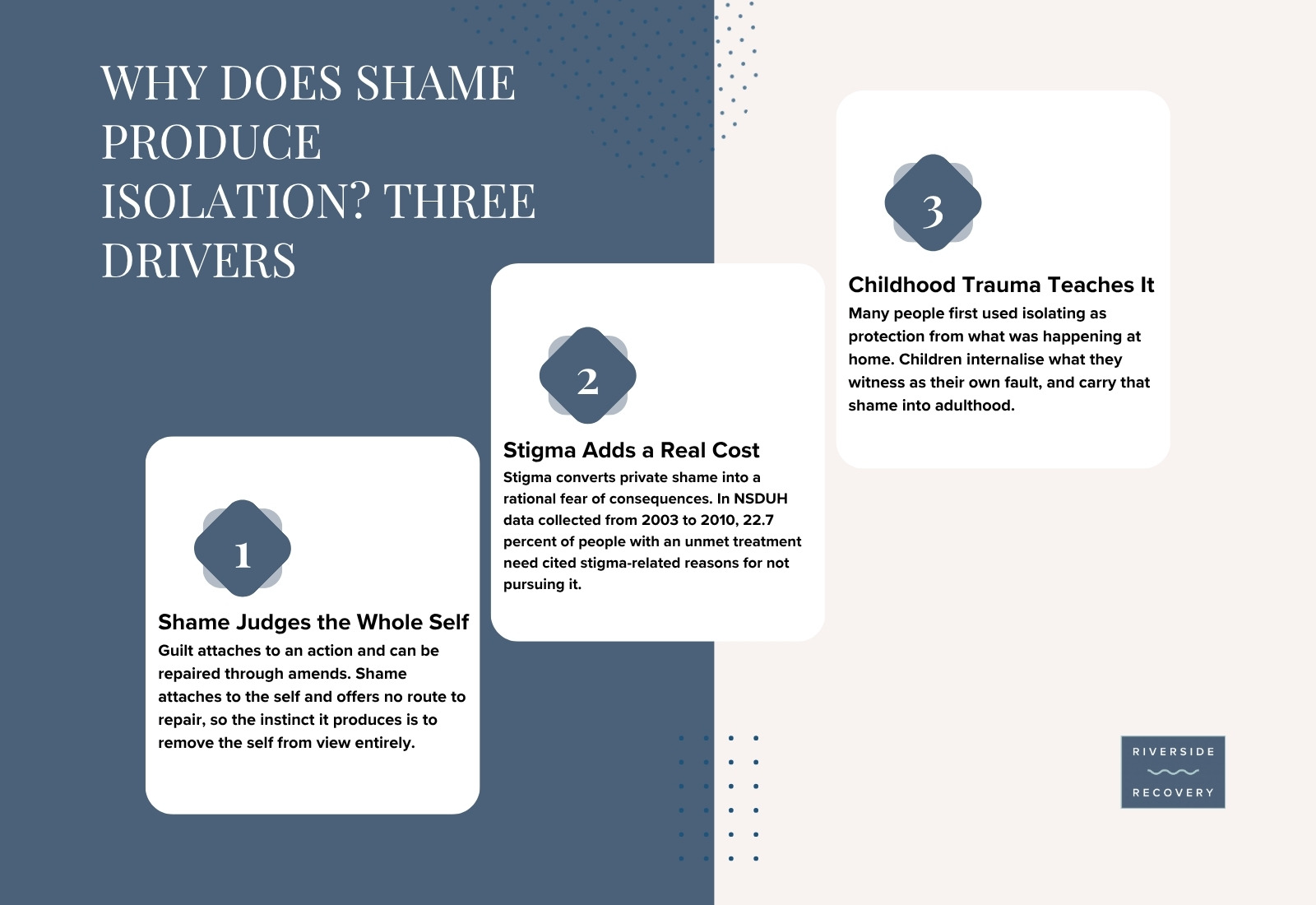
Shame is a judgment of the whole self as inferior rather than a judgment of one action, so the instinct it produces is to remove the self from view entirely.
Guilt says I did something bad. Shame says I am something bad. That distinction matters, because you can apologise for an action but you cannot apologise for a self. So we retreat inward, very often because we are afraid people will discover our painful secrets.
The hiding takes recognizable forms:
- Concealment of entire parts of ourselves we judge as less worthy, less deserving, less acceptable
- Discomfort with our own pasts, which we cringe at and wish had not happened
- Fear of exposure, and of being publicly shamed once the truth is known
- Rejection of our own histories, including the parts hardest to talk about
Those secrets become burdensome weights we carry for years, contributing to depression, anxiety and other mental health conditions.
What Is Self-Isolation as a Coping Mechanism?
Psychiatrist Donald Nathanson mapped shame responses onto four poles, and withdrawal, the pole that produces isolation, works by removing yourself from the situation to shrink the pain.
Nathanson’s Compass of Shame describes four patterns people use to manage shame:
- Withdrawal accepts the shaming message and reduces the pain by removing and isolating yourself from the situation. This is the pole that produces self-isolation as a coping mechanism.
- Attack self also accepts the message, turning anger and criticism inward into self-loathing and contempt.
- Avoidance distracts from shame, including by substance use, or by directing attention toward anything that brings pride instead.
- Attack other pushes the anger and criticism outward at other people.
Two of those four poles map directly onto addiction. Avoidance describes using a substance to not feel the shame. Withdrawal describes isolating so nobody sees you using it. Researchers note that maladaptive shame-coping, rather than shame itself, is what drives psychological harm, which means the response is the treatable part.
Why Do People Isolate Themselves After Childhood Trauma?
Isolating as a coping mechanism often begins in childhood, when withdrawing was the only available protection from what was happening in the home.
Many of us encountered addiction in the early formative years of our lives, which contributes to the patterns we carry as adults. As children we may have witnessed addiction in our families and used isolating as our coping mechanism to protect ourselves from the trauma around us. Retreating inward felt safer, removed from the frightening and turbulent things we witnessed.
Children frequently internalise what they see as being their fault, and that inner shame is what we are still carrying decades later. Where trauma is part of the picture, PTSD and substance use are treated together rather than separately, because addressing one while ignoring the other leaves the driver of the isolation intact.
How Does Stigma Deepen Isolation and Shame?
Stigma converts private shame into a rational fear of real consequences, and it measurably keeps people out of treatment.
We often isolate out of shame because our culture stigmatises both addiction and the people living with it. We are demonised and socially shunned, perceived as criminals, as lazy, as people who simply were not strong enough. Some of us come from families that were particularly judgmental about addiction.
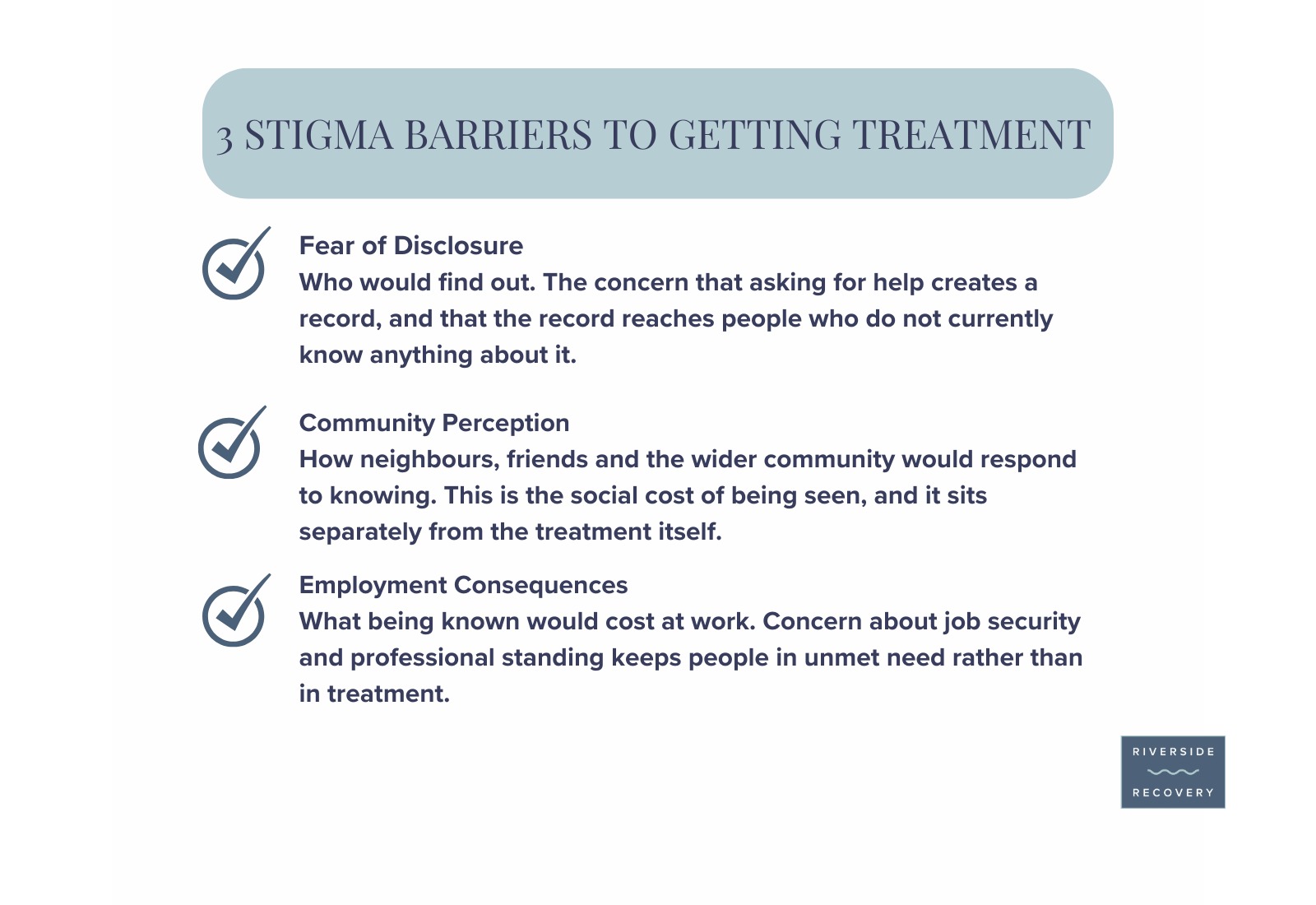
That fear is not irrational. In an analysis of National Survey on Drug Use and Health data collected between 2003 and 2010, 22.7 percent of people with an unmet need for substance abuse treatment reported stigma-related reasons for not pursuing it. The researchers built that figure from three specific concerns:
- Disclosure, meaning who would find out
- Community perception, meaning how neighbors and friends would respond
- Employment consequences, meaning what being known would cost at work
Isolation is not only an internal retreat. It is also a calculation about what being seen might cost.
How Do You Break the Cycle of Shame and Isolation?
Shame loses its grip when the story is told to someone who does not recoil, which is why treatment for shame-driven isolation is structurally social rather than solitary.
Addiction is increasingly understood as a disorder of social isolation and disconnection, and the relationship runs in both directions. Substance use offers temporary relief from emotional pain, and over time it deepens the suffering while suppressing the natural coping mechanisms that would otherwise help.
Breaking that cycle is a sequence of small, specific moves rather than one large decision:
- Tell one person who has proven safe, rather than announcing anything to everyone
- Choose a setting where shared history is the norm, so the first disclosure meets recognition instead of judgment
- Name the specific thing you feel ashamed of, because vagueness lets shame stay intact
- Treat trauma alongside the substance use wherever both are present
- Book a clinical assessment if the isolation has already become total
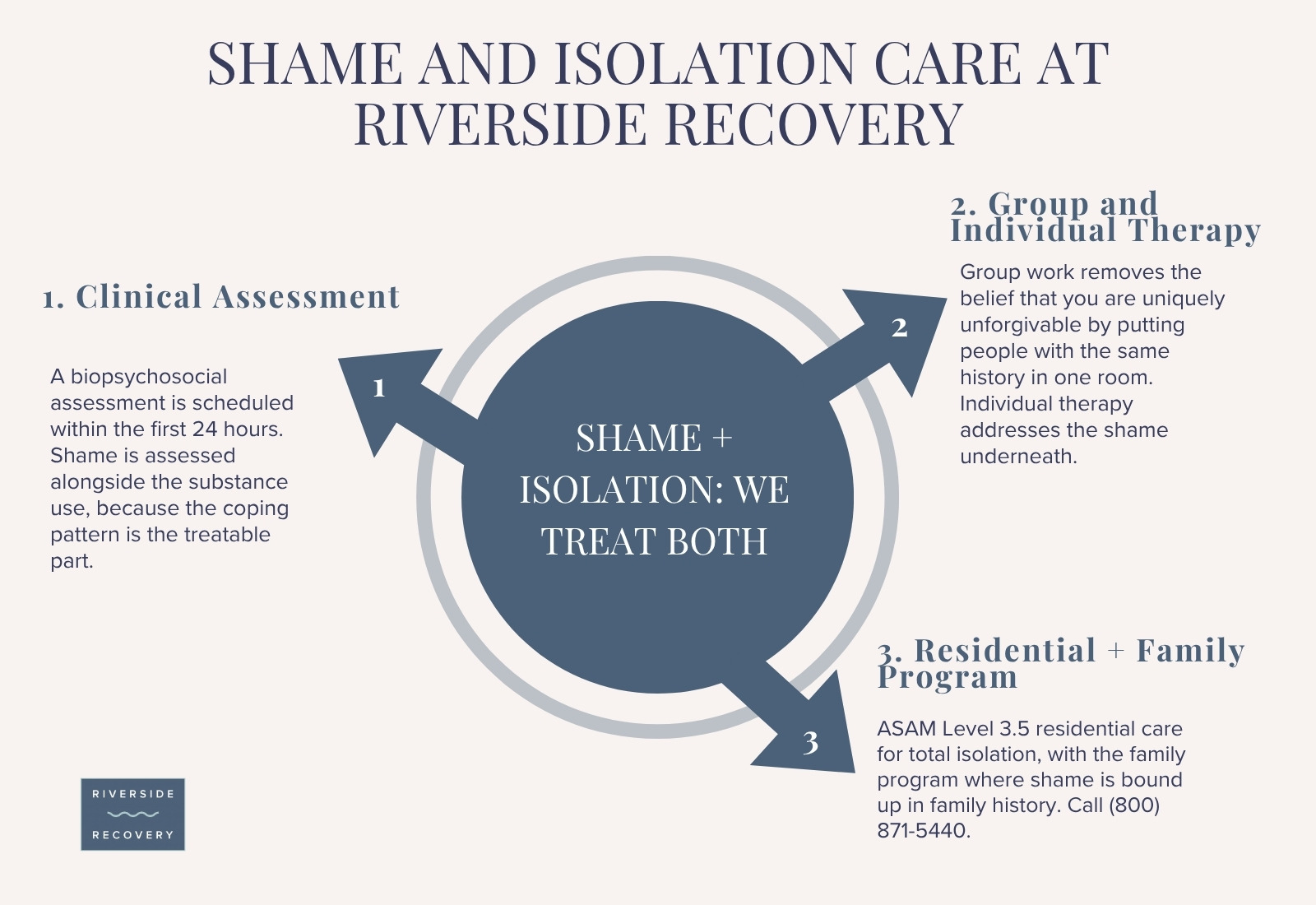
Addiction therapy addresses the shame underneath the substance use rather than the substance use alone. Residential addiction treatment provides that structure daily for people whose isolation has become total. Where shame is bound up in family history, the family program brings those relationships into the work.
Isolation also compounds itself, because loneliness becomes a trigger in recovery once the withdrawal has gone on long enough to become the default.
Frequently Asked Questions
Why do I self isolate?
Self-isolation is a shame-coping response. Nathanson’s Compass of Shame identifies withdrawal as one of four ways people manage shame, and it works by removing you from the situation so the feeling of being judged shrinks. It reduces pain in the moment and increases it over time, because the shame is never contradicted by anyone.
Is isolating a coping mechanism or a symptom?
Both. Isolating functions as a coping mechanism, and sustained isolation is also a recognized feature of depression, anxiety and substance use disorders. Research indicates that maladaptive shame-coping rather than shame itself is the key factor in psychological problems, which is why the coping pattern is the part treatment targets.
What is the difference between shame and guilt in addiction?
Guilt attaches to an action and can be repaired through amends. Shame attaches to the self and involves judging yourself as inferior, which offers no route to repair. That is why shame drives concealment while guilt more often drives correction.
Why do people isolate themselves when they need help most?
Because being seen is the specific thing shame is defending against. Asking for help requires disclosing the very information the withdrawal exists to protect, so the moment support is most needed is the moment isolation feels most necessary.
Does complex PTSD cause isolation?
Childhood adversity is linked to shame and to the coping styles that follow from it, including withdrawal. Where complex trauma and substance use occur together, both are treated concurrently, because treating the addiction while leaving the trauma unaddressed leaves the driver of the isolation in place.
How do I stop isolating myself?
Start with one disclosure to one person who is safe, rather than attempting to rejoin everything at once. Structured group settings do this deliberately, pairing people with shared history so the first disclosure meets recognition instead of judgment. If isolation has already become total, a clinical assessment is the practical first step.
Healing from addiction means having a safe, supportive space to share our stories and heal our shame, both individually and collectively. Call (800) 871-5440 today to receive the support you need and deserve.
Sources
- Nathanson DL, Compass of Shame, as described in Shame and Self-Compassion Connect Childhood Experience of Adversity With Harm Inflicted on the Self and Others. PMC.
- Shame-coping clusters: comparisons regarding attachment insecurities, mentalizing deficits, and personality pathology. PMC.
- Chan G, et al. Stigma as a Barrier to Substance Abuse Treatment Among Those With Unmet Need. PMC. NSDUH data 2003-2010.
- Addiction Psychotherapy: Going Beyond Self-Medication. PMC.
- Substance Abuse and Mental Health Services Administration. Stigma and Language: The Power of Perceptions and Understanding.