



When an urge or compulsion hits, the most effective response is not to fight it directly. Fighting the urge with force often strengthens the urge. Instead, the goal is to observe, delay, and redirect until the urge naturally subsides.
This applies to both OCD compulsions and addiction urges. The brain mechanisms are similar to an intense drive to perform a behavior that temporarily relieves discomfort.
Key Takeaways
- Urges rise, peak and subside on their own when they are not acted upon. Relapse prevention practice commonly describes a window of several minutes to around half an hour, and individual episodes vary widely, so no single measured duration applies to everyone.
- The “urge surfing” technique sits within mindfulness-based relapse prevention, which produced significantly lower rates of substance use than treatment as usual across the four months after treatment in a pilot efficacy trial. A meta-analysis of 17 randomized controlled trials covering 1,228 participants found mindfulness-based interventions reduced craving, with the authors rating the overall evidence low quality because of inconsistency between studies.
- Resisting a compulsion raises anxiety before that anxiety falls on its own. Exposure and Response Prevention relies on exactly this pattern, which is why the spike is expected rather than a sign the technique is failing.
- Performing a compulsion relieves anxiety only temporarily and reinforces the obsession-compulsion cycle, which is why compulsions strengthen over time.
- The “HALT” framework, meaning hungry, angry, lonely and tired, originates in Alcoholics Anonymous and works as a checklist for identifying the state underneath an urge. It is a practical prompt rather than a measured instrument.
- Delay strategies are more effective than complete resistance.
- Physical movement disrupts urge pathways.
- Trying to suppress an intrusive thought tends to increase how often it returns, an effect documented in thought suppression research.
What Is an Urge?
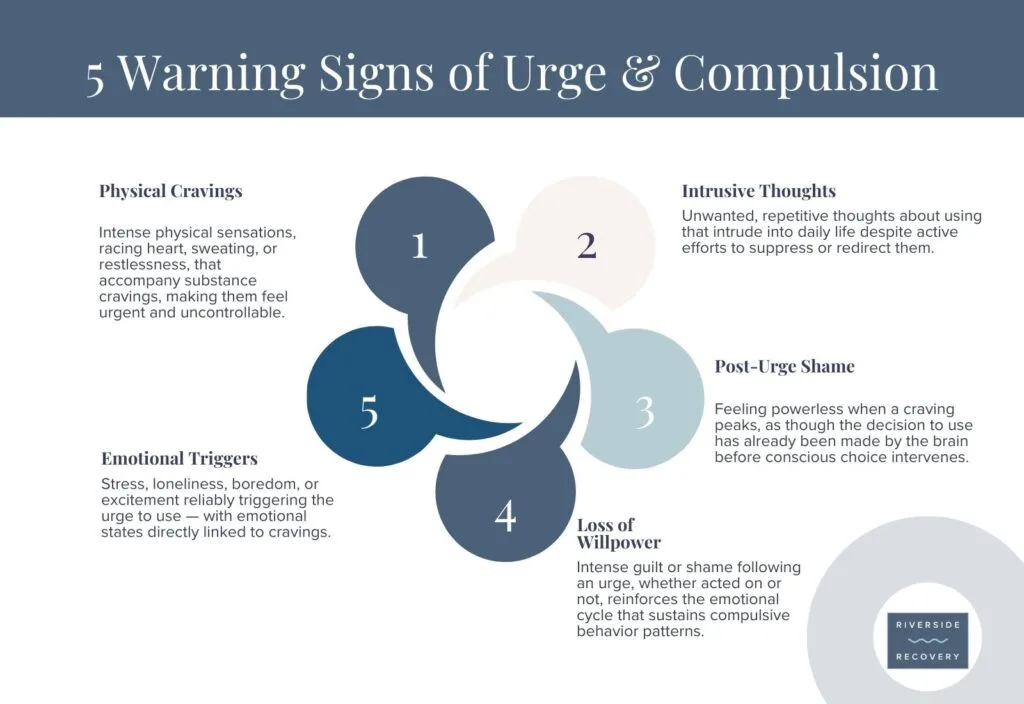
An urge is an intense physical or psychological drive to perform a specific behavior. It feels urgent, uncomfortable, and often overwhelming.
Urges are cravings, the compelling desire to use a substance despite wanting to stay sober. In OCD, urges manifest as compulsions, the drive to perform rituals or mental acts in response to an obsession.
Urges are temporary. They rise, peak, and fall naturally within minutes, even without action. The problem is that acting on urges provides immediate relief, which trains the brain to generate stronger urges over time.
Why Fighting Urges Directly Doesn’t Work
The instinct when an urge hits is to fight it to force it away through willpower alone. This approach typically fails for three reasons:
- Thought suppression backfires: Attempting not to think about something makes you think about it more. Studies consistently show that trying to suppress an intrusive thought increases its frequency and intensity.
- Resistance increases anxiety: Fighting an urge creates a secondary struggle. You’re now dealing with both the original urge and the distress of trying to resist it.
- Willpower depletes: Resisting urges through sheer force consumes mental energy. Over time, this resource exhausts, making later urges harder to resist.
The alternative is not surrender; it is skillful non-engagement.
How to Stop Urges: Evidence-Based Strategies
The following are the ways to stop urging:
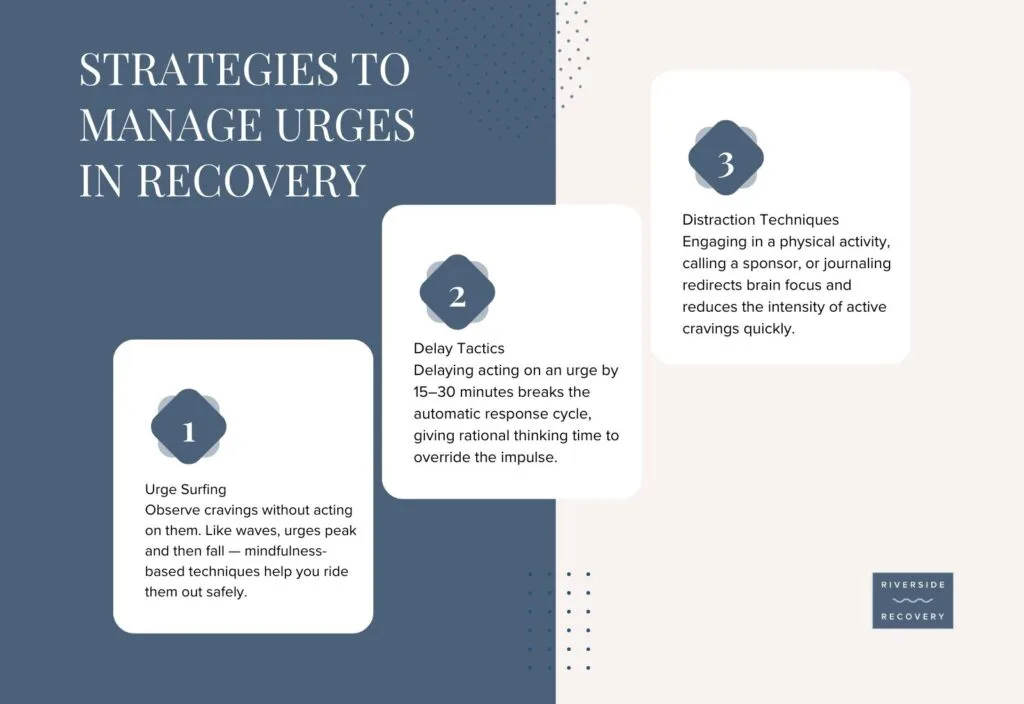
Urge Surfing
Urge surfing, developed by psychologist G. Alan Marlatt, treats urges like ocean waves. Rather than fighting the wave, you ride it.
When an urge arises, notice it without judgment. Observe where you feel it in your body, like chest tightness, stomach tension, or muscle clenching. Notice its intensity on a scale of 1-10.
Breathe slowly and deeply. Stay present with the sensation without acting on it. Watch as the urge peaks and begins to subside naturally.
This technique works because urges are self-limiting. They rise, peak and decline whether or not you act on them. By riding the wave, you prove to yourself that urges pass without requiring action.
Delay and Distract
If urge surfing feels too difficult, use delay tactics for fighting the urge.
Tell yourself: “I can act on this urge in 10 minutes if I still want to.” Then distract yourself for those 10 minutes. Call someone. Take a walk. Watch a video. Engage in any absorbing activity.
Most urges lose intensity during the delay. When 10 minutes pass, the compulsion to act is significantly reduced. If the urge persists, delay another 10 minutes.
This strategy works because it removes the immediate yes-or-no decision. You’re not resisting permanently, just postponing. The psychological pressure decreases.
Physical Movement
Physical activity competes with the urge for attention and shifts physiological arousal. Short bouts of exercise reduce craving intensity in controlled studies, though the size of the effect varies by substance and by how the craving is measured.
When an urge hits, move. Walk around the block. Do jumping jacks. Climb stairs. Stretch vigorously. Any movement that elevates heart rate and shifts attention works.
Exercise releases endorphins and dopamine, the same neurochemicals that substances and compulsions temporarily provide. The brain gets a healthier hit of reward chemistry without reinforcing the problematic behavior.
Opposite Action
Opposite action, from Dialectical Behavior Therapy (DBT), means doing the opposite of what the urge demands.
If the urge is to isolate, reach out to someone. If the urge is to check a lock repeatedly, walk away from the door. If the urge is to ruminate, engage in a hands-on task.
This technique works by breaking the automatic stimulus-response pattern. Over time, the brain learns that the feared outcome (increased anxiety, disaster) does not occur when the compulsion is not performed.
Grounding Techniques
Grounding brings attention back to the present moment and away from the urge.
Try the 5-4-3-2-1 technique: Name 5 things you see, 4 things you can touch, 3 things you hear, 2 things you smell, 1 thing you taste.
Or use physical grounding: Hold an ice cube. Splash cold water on your face. Press your feet firmly into the floor.
Grounding works by engaging the sensory system, which interrupts the mental loop driving the urge.
Talk It Through
Call someone who understands. Describe the urge out loud. Saying it aloud reduces its power.
This works for two reasons. First, articulating the urge engages the rational brain, which reduces emotional intensity. Second, connection with another person activates the brain’s social bonding system, which competes with the urge pathway.
In 12-step programs, this is called “calling your sponsor.” In therapy, it’s called reaching out for support. The principle is the same: externalize the struggle.
Acceptance and Commitment
Rather than trying to eliminate the urge, accept its presence and commit to values-based action despite it.
Acknowledge: “I’m having the thought that I need to use right now” or “I’m experiencing the urge to check the stove again.” This creates distance between you and the urge.
Then ask: “What action aligns with my values right now?” Act on that answer, even while the urge persists.
This approach, from Acceptance and Commitment Therapy (ACT), treats urges as mental events, not commands that must be obeyed.
How to Resist OCD Compulsions
Resisting OCD compulsions uses the same principles but with a specific application to the obsession-compulsion cycle.
To resist OCD compulsion, do the following things:
- Understand the cycle: Obsessions trigger anxiety. Compulsions temporarily reduce anxiety. This relief reinforces the compulsion, making future urges stronger.
- Break the cycle through exposure: The gold standard treatment for OCD is Exposure and Response Prevention (ERP). The person experiences the obsession (exposure) without performing the compulsion (response prevention).
- Start small: If you check locks 10 times, reduce it to 8 times. Then 6. Then 4. Gradual reduction builds tolerance for the anxiety that arises when compulsions are resisted.
- Expect anxiety to spike first: Resisting compulsions temporarily increases anxiety. This is normal and expected. The anxiety peaks, then falls as the brain learns that the feared outcome does not occur.
- Practice regularly: One-time resistance is not enough. Repeated exposure retrains the brain’s threat-detection system. Over weeks and months, obsessions lose power and compulsions weaken.
Why Urges Feel So Strong
Urges feel overwhelming because they activate the brain’s survival circuitry, the same systems designed to drive hunger, thirst, and reproductive behavior.
In case of addiction, substances hijack the reward pathway, creating artificial cravings as strong as biological needs. The brain treats the substance as necessary for survival.
In OCD, the brain’s alarm system malfunctions, generating false threat signals. Compulsions temporarily silence the alarm, reinforcing the belief that the threat is real.
In both cases, the urge feels life-or-death urgent. But it is not. It is a misfiring signal that will pass on its own.
How Long Do Urges Last?
Urges rise, peak and naturally decline whether they are acted upon or not. Relapse prevention practice commonly describes a window of several minutes to around half an hour, and delaying action through that window usually means meeting a weaker urge. Individual episodes vary widely, so treat any single figure as a rule of thumb rather than a measured limit.
However, urges can recur. Successfully resisting one urge does not prevent the next. The goal is not to eliminate urges permanently but to build the skill of non-action over time.
With repeated practice, several things happen:
- Urges become less frequent
- Peak intensity decreases
- Recovery time shortens
- Confidence in your ability to resist increases
The HALT Framework for Urge Triggers
HALT is a recovery tool used to identify common urge triggers. It originates in Alcoholics Anonymous, and SAMHSA’s counseling guidance describes it as a way to help people address these needs early rather than as a diagnostic measure. Before acting on an urge, ask:
Am I Hungry? Low blood sugar triggers cravings and impulsivity. Eating a balanced meal or snack can reduce urge intensity.
Am I Angry? Unresolved anger or frustration drives escape behaviors. Addressing anger directly, through conversation, exercise, or addiction therapy, removes the urge trigger.
Am I Lonely? Isolation intensifies urges. Reaching out to someone, even briefly, reduces the drive to use substances or perform compulsions to cope with loneliness.
Am I Tired? Fatigue impairs impulse control and decision-making. Rest, even a short nap, can restore the mental resources needed to resist urges.
HALT identifies the underlying state driving the urge. Addressing the state directly is often more effective than battling the urge itself.
What Not to Do When an Urge Hits
Certain responses make urges stronger rather than weaker. Don’t do any of the following things during an urge:
- Don’t negotiate with the urge: “Maybe just once” or “I’ll stop after this” are rationalizations that lead to action. Recognize these thoughts as part of the urge, not rational analysis.
- Don’t rely solely on willpower: Willpower is a limited resource. Skills, support, and environmental changes are more reliable than the sheer force of will.
- Don’t isolate: Isolation removes accountability and support, making it easier to give in. Stay connected, even when you don’t want to.
- Don’t punish yourself for having urges: Urges are involuntary. Their presence does not mean failure. Responding skillfully, not the absence of urges, is the measure of progress.
When Urges Indicate a Need for Professional Help
Urges are manageable with the right tools. But certain situations require professional intervention:
- Urges are constant and overwhelming despite using coping strategies
- Urges lead to behaviors that endanger yourself or others
- Compulsions take up more than an hour per day
- Substance urges result in relapse despite wanting to stay sober
- OCD significantly impairs work, relationships, or daily functioning
Professional treatment for OCD typically involves Exposure and Response Prevention (ERP) therapy, often combined with medication. Treatment for substance use disorders includes therapy, peer support, and often medication-assisted treatment.
At Riverside Recovery of Tampa, treatment plans address both the urges and the underlying conditions driving them. Riverside Recovery treats adults whose substance use disorder occurs alongside a mental health condition such as OCD, PTSD or trauma, and admission requires a co-occurring substance use disorder rather than a primary mental health diagnosis alone. Anyone seeking treatment for OCD on its own should ask their physician for a referral to a provider offering Exposure and Response Prevention.
Building Long-Term Urge Resistance
Managing urges is a skill that improves with practice. Over time, you develop:
- Greater awareness: You notice urges earlier, before they peak, giving you more time to respond skillfully.
- Expanded toolkit: You identify which strategies work best for different types of urges and situations.
- Increased confidence: Each time you successfully resist the urge proves that you can tolerate discomfort without giving in.
- Reduced urge frequency: As the brain learns that urges do not result in reward, it generates them less often.
Recovery from addiction and OCD both involve learning to live with urges without acting on them. The goal is not perfect control; it is a skillful response.
References
- Marlatt, G.A., & Gordon, J.R. (1985). Relapse Prevention: Maintenance Strategies in the Treatment of Addictive Behaviors. Guilford Press.
- Bowen, S., Chawla, N., & Marlatt, G.A. (2011). Mindfulness-Based Relapse Prevention for Addictive Behaviors: A Clinician’s Guide. Guilford Press.
- Abramowitz, J.S., Deacon, B.J., & Whiteside, S.P.H. (2019). Exposure Therapy for Anxiety: Principles and Practice (Second Edition). Guilford Press.
- International OCD Foundation. What You Need to Know About OCD.
- Substance Abuse and Mental Health Services Administration. Counseling Approaches to Promote Recovery From Problematic Substance Use and Related Issues. Treatment Improvement Protocol series. NCBI Bookshelf NBK601489.
- Bowen, S., Chawla, N., Collins, S. E., et al. (2009). Mindfulness-based relapse prevention for substance use disorders: A pilot efficacy trial. Substance Abuse, 30(4), 295-305. PubMed 19904665.
- Witkiewitz, K., Bowen, S., Douglas, H., & Hsu, S. H. (2013). Mindfulness-based relapse prevention for substance craving. Addictive Behaviors, 38(2), 1563-1571. PubMed 22534451.
- Mindfulness interventions for craving reduction in substance use disorders and behavioral addictions: Systematic review and meta-analysis of randomized controlled trials (17 trials, 1,228 participants). PMC10583418.
- National Institute of Mental Health. Obsessive-Compulsive Disorder. National Institutes of Health.