



Positive thinking in recovery is a trained cognitive skill that replaces distorted negative thoughts with accurate ones, not forced optimism or denial. The practice retrains the brain’s response to stress, cravings, and challenges.
Optimism strengthens self-control, emotional regulation and decision-making, the capacities that sustain long-term recovery. Higher optimism predicts lower relapse risk among people treated for substance use disorder.
Key Takeaways
- Optimism in recovery predicts a lower relapse rate than predominantly negative thinking patterns.
- Positive thinking engages the prefrontal cortex, the brain region responsible for decision-making and impulse control that addiction weakens.
- Daily gratitude practice is used in recovery to reduce the intensity of cravings.
- Cognitive restructuring, the core technique in cognitive behavioral therapy, reduces depressive symptoms in early recovery.
- Positive self-talk supports treatment retention.
- Mindfulness-based interventions change brain function in regions affected by addiction, per a systematic review of fMRI evidence.
- Optimism works alongside social support rather than replacing it.
What Is Positive Thinking in Recovery?
Positive thinking in recovery is the practice of noticing a negative thought, testing it against evidence, and replacing it with an accurate one. It is not denial or forced cheerfulness, and it involves four steps: cognitive awareness, thought evaluation, reframing, and forward focus. This approach involves:
- Cognitive awareness: Recognizing when negative thoughts arise
- Thought evaluation: Questioning whether negative thoughts are accurate or helpful
- Reframing: Replacing unhelpful thoughts with realistic, constructive alternatives
- Forward focus: Emphasizing progress, possibilities, and solutions
Positive thinking in recovery is not:
- Denying real problems or challenges
- Pretending everything is fine when it isn’t
- Forcing fake happiness or toxic positivity
- Ignoring legitimate emotions like grief or anger
Instead, it’s acknowledging difficulties while choosing to focus on what you can control and the growth opportunities each challenge presents.
Why Does Positive Thinking Help Recovery?
Positive thinking supports recovery through four mechanisms. Neuroplasticity rebuilds damaged neural pathways, stress reduction lowers a primary relapse trigger, self-efficacy predicts abstinence length, and emotional regulation replaces substances as a coping strategy.
The following are the reasons positive thinking helps recovery:
Neuroplasticity and Brain Healing
Addiction physically changes the brain’s structure and function, particularly in areas governing decision-making, impulse control, and emotional regulation. Positive thinking activates neuroplasticity, the brain’s ability to form new neural connections.
How it works:
- Repeated positive thoughts create new neural pathways
- These pathways strengthen with practice
- Eventually, positive responses become more automatic
- Brain regions damaged by addiction begin healing
Longitudinal neuroimaging shows structural and functional brain recovery during sustained abstinence, over months rather than weeks. Mindfulness-based interventions change brain function in people with substance dependence, per a systematic review of the fMRI evidence. No fMRI study measures “positive thinking” as an isolated practice, so no timeline for it exists.
Stress Reduction
Chronic stress is one of the primary relapse triggers. Negative thinking amplifies stress through catastrophic predictions, rumination, and helplessness.
Positive thinking reduces stress by:
- Lowering cortisol (primary stress hormone)
- Decreasing amygdala activation (fear center)
- Improving heart rate variability
- Enhancing sleep quality
Lower stress reduces cravings and strengthens coping.
Improved Self-Efficacy
Self-efficacy, belief in your ability to succeed, directly predicts recovery outcomes. People with higher self-efficacy experience fewer relapses and longer periods of abstinence.
Positive thinking builds self-efficacy through:
- Recognizing small wins and progress
- Reframing setbacks as learning opportunities
- Focusing on strengths rather than only weaknesses
- Celebrating effort, not just outcomes
Enhanced Emotional Regulation
Alcohol use disorder disrupts emotional regulation, and substances supplied temporary relief from uncomfortable emotions. Recovery requires rebuilding healthy emotional coping in their place.
Positive thinking improves emotional regulation by:
- Creating distance from overwhelming emotions
- Providing alternative perspectives on situations
- Reducing reactivity to triggers
- Building tolerance for discomfort
What Are the 10 Benefits of Positive Thinking in Recovery?
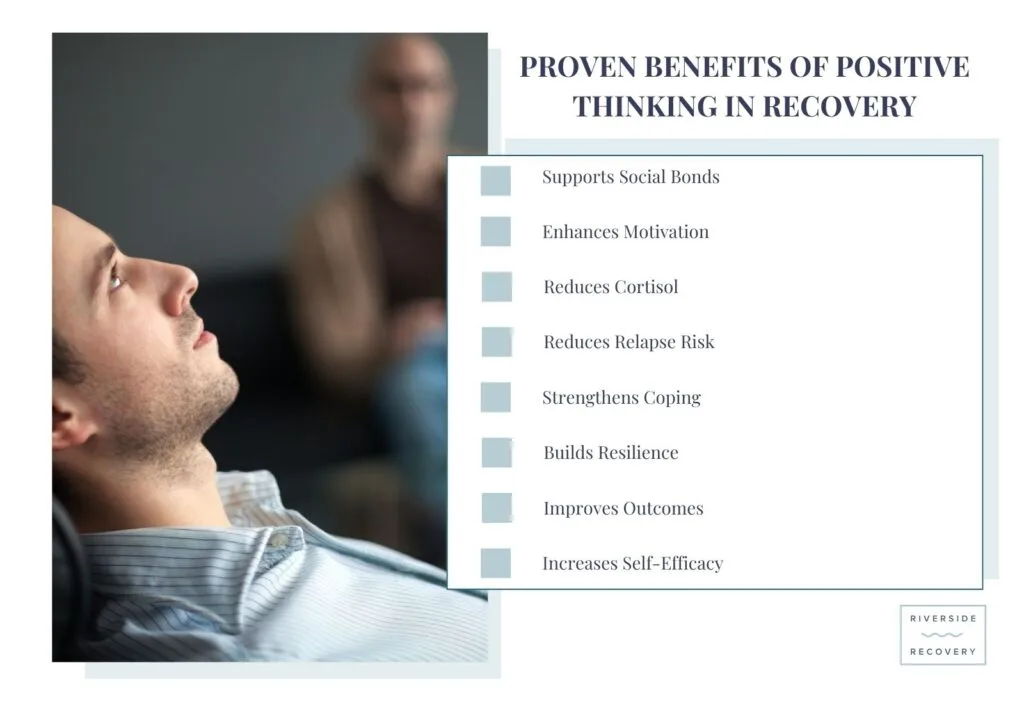
Positive thinking in recovery delivers 10 benefits. The first five are reduced relapse risk, decreased depression and anxiety, improved physical health, stronger relationships, and better problem-solving. The remaining five are increased motivation, better stress management, higher self-esteem, greater resilience, and improved quality of life.
1. Reduced Relapse Risk
Studies consistently associate an optimistic outlook in recovery with lower relapse rates, though the size of the effect varies considerably between studies and populations.
Positive thinking reduces relapse risk by:
- Strengthens commitment to recovery goals
- Improves problem-solving during high-risk situations
- Increases willingness to seek help when struggling
- Maintains hope during difficult periods
2. Decreased Depression and Anxiety
Depression and anxiety commonly co-occur with substance use disorders. Negative thinking patterns fuel both conditions, creating cycles that threaten recovery.
Positive thinking interrupts the depression-anxiety cycle by:
- Challenging catastrophic thinking
- Reducing rumination on past mistakes
- Decreasing worry about future scenarios
- Improving present-moment awareness
Cognitive reframing reduces depressive symptoms in early recovery.
3. Improved Physical Health
Positive thinking improves four health markers:
- Immune function: Segerstrom, Suzanne C.’s 2005 paper in Brain, Behavior, and Immunity found that optimism and immune response interact in a context-dependent way. Optimism tracks with better immune measures when a stressor is manageable, but the relationship can reverse when stressors are severe and persistent
- Cardiovascular health: Lower blood pressure and reduced heart disease risk
- Pain tolerance: Improved coping with pain alongside medical management
- Sleep quality: Deeper, more restorative sleep
Better physical health supports recovery by increasing energy, reducing illness, and improving overall well-being.
4. Stronger Relationships
Addiction damages relationships through broken trust, disappointment, and conflict. Recovery requires rebuilding these connections.
Positive thinking improves relationships by:
- Reducing defensiveness and reactivity
- Increasing patience and understanding
- Fostering gratitude and appreciation
- Improving communication quality
Taherkhani, Zahra et al.’s 2023 randomized controlled trial in Scientific Reports found that positive thinking raised resilience and life satisfaction among older adults.
5. Enhanced Problem-Solving
Recovery presents constant challenges requiring effective problem-solving. Negative thinking narrows perspective and limits options. Positive thinking expands possibilities.
Improved problem-solving includes:
- Considering multiple solutions rather than feeling stuck
- Viewing obstacles as solvable rather than insurmountable
- Seeking resources and support proactively
- Persisting through setbacks
6. Increased Motivation and Goal Achievement
Positive thinking fuels motivation by maintaining focus on possibilities rather than limitations. This drives continued effort toward recovery goals even when progress feels slow.
Motivation improvements:
- Better treatment program completion rates
- More consistent attendance at support meetings
- Greater engagement in healthy activities
- Stronger commitment to long-term goals
7. Better Stress Management
Stress management is crucial in recovery. Positive thinking provides effective stress reduction through multiple mechanisms:
- Cognitive reappraisal (seeing situations differently)
- Reduced physiological stress response
- Increased use of healthy coping strategies
- Greater resilience during difficult times
Conversano, Ciro et al.’s 2010 review in Clinical Practice and Epidemiology in Mental Health associates an optimistic outlook with better coping strategies and higher quality of life. It does not quantify stress-hormone changes in recovery populations, and no reliable figure for that exists.
8. Improved Self-Esteem and Self-Worth
Addiction often devastates self-esteem through shame, guilt, and repeated failures. Positive thinking rebuilds self-worth by:
- Acknowledging personal strengths and progress
- Practicing self-compassion rather than self-criticism
- Recognizing inherent worth beyond past mistakes
- Celebrating recovery achievements
Higher self-esteem correlates with longer abstinence in recovery.
9. Greater Resilience
Resilience, the ability to bounce back from setbacks, is essential for long-term recovery. Positive thinking builds resilience through:
- Viewing challenges as temporary rather than permanent
- Finding meaning and growth in difficult experiences
- Maintaining hope during struggles
- Drawing on inner strengths during crises
Mhaidat, Ihab et al.’s 2024 national cross-sectional study in Frontiers in Psychiatry, covering adults in treatment for substance use disorder in the United Arab Emirates, found a moderate inverse correlation between resilience and relapse risk, r = -0.49, so higher resilience tracked with lower risk. The study measured correlation rather than a percentage reduction in relapse.
10. Enhanced Quality of Life
Ultimately, positive thinking improves overall quality of life in recovery:
- Greater life satisfaction and happiness
- More meaningful relationships
- Increased engagement in activities
- Stronger sense of purpose
- Better work or school performance
People who practice positive thinking generally rate their quality of life more highly than those who do not, independent of how long they have been sober.
How Do You Practice Positive Thinking in Recovery?
You practice positive thinking in recovery through eight techniques: daily gratitude, cognitive restructuring, positive self-talk, mindfulness meditation, reframing setbacks as learning, choosing a supportive environment, celebrating small wins, and helping others. Each is a learnable skill that strengthens with repetition:
1. Daily Gratitude Practice
Write down 3-5 things you’re grateful for each day. This simple practice rewires the brain to notice positives rather than only negatives.
- Keep a gratitude journal
- Be specific (not just “family” but “my sister called to check on me”)
- Include small things (good coffee, sunny weather)
- Review entries when feeling down
2. Cognitive Restructuring
Identify negative thoughts and challenge them with evidence. Replace them with balanced, realistic alternatives.
Example:
| Negative Thought | Evidence Against | Realistic Alternative |
|---|---|---|
| “I’ll never stay sober.” | I’ve been sober for 30 days already | “Recovery is challenging, but I’m making progress.” |
| “Everyone thinks I’m a failure.” | My sponsor and therapist believe in me | “Some people support my recovery journey.” |
| “One mistake means I’ve ruined everything.” | Setbacks are normal in recovery | “I can learn from this and keep going.” |
3. Positive Self-Talk
Replace self-criticism with encouraging internal dialogue. Speak to yourself as you would a friend facing similar challenges.
Self-talk examples:
- “I’m doing my best, and that’s enough.”
- “Recovery takes time, and I’m making progress.”
- “I deserve compassion, not criticism.”
- “Each day sober is an achievement.”
4. Mindfulness Meditation
Mindfulness creates space between thoughts and reactions. This allows conscious choice about which thoughts to engage with.
Basic practice:
- Sit comfortably for 5-20 minutes
- Focus on breath
- Notice thoughts without judgment
- Gently return attention to breath
- Practice daily
5. Reframe Setbacks as Learning
View challenges as opportunities for growth rather than evidence of failure.
Questions to ask:
- What can I learn from this situation?
- How can this make me stronger in recovery?
- What would I tell someone else facing this?
- What’s one positive thing that could come from this?
6. Surround Yourself with Positivity
Social environment shapes thinking patterns. Deliberately build positive surroundings.
Practical steps:
- Spend time with supportive, optimistic people
- Limit exposure to negative influences
- Listen to uplifting music or podcasts
- Display recovery affirmations or quotes
- Engage in activities that bring joy
7. Celebrate Small Wins
Acknowledge every step forward, no matter how small. This reinforces positive behavior and builds momentum.
Celebration ideas:
- Track days sober in an app
- Share victories in support meetings
- Reward yourself for milestones
- Keep a success journal
8. Help Others
Helping others in recovery creates a positive perspective by:
- Recognizing your own progress
- Finding purpose and meaning
- Building connections
- Reinforcing recovery principles
How Do You Overcome Negative Thinking in Recovery?
You overcome negative thinking in recovery in six steps. Identify the thought, examine the evidence for and against it, consider alternatives, and test the prediction against the recorded outcome. Replace the thought with a balanced statement, then take one small action that supports it. Six patterns recur most often in early recovery:
Common Negative Thought Patterns include:
- All-or-nothing thinking: “If I’m not perfect, I’ve failed completely.”
- Catastrophizing: “This one problem means everything will fall apart.”
- Mind reading: “Everyone thinks I’m weak for needing help.”
- Overgeneralization: “I struggled today, so I’ll always struggle.”
- Discounting positives: “That achievement doesn’t count because…”
- Emotional reasoning: “I feel like a failure, therefore I am one.”
How to Challenge Negative Thoughts
You can challenge negative thoughts in the following ways:
- Identify the thought: Notice when negative thinking occurs
- Examine the evidence: What facts support or contradict this thought?
- Consider alternatives: What are other possible interpretations?
- Test predictions: Has this always been true? What was the recorded outcome?
- Replace with balance: What’s a more realistic perspective?
- Take action: What small step supports the positive alternative?
When Negative Thinking Is Severe
Professional help is essential when negative thinking includes suicidal thoughts, severe depression, or a loss of the ability to work, sleep, or maintain relationships.
Warning signs requiring immediate help include:
- Thoughts of self-harm or suicide
- Inability to complete basic daily tasks
- Severe hopelessness lasting weeks
- Withdrawal from all support
- Planning to use substances
Call 988 (Suicide and Crisis Lifeline) or your treatment provider immediately if experiencing a crisis.
What Are Positive Addictions?
“Positive addictions” are healthy activities that produce neurological rewards similar to substances without the harm. The five are exercise and physical activity, creative expression, service and volunteering, learning and skill development, and time outdoors. Each engages the brain’s reward system through effort rather than chemistry.
Examples of Positive Addictions are:
Exercise and physical activity
- Releases endorphins and dopamine naturally
- Reduces cravings and stress
- Improves mood and sleep
- Builds a healthy routine
Creative expression
- Art, music, writing, crafting
- Provides emotional outlet
- Creates a sense of accomplishment
- Engages the brain’s reward system
Service and volunteering
- Creates meaning and purpose
- Builds connections
- Provides positive identity
- Strengthens self-worth
Learning and growth
- Reading, courses, skills development
- Stimulates brain plasticity
- Builds confidence
- Opens new opportunities
Nature and outdoor activities
- Reduces stress hormones
- Improves mood
- Provides a healthy escape
- Encourages physical activity
Building Positive Addictions
You can build positive addictions by:
- Start small: Begin with 15-20 minutes daily
- Choose what you enjoy: Sustainability requires a genuine interest
- Track progress: Note how activities affect mood and cravings
- Make it social: Share activities with sober friends when possible
- Be consistent: Daily practice builds neural pathways
What Are Recovery Thinking Patterns?
Three cognitive patterns support long-term sobriety. A growth mindset treats recovery as ongoing learning rather than a fixed state. Solution-focused thinking directs energy toward the next step rather than the problem, and present-moment awareness interrupts rumination on the past and worry about the future.
Growth Mindset
Viewing recovery as ongoing learning rather than a fixed state. Challenges become opportunities to develop skills rather than evidence of failure.
Growth mindset statements include:
- “I’m learning how to handle stress without substances.”
- “This challenge is teaching me resilience.”
- “I’m not there yet, but I’m making progress.”
Solution-Focused Thinking
Directing mental energy toward solutions rather than dwelling on problems.
Questions to ask:
- What’s one small step I can take right now?
- Who could help me with this challenge?
- What has worked in similar situations before?
- What resources are available to me?
Present-Moment Awareness
Focusing on current experience rather than ruminating on past mistakes or worrying about future scenarios.
Present-moment practices:
- Notice physical sensations without judgment
- Engage fully in the current activity
- Use grounding techniques during stress
- Practice mindfulness regularly
What Words Support Addiction Recovery?
Recovery-positive language replaces powerlessness with agency. Say “I choose not to drink” rather than “I can’t drink”, and “I am sober” rather than “I’m trying to stay sober”. Say “I’m a person in recovery” rather than any label that defines someone by a substance. Self-directed wording shapes the thought that follows it:
Empowering Recovery Language
- Instead of: “I can’t drink/use” Say: “I choose not to drink/use” or “I don’t drink/use.”
- Instead of: “I’m trying to stay sober” Say: “I am sober” or “I’m committed to my recovery.”
- Instead of: “I’m just an addict” Say: “I’m a person in recovery” or “I’m in recovery from addiction.”
- Instead of: “I relapsed” Say: “I had a setback but I’m back on track.”
- Instead of: “I’ll never be normal” Say: “I’m creating a healthy, fulfilling life.”
- Instead of: “Why is this so hard?” Say: “What can I learn from this challenge?”
Daily Affirmations for Recovery
- “I am capable of handling today’s challenges.”
- “My recovery matters and deserves my full effort.”
- “I am stronger than my cravings.”
- “Each sober day is building a better future.”
- “I deserve peace, health, and happiness.”
- “I am worthy of love and support.”
- “My past does not define my future.”
- “I choose recovery every day.”
What Is the Ability to Keep a Positive Outlook Called?
The ability to keep a positive outlook and focus on the workable aspects of a situation is called optimism, or resilience where it involves recovering from setbacks. It is built through four capacities: perspective-taking, selective attention, reframing, and hope maintenance. This capacity develops through practice and conscious effort.
Optimism includes:
- Perspective-taking: Viewing situations from multiple angles
- Selective attention: Noticing positives alongside negatives
- Reframing: Finding growth opportunities in challenges
- Hope maintenance: Believing in positive future possibilities
How to Develop Optimism
You can develop optimism through the following steps:
- Practice daily gratitude (builds attention to positives)
- Challenge negative predictions (test catastrophic thinking)
- Recall past successes (prove your capability)
- Surround yourself with optimistic people (social modeling)
- Limit negative media consumption (reduce negativity exposure)
- Celebrate small wins (reinforce positive focus)
Consistent practice strengthens optimism until hopeful appraisal becomes automatic.
References
- Devi, S., & Rana, S.S. (2025). The Psychological Shield: Role of Optimism and Psychological Well-Being in Relapse of Drug Addiction. Guru Jambheshwar University of Science and Technology.
- Segerstrom, S.C. (2005). Optimism and immunity: Do positive thoughts always lead to positive effects? Brain, Behavior, and Immunity, 19(3), 195–200. doi: 10.1016/j.bbi.2004.08.003. PMID: 15797306; PMCID: PMC1948078
- Taherkhani, Z., Kaveh, M.H., Mani, A., Ghahremani, L., & Khademi, K. (2023). The effect of positive thinking on resilience and life satisfaction of older adults: A randomized controlled trial. Scientific Reports, 13(1), 3478. doi: 10.1038/s41598-023-30684-y. PMID: 36859479; PMCID: PMC9977771
- Medalia, A., & Saperstein, A. (2011). The role of motivation for treatment success. Schizophrenia Bulletin, 37(Suppl 2), S122–S128. doi: 10.1093/schbul/sbr063. PMID: 21860041; PMCID: PMC3160119
- Conversano, C., Rotondo, A., Lensi, E., Della Vista, O., Arpone, F., & Reda, M.A. (2010). Optimism and its impact on mental and physical well-being. Clinical Practice and Epidemiology in Mental Health, 6, 25–29. doi: 10.2174/1745017901006010025. PMID: 20592964; PMCID: PMC2894461
- Mhaidat, I., Al-Yateem, N., Al-Mamari, S., & Al-Suwaidi, F. (2024). Resilience and relapse risk in Emirate adult patients with substance use disorder: A national cross-sectional study from the United Arab Emirates. Frontiers in Psychiatry, 15, 1444233. doi: 10.3389/fpsyt.2024.1444233. PMID: 39381607; PMCID: PMC11458449
- Krentzman, A.R. (2013). Review of the application of positive psychology to substance use, addiction, and recovery research. Psychology of Addictive Behaviors, 27(1), 151–165. doi: 10.1037/a0029897. PMID: 22985057; PMCID: PMC3531570