



If you are thinking about suicide or in emotional crisis, help is available right now, free and confidential, 24 hours a day.
- Call or text 988 to reach the 988 Suicide & Crisis Lifeline, or chat at 988lifeline.org.
- Text HOME to 741741 to reach the Crisis Text Line.
- If someone is in immediate danger, call 911 or go to the nearest emergency room.
Feeling overwhelmed is a stress response in which the demands a person faces exceed the capacity they have to meet them, producing the shutdown people describe as being paralyzed. It arrives in two forms: acute overwhelm, triggered by a single event, and chronic overwhelm, sustained across weeks or months. Both reduce the brain’s capacity to plan, decide and act.
Sometimes it can all feel like too much. When we are overwhelmed and paralyzed, our addictions and mental health conditions become so debilitating and painful that we don’t know what to do or how to help ourselves. We are too confused to know where to turn for support, or how to find relief. We feel as though we cannot function day to day. Our basic responsibilities have become too much to handle, and the changes we know we need to make feel insurmountable.
What Does It Mean to Be Overwhelmed?
To be overwhelmed means the load facing a person is larger than the resources they have to carry it, and the nervous system responds by suppressing action rather than by producing it.
The word describes a specific state, not a mood. Three features distinguish it from ordinary stress:
- Volume, where the number of demands exceeds what can be held in mind at once
- Duration, where the pressure continues long enough to become the baseline rather than an episode
- Immobility, where the response to the pressure is shutdown instead of activity
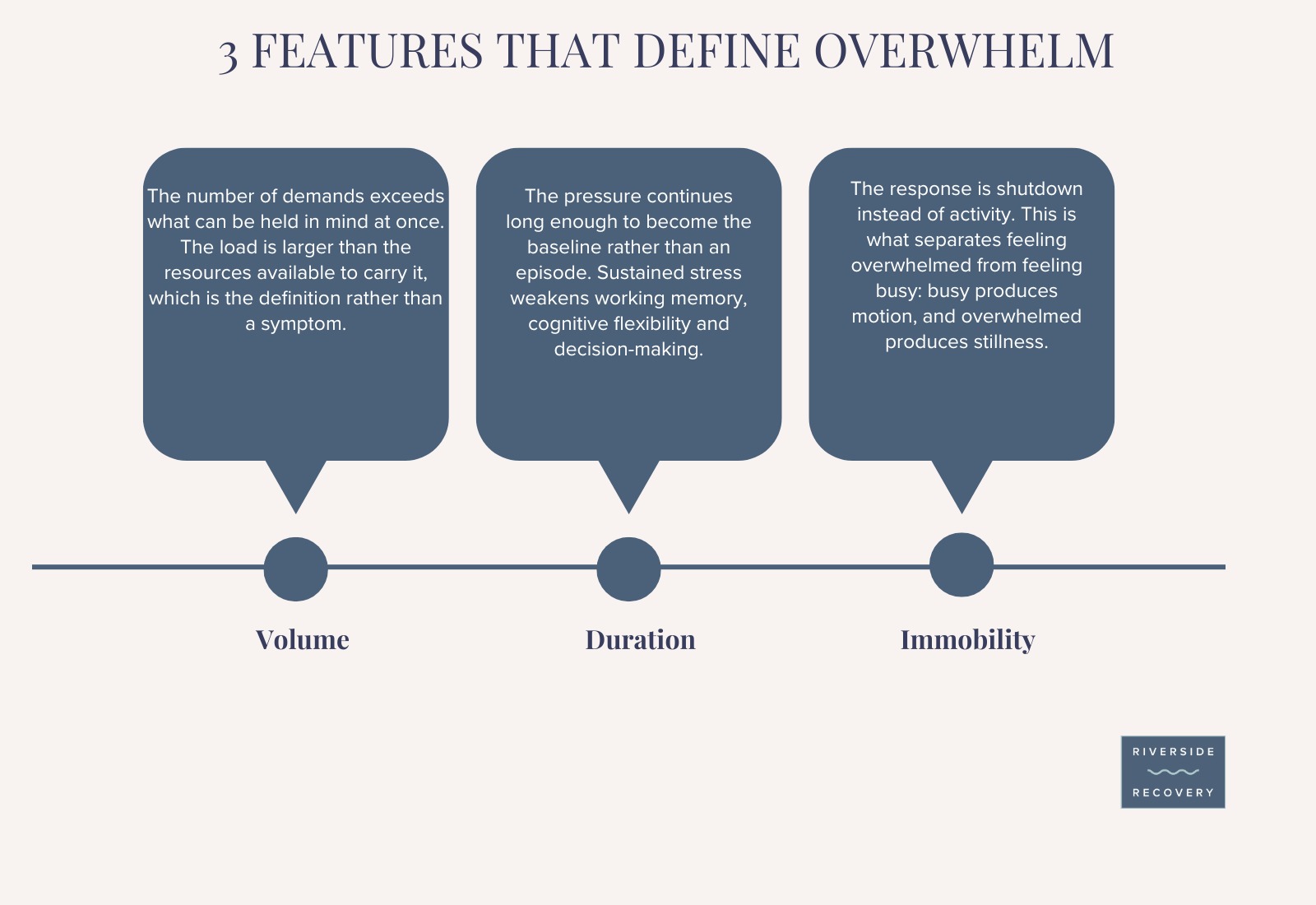
That third feature is what separates feeling overwhelmed from feeling busy. Busy produces motion. Overwhelmed produces stillness.
Why Does Feeling Overwhelmed Cause Emotional Paralysis?
Emotional paralysis is the freeze stage of the body’s defense cascade, a parasympathetic brake applied to the motor system while the brain assesses a threat it cannot yet escape.
Roelofs, Karin (2017) ‘Freeze for action: neurobiological mechanisms in animal and human freezing’, Philosophical Transactions of the Royal Society B, found that freezing is not passive. It is an active parasympathetic brake on movement that supports threat detection, driven by amygdala projections to the periaqueductal grey and accompanied by a slowed heart rate.
Kozlowska, Kasia et al. (2015) ‘Fear and the Defense Cascade: Clinical Implications and Management’, Harvard Review of Psychiatry, described freezing as a flight-or-fight response put on hold, with tonic immobility and collapsed immobility as responses of last resort once active defense has failed.
So when we say we are so overwhelmed we feel paralyzed, the description is literal. The body has applied a brake.
What Causes Feeling Overwhelmed When Choosing Addiction Recovery Programs?
Choosing a program is hardest at precisely the moment stress has degraded the machinery required to choose, because sustained stress impairs the prefrontal cortex that handles planning and decision-making.
Research on prefrontal cortex executive processes affected by stress in health and disease shows that prolonged stress exposure weakens working memory, cognitive flexibility and decision-making, while promoting rigid, habit-driven behaviour. The decision about treatment arrives when that capacity is already reduced.
Naming the levels of care removes some of the load. Riverside Recovery of Tampa runs four:
- Medical detox, onsite and 24-hour, under ASAM Level 3.7 certification
- Residential treatment, 68 beds under ASAM Level 3.5, typically 30 days
- Partial hospitalization and day/night treatment, Monday to Friday, 9:00 AM to 4:00 PM
- Intensive outpatient, nine clinical hours weekly, on a morning or an evening track
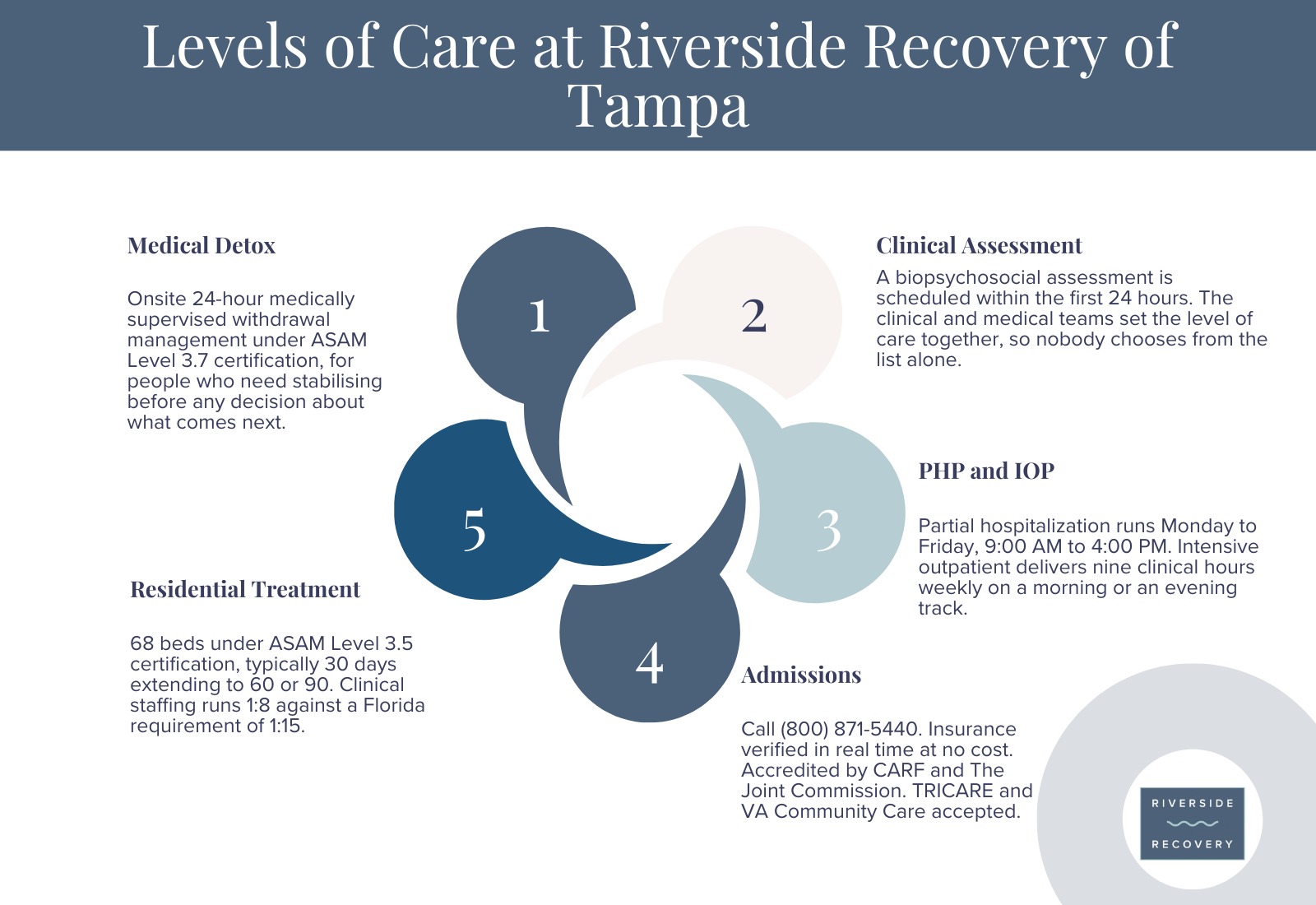
Nobody is asked to pick from that list alone. Admission opens with a biopsychosocial assessment scheduled within the first 24 hours, and the clinical and medical teams set the level of care together. The intensive outpatient program exists for people who cannot step away from work or family, which removes one of the decisions that makes the whole thing feel impossible.
What Does Overwhelm Do to Recovery?
Overwhelm sustains addiction by removing the capacity to act on the intention to change, and the isolation it produces then removes the people who would otherwise help.
The paralysis is self-reinforcing. We shut down, and shutting down produces consequences, and those consequences increase the load that caused the shutdown. Many of us withdraw at this point, and we isolate out of shame rather than admit how far things have gone. That withdrawal has its own cost, because loneliness becomes a trigger in recovery once it has lasted long enough to become normal.
How Do You Stop Feeling Overwhelmed?
Break the load into pieces small enough that the next one is achievable now, because a reduced planning capacity can still execute a single concrete step.
The transformation we need is real, and it is also divisible. Sobriety is a lofty, frightening goal when held whole. Taken apart, it becomes a sequence:
- Attend one meeting today rather than committing to a programme of them
- Call your sponsor at the moment you feel triggered, not afterwards
- Schedule one therapy session and let that be the day’s achievement
- Add one practice, whether exercise, meditation or gratitude, once the first steps hold
- Ask what you can do in the next hour, if the next day is still too large to consider
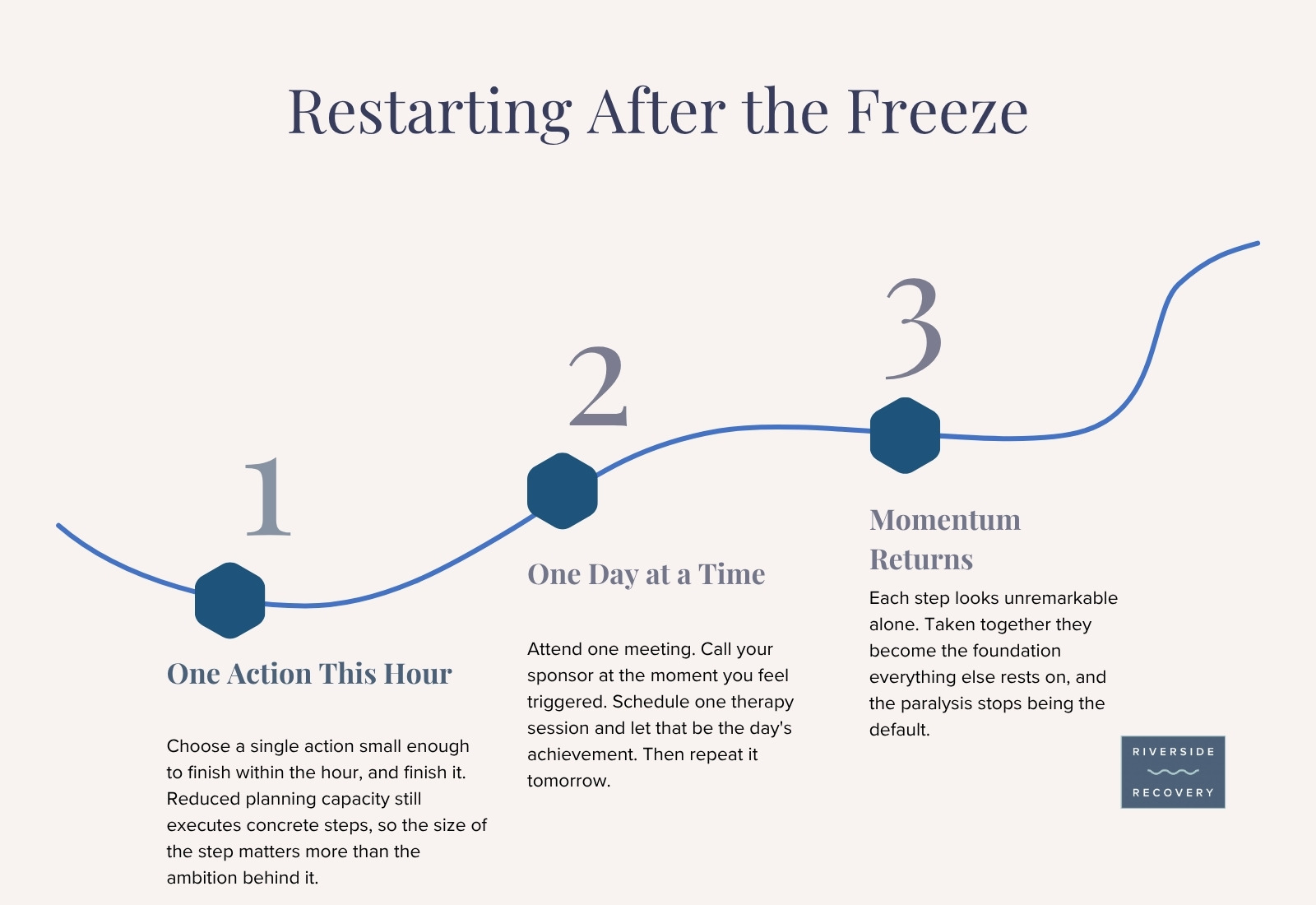
Long-lasting sobriety started as one day of exactly that. Then it became two. Each step is small enough to look unremarkable, and taken together they are the foundation everything else rests on. Where confusion rather than volume is the obstacle, navigating confusion in recovery covers that separately.
Frequently Asked Questions
What does it mean to be overwhelmed?
Being overwhelmed means the demands facing you exceed your capacity to meet them. It differs from stress in its result: stress produces activity, and overwhelm produces shutdown. Volume, duration and immobility together define the state.
Why do I feel paralyzed when I am overwhelmed?
The body applies a freeze response. Freezing is a parasympathetic brake on the motor system, driven by the amygdala, that holds movement while the brain assesses a threat. The immobility is physiological, not a failure of will.
Is emotional paralysis a real condition?
Emotional paralysis describes the freeze stage of the defense cascade, a documented stress response rather than a standalone diagnosis. It appears across anxiety disorders, trauma responses and substance use disorders.
I need help but I don’t know what to do. Where do I start?
Start with one call rather than a plan. If you are in crisis, call or text 988. If you are ready to ask about treatment, call (800) 871-5440, where the first step is an assessment rather than a commitment.
What do I do if I feel overwhelmed right now?
Choose one action small enough to complete within the hour, and complete it. Reduced planning capacity still executes single concrete steps. If the feeling includes thoughts of suicide, call or text 988.
How do I stop feeling like this?
Divide the load until one piece is achievable today, then do that piece. The pattern breaks through repetition of small completed actions, not through a single decision to feel differently.
Does being overwhelmed make addiction worse?
Yes. Overwhelm removes the capacity to act on the intention to change, and the isolation that follows removes the support that would otherwise interrupt the cycle. Both effects sustain the substance use.
Can I get treatment without stopping work?
Yes. Riverside Recovery’s intensive outpatient program runs Monday to Friday, 9:00 AM to 12:00 PM, or Monday, Tuesday and Thursday, 6:00 PM to 9:00 PM, so daytime employment does not rule it out.
How do I choose a level of care when I cannot think straight?
You do not choose alone. A biopsychosocial assessment is scheduled within the first 24 hours, and the clinical and medical teams determine the appropriate level together based on that assessment.
Riverside Recovery is committed to helping you uncover the issues fueling your addictions. Our treatment programs include multiple forms of therapy, family workshops and mindfulness-based relapse prevention education. Call (800) 871-5440 for more information.
Sources
- Roelofs K. Freeze for action: neurobiological mechanisms in animal and human freezing. Philosophical Transactions of the Royal Society B. 2017.
- Kozlowska K, Walker P, McLean L, Carrive P. Fear and the Defense Cascade: Clinical Implications and Management. Harvard Review of Psychiatry. 2015.
- Prefrontal cortex executive processes affected by stress in health and disease. PMC.
- Chronic Stress Impairs Prefrontal Cortex-Dependent Response Inhibition and Spatial Working Memory. PMC.
- 988 Suicide & Crisis Lifeline. 988lifeline.org.